

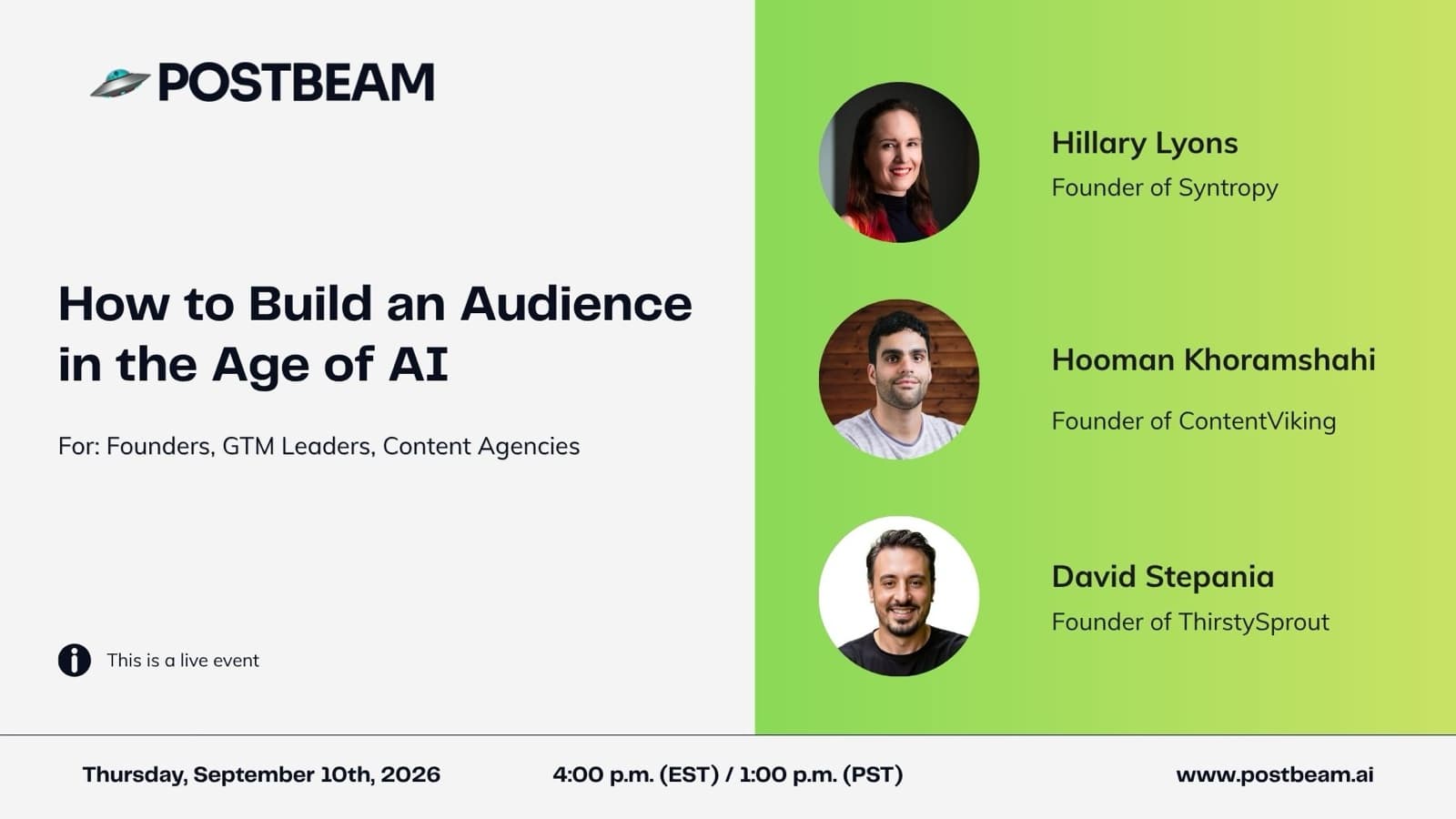
Watch the full conversation above. Below is the recap: the three big questions we put to the panel, plus the audience Q&A on tracking.
TL;DR
AI made building easy and attention scarce, so the audience is the moat. What makes you worth following is exactly what AI can't fake: personality, a point of view, and lived experience.
Consistency beats intensity. Never let the account go to zero - keep easy content buckets for busy weeks, build a system that captures ideas from your meetings and Slack, and let AI draft while humans decide what's worth saying.
And measure both layers: content analytics in one place, plus GA4 key events by channel. On Postbeam's own GA4, AI assistant traffic converts at 27.64% versus 4.41% for organic search.
The panel

Hooman Khoramshahi
Founder & CEO, ContentViking
Hooman runs ContentViking, which helps founders and go-to-market leaders generate high-quality LinkedIn content in their own voices. He works with Y Combinator founders, Fortune 500 execs, and some of the fastest-growing startups in the world, generating millions of impressions per month across 20-25 clients. He's also a certified Postbeam Expert partner.

David Stepania
Founder, ThirstySprout
David founded ThirstySprout (#247 on the Inc. 5000) and runs ThirstyPro, a hiring platform connecting startups with remote technical talent. He's worked with companies like Mailchimp and Rover, scaled multiple bootstrapped startups to over $100M in combined revenue, and has built a 31,000-follower LinkedIn audience himself - the largest on the panel.

Hillary Lyons
Founder, Syntropy
Hillary brings 15+ years of marketing and brand strategy experience to Syntropy, her AI-native marketing agency. She helps founders and fractional operators get leverage with AI without outsourcing the thinking that makes them valuable - custom Notion workspaces, AI toolmates, and training built around real workflows. She's also a legitimate Notion superuser.
Why building an audience is hard (and why it matters anyway)
Everyone is saying the same thing right now: with AI, the most important asset is an audience. We agree, and the reason is simple. It's easier than ever to build a product, and harder than ever to get anyone's attention for it. Distribution is the bottleneck.

But actually doing it is hard for three very human reasons. You have a million other things going on - even Hooman and Hillary, who build audiences for a living, are inundated. You don't know where to start: content ideas, strategy, platforms. And the quiet one nobody admits: is it cringe? A lot of smart people never post because they can't answer that question.
Founder-led content is the future (the trust battery)
Our thesis going into this panel: people buy from people. B2B is following B2C, where the best brands are now led by celebrities and athletes because they have a following. When people think of your brand, they increasingly think of your team - Adam Robinson at RB2B, Tyler Denk at beehiiv, Shelby Sapp of She Sells. It's the same argument we made in our executive thought leadership guide: the person is the distribution channel.

The mental model we keep coming back to is the trust battery. Content is time and consistency: every genuinely helpful post charges the battery a little. Then, once in a while, you sell - and each ask depletes it by 10 or 20%. Founder-led content works because it keeps the battery charged between asks. If you only show up when you have something to sell, the battery is always empty.
Q1: With AI making content easy, what makes someone worth following?
Hooman's take: everyone on LinkedIn now sets their own bar for what rises above the noise, and what clears it is specific to the person - a genuinely interesting background, stories from their life, or things they're building. One COO he works with shares childhood stories (a trip to the Grand Canyon with his dad) and applies them to his industry, and it consistently drives engagement. The variety of what works is much wider than the templated advice suggests.
Hillary's filter is the sharpest version of the answer. She follows people for one of three things, ideally a combination:
- 1. Personality. “With everyone using the same AI tools to write the same kind of stuff, the second I see a typo or a quirky expression, I'm like: ooh, a human wrote this. Let me read more.”
- 2. A unique point of view on her industry or a problem she's trying to solve.
- 3. Lived experience. AI can write a lot, but it can't reliably replicate the depth of a real human story about how you solved a specific problem.
David, who has 31,000 followers - more than anyone else on the call - added a fourth: relevance. Take a position on what's happening right now, the conversations on Reddit and Hacker News. Living in Mexico, away from the San Francisco bubble, he follows people specifically because they keep him in the loop. And the inverse is just as instructive: templated AI posts are “a quick unfollow.” The template influencers who dominated LinkedIn a couple of years ago? He can't even remember their names, because the algorithm stopped showing them.
Q2: How do you actually stay consistent?
Consistency is where audiences are won and abandoned, because the algorithm makes it emotionally hard. David was blunt about the roller coaster: one week you do hundreds of thousands of impressions, the next week 100, and the posts aren't even that different. “LinkedIn wants you to be happy sometimes, not all the time.”
Three systems came out of this question:
Hillary: flip where AI sits in the workflow. After four years of experimenting, her team recently inverted the usual setup. Ideation and concepting are now mandated to be human-led, grounded in the strategic discussions they're actually having. AI does what humans are bad at: holding all the rules at once. Her team has dozens of content rules (a third of posts should have a CTA, two posts per pillar per month, and so on), and no human can write while juggling them. So humans concept, and AI synthesizes - scanning meeting transcripts, client communications, and Slack threads for ideas, then filling in the editorial calendar according to the rules for a human to approve.
Hooman: consistency is a context problem. With 20-25 clients, he uses Claude for drafting - tone-of-voice templates, hooks, CTAs. But AI is bad at the one thing that matters most: finding topics. “If you take its advice, you'll sound like everybody else.” The fix is a system that continuously captures your own context: farm meeting transcripts from Gong or Fathom, interview your execs (or yourself) for anecdotes, even have AI quiz you about your week. Hook Postbeam's MCP up to your Slack and email so it surfaces the nuggets that seem normal to you but are fascinating to everyone else. Retain the context, and the posts write themselves.
David: never start from zero. His hardest-won lesson from years of highs and drop-offs (including having his second child a year ago): define a few content buckets, and make sure at least one is easy - curating AI news three times a week, for example. It doesn't need to be your deepest expertise or a blockbuster. It just needs to keep the account alive through busy stretches, because restarting after a month of silence means rebuilding from zero, and that's the point where most people quit.
Q3: Beyond LinkedIn, how do you choose channels?
Hillary maps channels to personas. Her Notion-pro audience lives on LinkedIn, where she can use sophisticated, nuanced language. Her AI-curious beginners live in Slack communities, where the same content gets repackaged to be more accessible. Same post, two framings, two channels - and lately she's leaning into relationship-based marketing over spray-and-pray, concentrating time where she sees actual traction.
David went down the YouTube rabbit hole for a reason that has aged well: when AI templates flooded LinkedIn, he figured video was the one format where you can show your real personality - AI can't fake that. He then did the thing everyone tells you not to do (a podcast on YouTube), confirmed it doesn't get traction, and came out still bullish: YouTube is now one of the key sources ChatGPT and Claude pull answers from, which makes it an audience channel and an AI search channel at once.
Hooman's framework has two lenses. First, repurposing: if you're writing insightful blog posts, turn them into LinkedIn posts; if you're making YouTube videos, clip them for LinkedIn and Instagram. The marginal cost is low if the source material is good. Second, platform-specific value: Reddit is huge from an SEO and AEO perspective, LinkedIn taps the strongest B2B audience, and X has a real C-suite crowd. Just don't assume a post transfers verbatim - each platform demands its own editing, and there's a learning curve every time.
One addition from us: the inverse works too. If a content format doesn't exist yet for your ICP, being first can carry you - FreightWaves built a live radio show for the freight industry, and now everyone in the industry listens to it.
Audience Q&A: “Tracking is where I lack”
The best audience question of the session: I can be consistent and creative, but tracking is where I fall down. How do you do it? The panel's answers stack into a three-layer system.
Layer 1: content analytics in one place
Hooman's workflow for his clients: get all the LinkedIn data - every post's impressions and engagement, historically - into one central place with Postbeam's analytics, then hand it to Claude or ChatGPT and ask what to do more of. “It'll tell you: focus more on stories about your background, less on this topic, because engagement is trending down compared to June.” The same view doubles as calendar tracking: what's drafted, what's scheduled, and where the gaps are next week. David's team uses Postbeam the same way to see the whole picture of how the team is performing.

That's our own team dashboard above: 1.1M impressions, 481K members reached, and 6,847 followers gained over the past year across the founders' accounts.
Layer 2: pipe the data into your own system
Hillary went a step further and built her first custom MCP agent to connect Postbeam to Notion, where she runs her entire content operation. The agent pulls social listening data and Marv's post ideas from Postbeam into Notion for brainstorming, and at the end of every month it pulls LinkedIn analytics into properties on her Notion content calendar. Then she asks Notion AI: which post performed best last month and why? What do the poor performers have in common? It even schedules - when she flips a post's status to “scheduled” in Notion, Postbeam schedules it automatically. “I love Postbeam as a tool, but I didn't like going back and forth between windows. The MCP let me build an agent that does the Postbeam side of everything.”
Layer 3: GA4 for what actually converts
Content analytics tell you what resonates; they don't tell you what converts to customers. For that, Cassy's answer was to get comfortable in GA4's user acquisition reports: filter by channel or source/medium, then compare the key events you've set up on your funnel (demo started, demo booked, self-serve signup) across channels. Here's what that looks like on Postbeam's own GA4:

The number worth staring at is the key event rate column. AI assistant traffic (ChatGPT, Claude, Perplexity) converts at 27.64% - more than six times organic search's 4.41%. Fewer users, radically higher intent. Referral traffic, which includes LinkedIn, sits at 20.75%. This is why the panel kept connecting audience-building to AI search: the channels you build an audience on are increasingly the channels AI assistants cite.

Drill into source/medium and you can isolate a single channel: linkedin.com referrals sent us 281 users, with 8.24% of them starting onboarding. That's the loop closed - from posts, to profile visits, to site traffic, to signups, each layer measured.
Build your audience with Postbeam
Everything the panel described runs on Postbeam: drafting in your voice from your own context, team analytics in one place, an MCP that connects LinkedIn to Claude, ChatGPT, Slack, and Notion, and engagement leads so you know who's warming up.
Book a demo →Related reading
- How to go viral: the 11 rules behind Bryan Johnson's 10M followers
- Executive thought leadership strategy: the founder-led content playbook
- What is social selling? A 2026 playbook
- B2B content marketing: the ultimate guide for 2026
- Why every B2B company needs a video strategy in 2026 (our last webinar)
- All Postbeam webinars →