

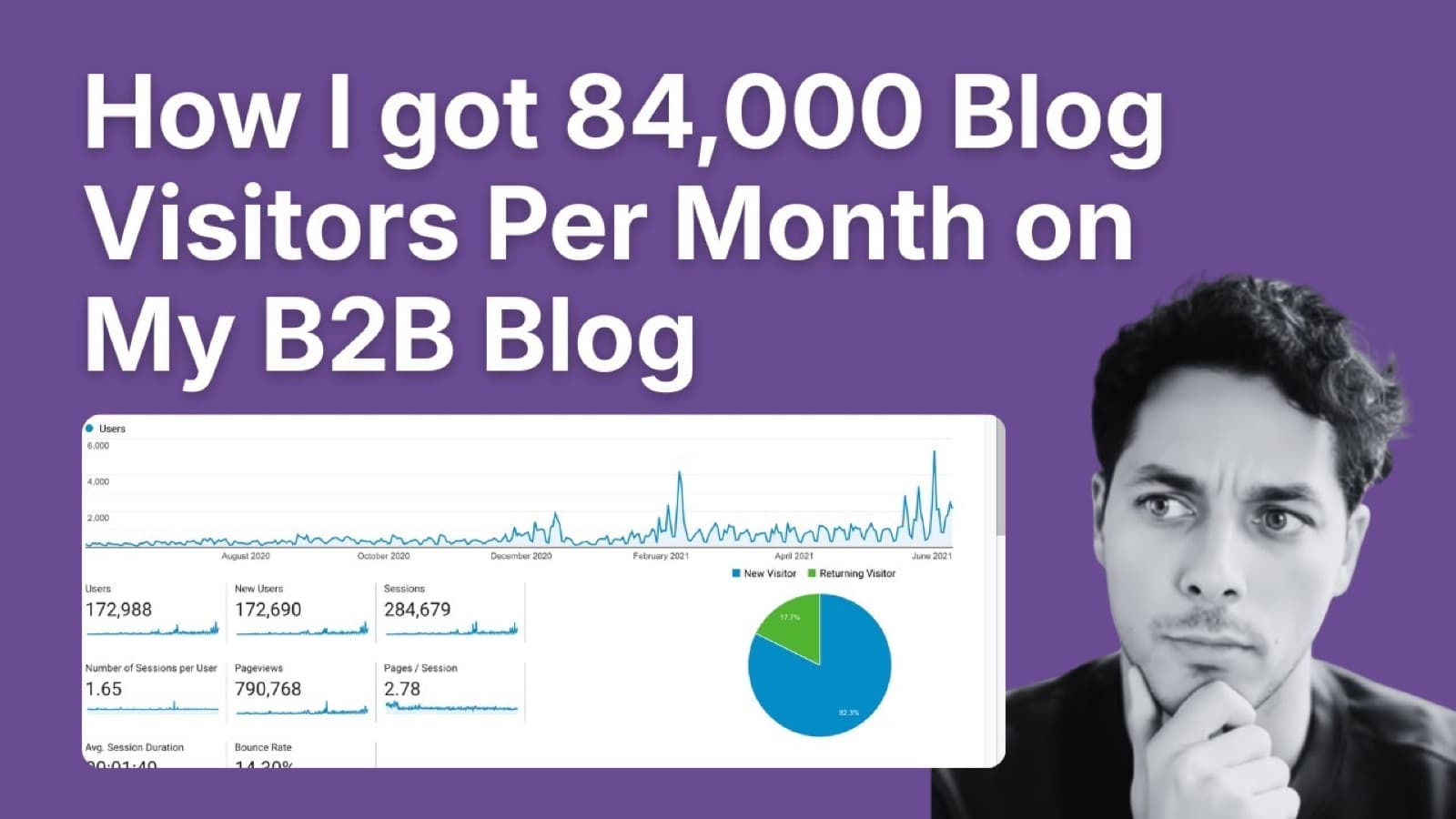
This is the exact B2B SEO strategy - I call it the SEO content growth engine - that took Hoppier's blog from basically nothing in 2019 to a peak of 84,000-87,000 monthly visitors, almost all of it from organic search. I've since run the same engine on three more sites, so this isn't a one-time fluke; it's a repeatable process, and this post is the full write-up of it: how to pick keywords, what to pay writers, how to plan content quarterly, and the ROI math that keeps the whole thing honest.
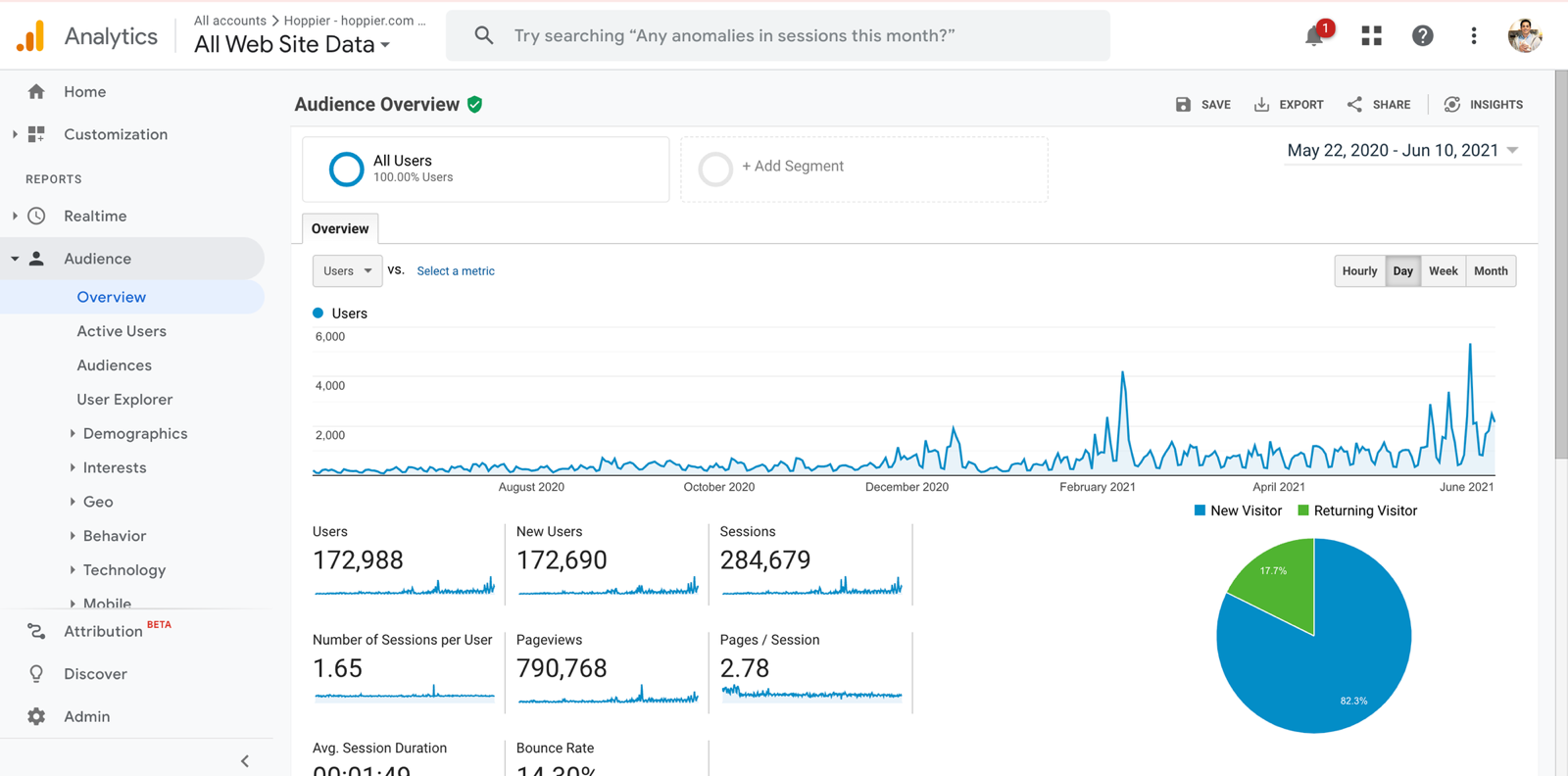
The receipts first. Hoppier did 172,988 users in a single 12-month stretch of the ramp, and even after the AI-era decline (more on that at the end) still does 20-30K monthly readers:
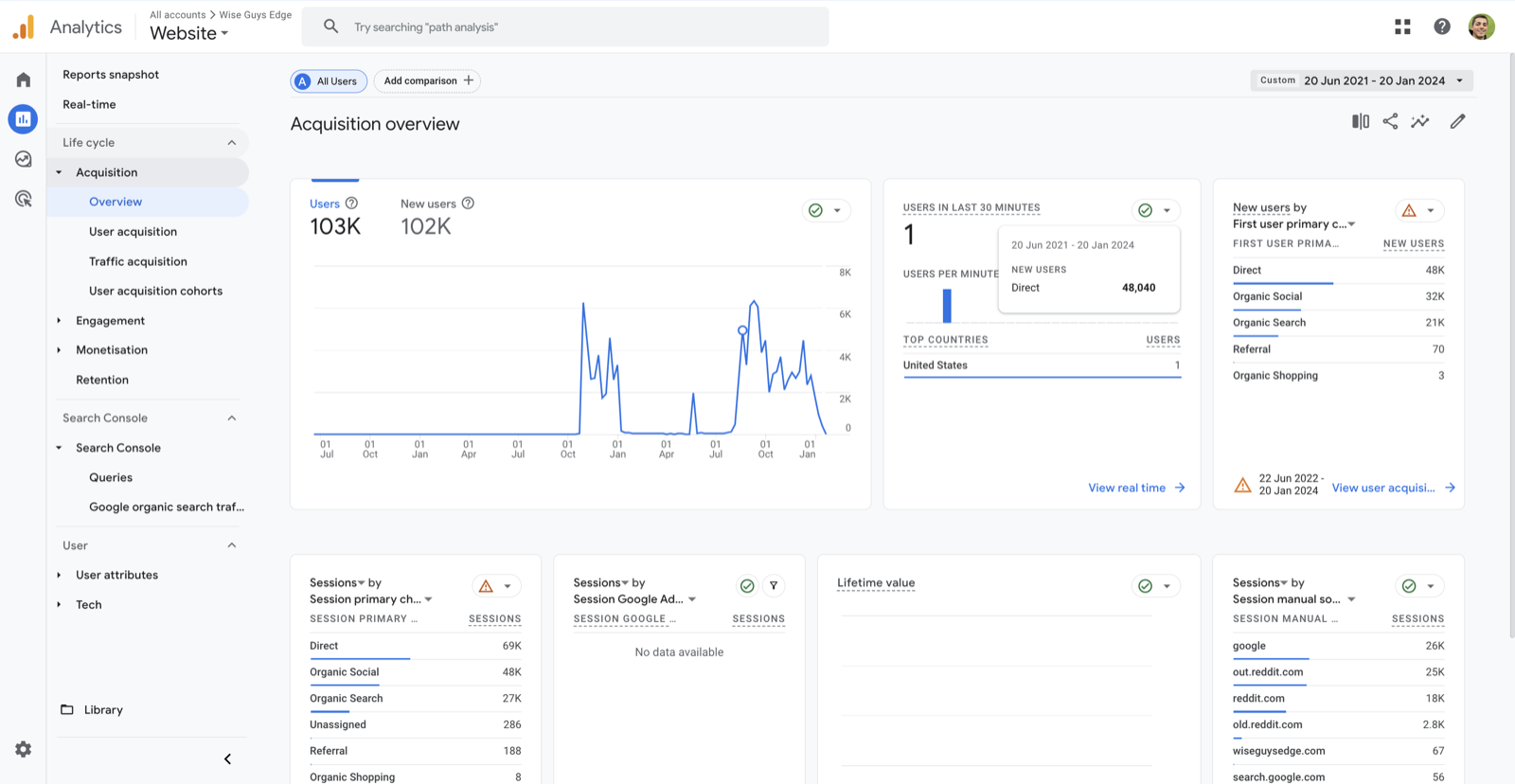
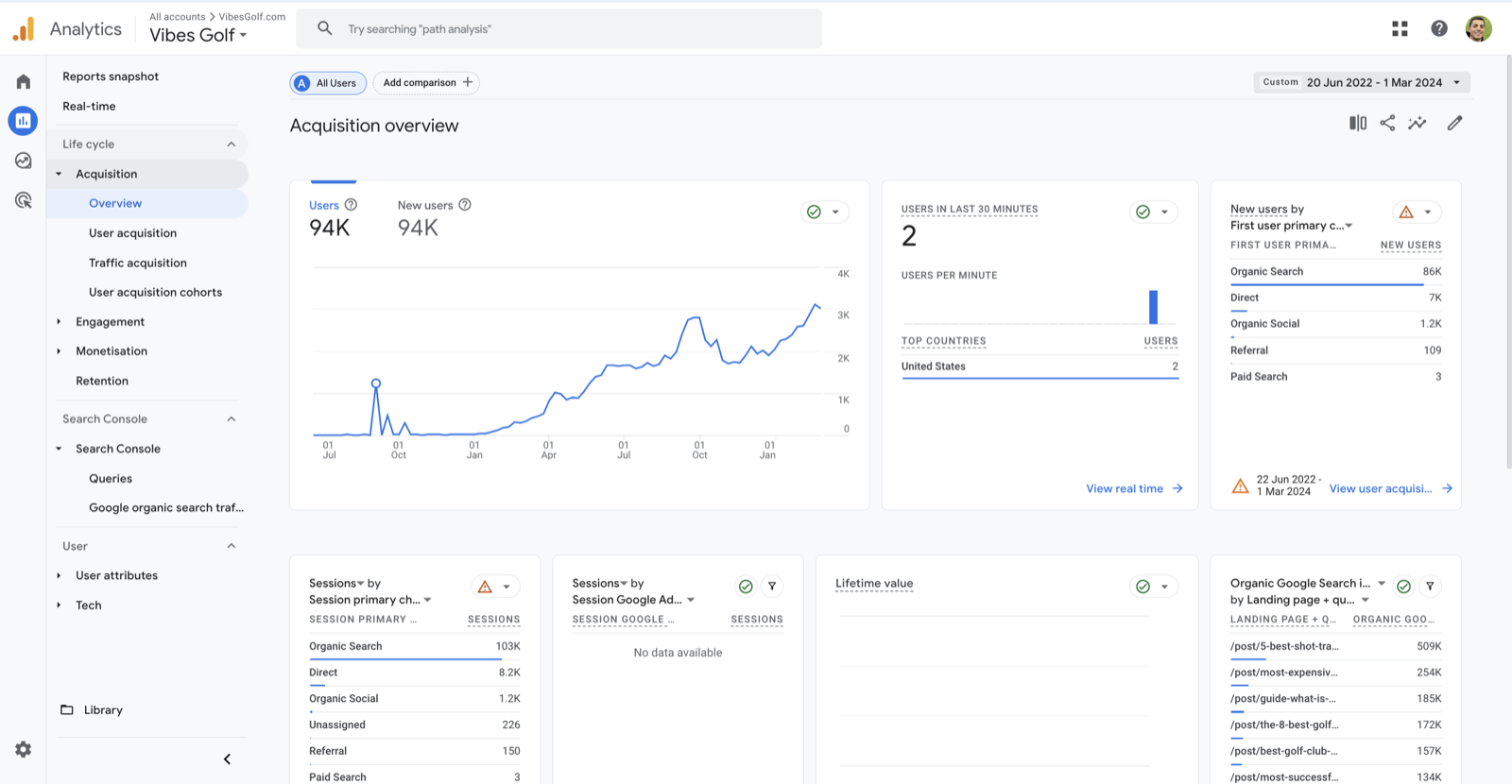
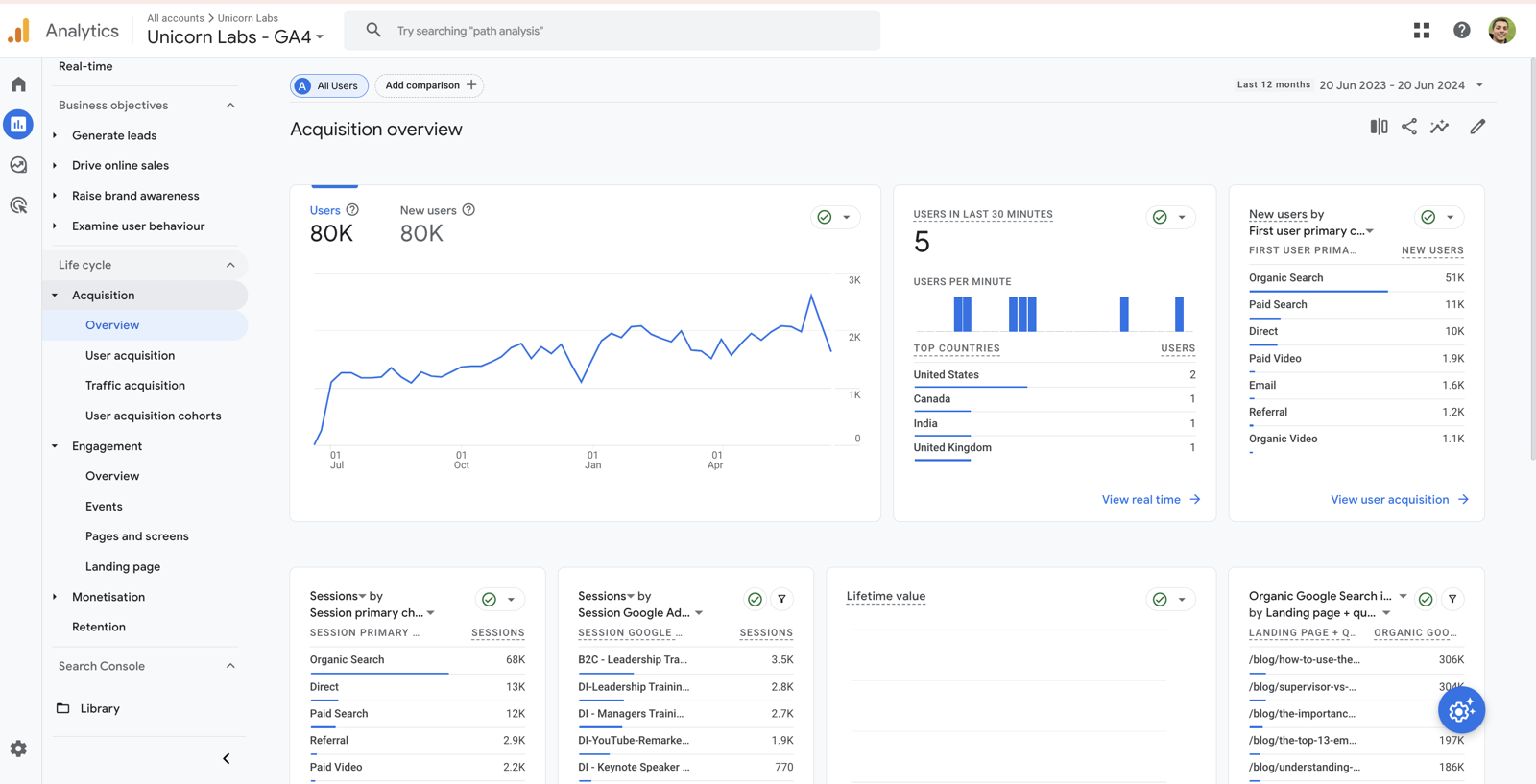
And because the process matters more than any one site, here it is working three more times: my fantasy football site Wise Guys Edge (50-80K monthly), Vibes Golf (grew to ~12K monthly before Google updates and AI overviews crushed it - I'll be honest about the failures too), and Unicorn Labs, a friend's leadership-training company whose content planning I helped with (tens of thousands of monthly visitors, 51K of 80K annual users from organic search).
Meta proof: the post you're reading was chosen with this exact process. "B2B SEO strategy" gets 1,700 US searches/month at keyword difficulty 11 (Ahrefs), and the bigger term "b2b seo" (4,000/month, KD 7) has it as its parent topic - so one well-built post can capture the whole cluster. High intent, high ICP fit, low difficulty. Engine engaged.
TL;DR: the engine in five lines
- Pick keywords on two axes: high intent x high ICP fit, scored 1-5 each from real customer conversations - then filter to keyword difficulty under 10 if your domain is young.
- Budget honestly: $300-$600 per post, professional writers only, at least one post a week (4-6 pieces/month planned quarterly).
- Optimize as much as you create: track traffic, content grade, and ranking history per post; refresh the ones that matter when they slip.
- Run the ROI math per post: searches → realistic traffic → leads → customers → revenue vs. cost. If it doesn't pencil, don't write it.
- Backlinks last, reader experience first: skip link building until ~1.5 years / 50 posts in. Google ranks whoever scratches the reader's itch.
The whole engine on one table
This is the operating checklist I actually run - every task in the system and how often it happens. Everything below the table explains the four steps that matter most. (One prerequisite worth naming: a website you can actually publish to without friction - Emil wrote up the SEO migration checklist we used to move our own site to an AI-editable stack.)
| Task | Cadence |
|---|---|
| Opportunity evaluation | Once, at the beginning |
| Content calendar plan | Every 3 months |
| Write + publish posts (with on-page SEO) | Every post, 4-6/month |
| Hiring, managing, and paying writers | Ongoing |
| CTAs (sidebar offers, mobile popups) | Once, then update |
| Site structure | Once, then update |
| Technical SEO / site health monitoring | Every day |
| Dead link updating | Every month |
| Programmatic SEO pages (only if the opportunity exists) | Once, then update |
| Backlink building (skip until ~1.5 years and 50 posts in) | Every day, once started |
| Backlink ROI analysis | Every 3-6 months |
Step 1: Evaluate whether the opportunity even exists
First filter, and be honest with yourself: does your audience read blogs online? If not, stop here and spend the budget elsewhere (probably social selling). If yes, open Ahrefs or Semrush and look for queries that score high on two axes at once:
- High intent - the searcher is close to a buying decision, not browsing.
- High ICP fit - the searcher looks like your ideal customer.
Hoppier example: we send prepaid cards and gifts to employees and clients worldwide. "Motivational quotes" would bring mountains of traffic and zero customers. "Best gifts for remote employees" is the opposite: modest volume, but the searcher is a company with distributed employees actively shopping for gifts - high intent AND high ICP fit. That asymmetry is the entire game. I'm happy to target a term with 150 searches a month if both scores are high; if your niche only has 5,000 potential customers, traffic is a vanity metric anyway and niche-perfect content wins.
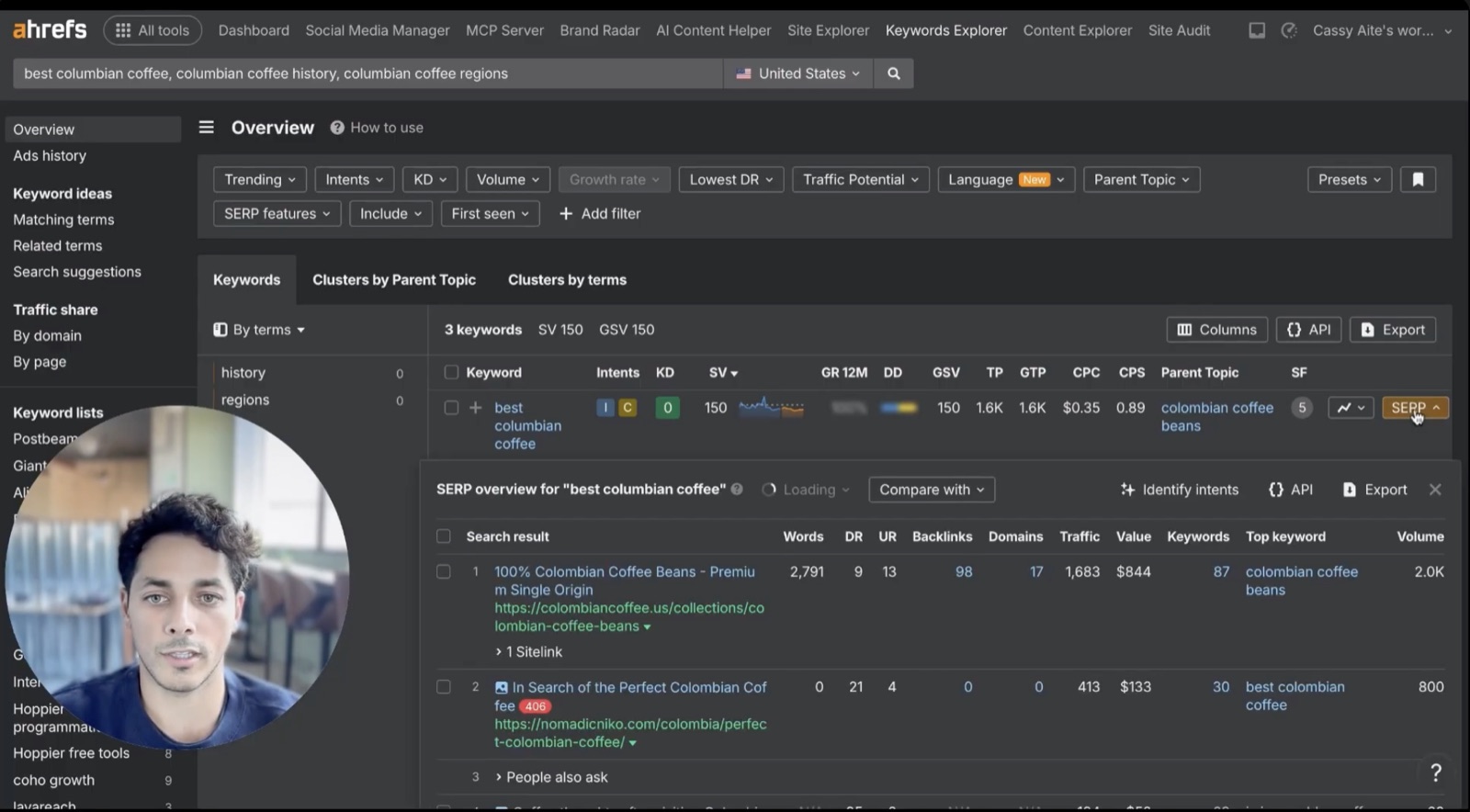
Then read the SERP like a customer. When someone searches "best Colombian coffee," do the current results actually scratch that itch? Google measures exactly this: if I click result one, bounce back in twenty seconds, and finish my journey on result three, Google learns that result one gave me a bad experience and result three deserves the ranking. Everything in this strategy ultimately serves that one metric - does the reader's itch get scratched?
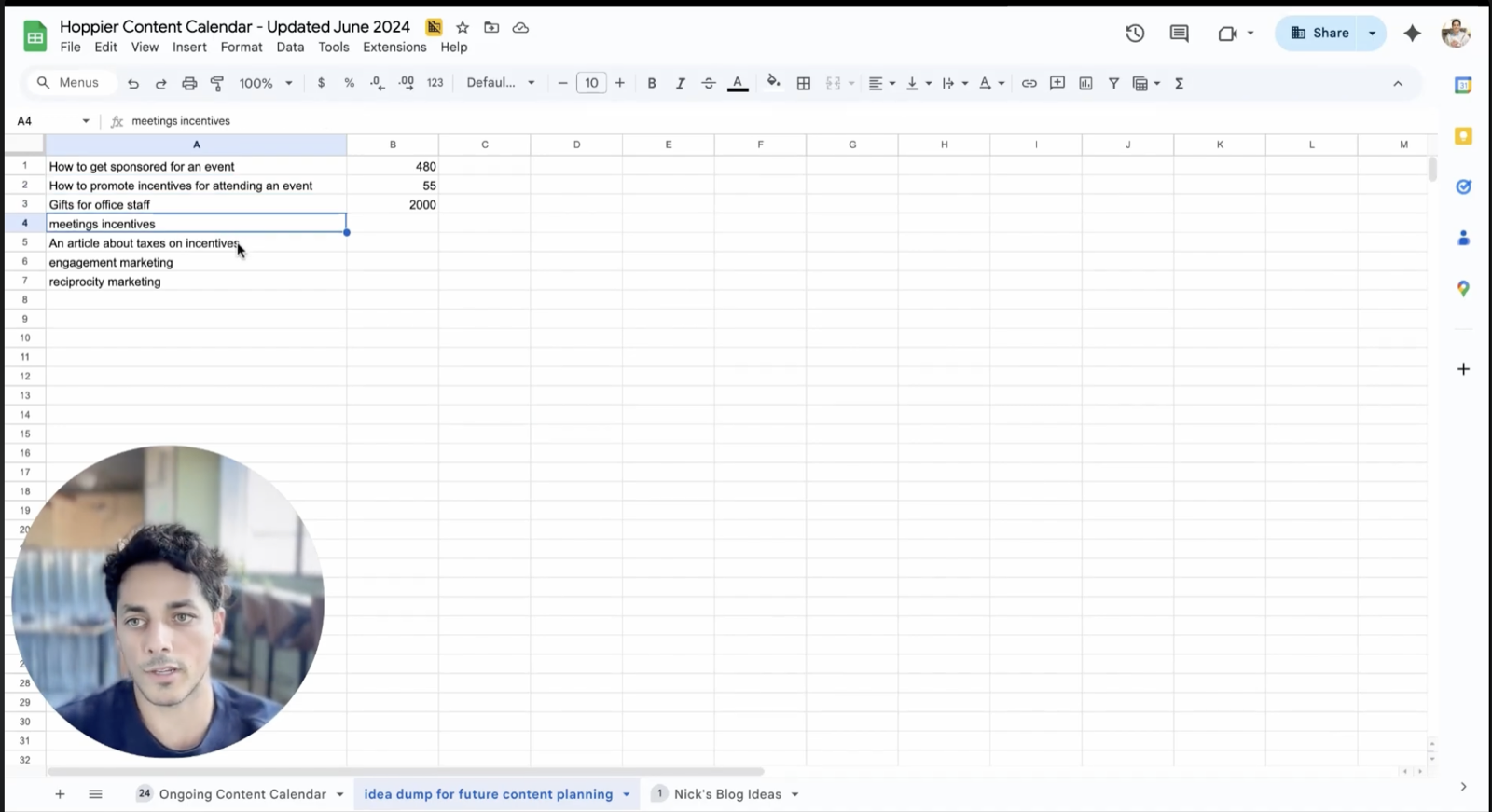
Two more sourcing tricks. One: plug competitors into Ahrefs and mine every keyword they rank for. Two - and this one is better, because you understand your customers and they don't: keep an idea dump fed by real customer conversations. Here's Hoppier's, verbatim:
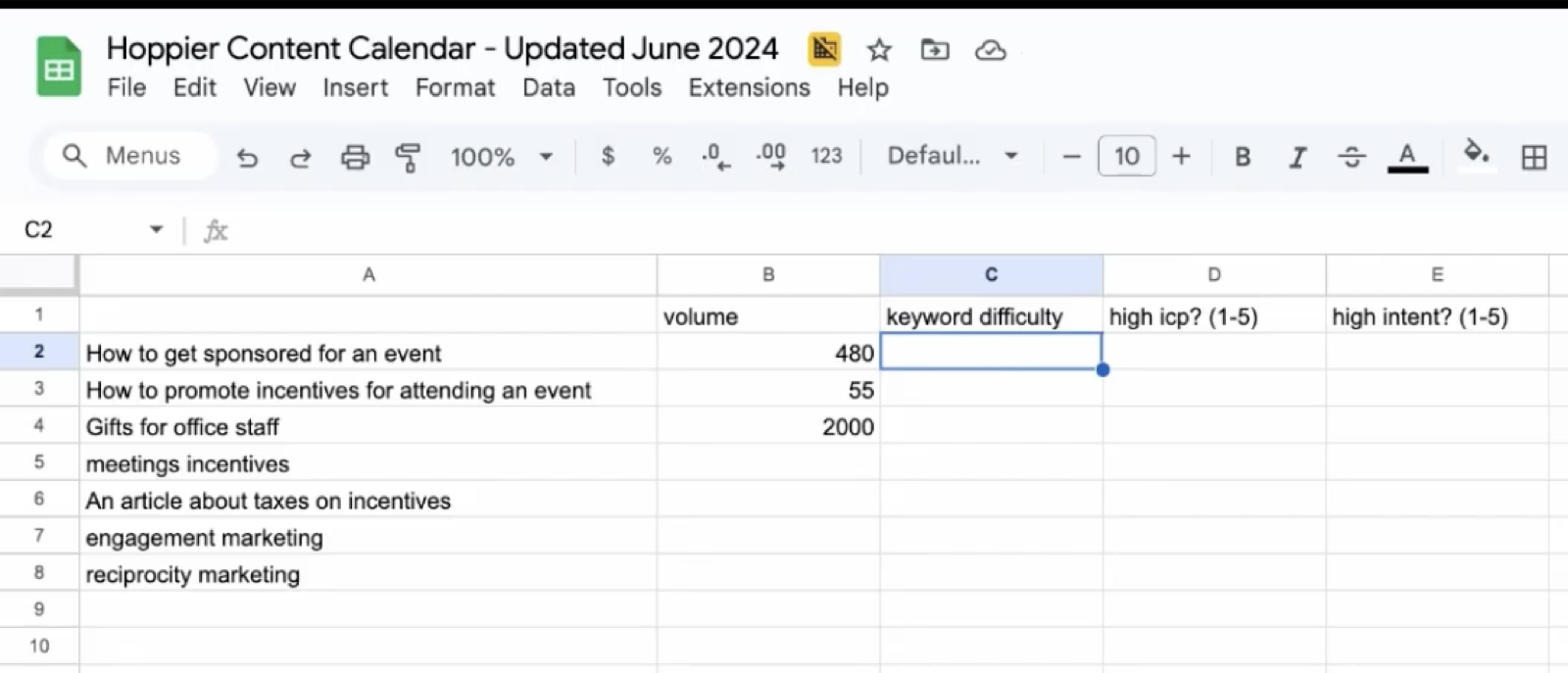
Last rule of step one: if you have low authority in the space, it will be hard to rank - filter to keyword difficulty under 10 and win the fights you can actually win. In Ahrefs that's literally one filter: KD max 10, then sort by what scores best on your two axes.
Step 2: Budget it like an investment and hire a real writer
Every piece of content costs $300-$600 USD to write and publish - that's the going rate for a professional writer on a 1,500-2,500 word SEO post. You can write it yourself, but publishing at least once a week (the minimum for this to compound) is brutally hard to sustain alongside running a company. I know because I've tried both ways.
And hire a professional, specifically. On-page SEO is a hundred small details: one H1, H2s for subheadings, title tags, meta descriptions, descriptive image alt text, internal links. A pro handles all of it reflexively. We once hired two genuinely smart marketing interns to write Hoppier blog posts and threw the money straight down the toilet - they were good writers, but SEO writing is a different ballgame, and at the time I couldn't even articulate what they were missing. Look for writers with agency pedigrees (Growth Machine alumni have been consistently great for us; Shortlist.io is another good source), and interview them on SEO specifics before anything else.
If you'd rather not run writers at all, that's the same buy-vs-build decision we broke down in our guide to content agencies and what they charge - just know what the per-post economics should look like before any retainer conversation.
Step 3: The B2B blog strategy - a quarterly content plan of new posts and optimizations
Your blog strategy is a spreadsheet: 4-6 pieces per month, planned every quarter, mixing brand-new posts with optimizations of existing ones. Brand new blog? Skip optimizations entirely. Existing library? Evaluate every post with four inputs, one column each:
- Google Analytics - traffic and conversions per post.
- Clearscope content grade - it monitors every post and flags when a grade decays, which usually means the content needs a refresh.
- Ahrefs ranking history - how your position for the target keyword has moved over time.
- Competitiveness today - is it still realistic to win this keyword?
A real example: our "virtual team building activities" post ranks #2 and jockeys constantly with two or three other blogs plus Reddit for #1. Watching the position history, you can see one competitor (ClassBento) fall off, clearly notice, refresh their post, and climb from outside the top 10 back into the top 5. That's the optimization game in one chart: someone on their content team ran exactly this process against us. Content also just ages out - posts written during the pandemic assume everyone's remote, vendors change, examples go stale. A refresh costs about the same $300-$600 as a new post and often returns more.
Then, every three months, re-open the calendar and ask: is the next quarter still right? New product launching that needs a keyword? A post that fell off a cliff? Don't be precious about the plan - and don't be afraid to change it mid-quarter when reality disagrees with it.
Step 4: The ROI math that keeps you honest
Every post gets this calculation before it's written (we turned it into a free SEO ROI calculator if you'd rather not spreadsheet it). Worked example with real-ish Hoppier numbers:
480 monthly searches → rank top 5 → ~200 visitors/month
200 visitors x 2% visitor-to-lead → 4 leads/month
4 leads x 25% lead-to-customer → 1 customer/month
1 customer x $2,000 value → $2,000 vs. ~$500 to produce the post
≈ 400% return - and that's one month of a post that keeps ranking.
Three honesty adjustments. First, your conversion rate might be 1%, not 2% - there is no benchmark, every business is different, and you only find out by shipping and measuring (or borrowing a ballpark from your own existing posts). Second, posts aren't one-time costs: budget one or two refreshes a year, so that $500 post is really ~$1,000/year. Third, be realistic about which rankings you can win at all - you will not outrank HeyReach for the keyword "HeyReach" (branded terms belong to the brand), but "HeyReach review" is a different fight entirely.
One nuance that makes the math better than it looks: a page that ranks for its main keyword usually ranks for a cluster of variations. Our team-building post's target term gets 5,100 US searches, but the page pulls ~3,600 monthly visits because it also ranks for a dozen variants that sum to ~20,000 searches. Target one keyword per post - the focus is what wins the ranking - but expect the cluster to pay you.
Domain authority and backlinks (do them later than you think)
Domain rating - Ahrefs' 0-100 logarithmic authority score - matters most at the start: higher DR ranks faster out of the gate. But watch any competitive SERP for a while and the pattern is clear: content quality takes over. On our team-building keyword, our post has 84 backlinks; a Reddit thread with barely any outranks half the field, and an Engagedly post with zero backlinks and modest DR sits comfortably at #6. Google keeps shifting weight toward whether the searcher's experience was good.
So our rule on link building: don't start until roughly 1.5 years and 50 published posts in, and even then run the ROI analysis every 3-6 months like everything else. Paid links run ~$250 each; if the theory is that 10 links ($2,500) move you from position 5 to 1, ask whether that money spent on making the content unambiguously better would do more. It usually would.
Information gain: the rule that decides everything
I recommend against purely AI-written content, and not for sentimental reasons: AI is trained on existing content, so by construction it produces the average of what already ranks. Google (and increasingly the LLMs themselves) reward information gain - something new the world didn't have: your data, your screenshots, your customer stories, your contrarian take. Most readers can tell the difference instantly.
The practical middle ground: voice-note your expertise. Talk through what you know - into a recorder, into ChatGPT, into a podcast with your co-founder - and let AI do the assembly while the ideas stay yours. That's literally how this post was made, and it's the production model behind our whole B2B content marketing system. The ideas must be new, interesting, and yours; the typing is negotiable.
What AI overviews changed (the honest part)
Full transparency: Hoppier peaked around 85K monthly visitors and now does 20-30K. Vibes Golf got crushed entirely. The causes are no mystery - AI overviews answer questions on the results page, and a growing share of buyers ask ChatGPT instead of Google. Anyone selling you an SEO program without mentioning this is selling you 2019.
Here's why I still run the engine: the destination changed, not the work. The same information-gain content that ranks in Google is what LLMs cite when they answer - and in our own analytics, visitors referred by AI assistants convert at roughly 6x the rate of organic search visitors (26.3% vs 4.4% key event rate on postbeam.ai). Fewer clicks, radically better clicks. The engine below produces exactly the content that wins that channel (score your readiness with our free AEO checker) - we broke down the LinkedIn side of the same shift in our social selling tools guide, and whether the paid trackers measuring this channel are worth it in our AI visibility tools breakdown.
Frequently asked questions
What is a B2B SEO strategy?
A B2B SEO strategy is a repeatable system for turning search demand into pipeline: pick keywords your ideal customers search with buying intent, publish content that answers those searches better than what already ranks, and measure each post against the revenue it produces. Ours has four steps - opportunity evaluation, a quarterly content plan, per-post ROI math, and ongoing optimization - and it took Hoppier's blog from zero to 84,000 monthly visitors.
How do I choose keywords for a B2B blog?
Score every idea on two axes: intent (is the searcher close to buying?) and ICP fit (is the searcher your ideal customer?). Then check keyword difficulty in Ahrefs or Semrush - if your domain is new or low-authority, only target KD under 10. A keyword with 150 searches a month that is high intent and high ICP fit beats a 10,000-search keyword that is neither. Dump ideas from real customer conversations into a sheet and score each 1-5 on both axes.
How much does B2B blog content cost?
Budget $300-$600 per post for a professional writer to research, write, and publish a 1,500-2,500 word SEO-focused post, and roughly the same again per refresh. At 4-6 posts a month that's a $1,200-$3,600 monthly program. Hire writers who understand on-page SEO (H1/H2 structure, title tags, meta descriptions, image alt text) - we once hired two smart marketing interns for this and threw the money down the toilet, because SEO writing is a different skill from good writing.
How many blog posts should a B2B company publish per month?
At least one per week - consistency matters more than bursts. We recommend planning 4-6 pieces per month as a mix of new posts and optimizations of existing ones, re-planned quarterly. Some months are all new content; some months are mostly refreshes of posts that slipped in rankings.
Do backlinks matter for B2B SEO?
Less than most people think, and later than most people start. Domain rating helps you rank faster out of the gate, but we've watched pages with zero backlinks rank in the top 10 because they satisfied the searcher better. Our rule: don't spend on backlink building until you're roughly 1.5 years and 50 posts in, and always run the ROI math first - if a link costs $250 and you need 10 to maybe move from position 5 to 1, that $2,500 usually loses to simply making the content better.
Is B2B SEO still worth it now that AI answers questions?
Yes, with honest expectations. Our Hoppier blog fell from an 85K-visitor peak to 20-30K monthly, mostly due to AI overviews and people asking ChatGPT instead of Google. But the same engine now feeds AI answers: LLMs cite exactly the kind of information-gain content this process produces, and AI-assistant visitors convert dramatically better than organic search visitors on our sites. Write content only you could write, and you win both channels.
Want this engine run for you?
This exact system - keyword selection, quarterly planning, information-gain posts built from your real calls and docs - is what Postbeam's Content Engine does for B2B companies, alongside your LinkedIn. We accept three new done-for-you clients a month.