

The #2 result on Google for “ai visibility tools” is a dev.to listicle whose author founded the company selling the tool he put at #1 - undisclosed. Pressed in his own comment thread, he concedes that to measure any of this you have to “rely on indirect signals.”
That is the state of the art in a category where Profound raised at a reported $1B valuation about 18 months after founding, and Peec went from zero to roughly $10M ARR in 16. The #3 result is a Reddit thread of real buyers asking what to use and getting no evidence-based answer. A lone skeptical LinkedIn post calling these tools a waste of money ranks in the top 10.
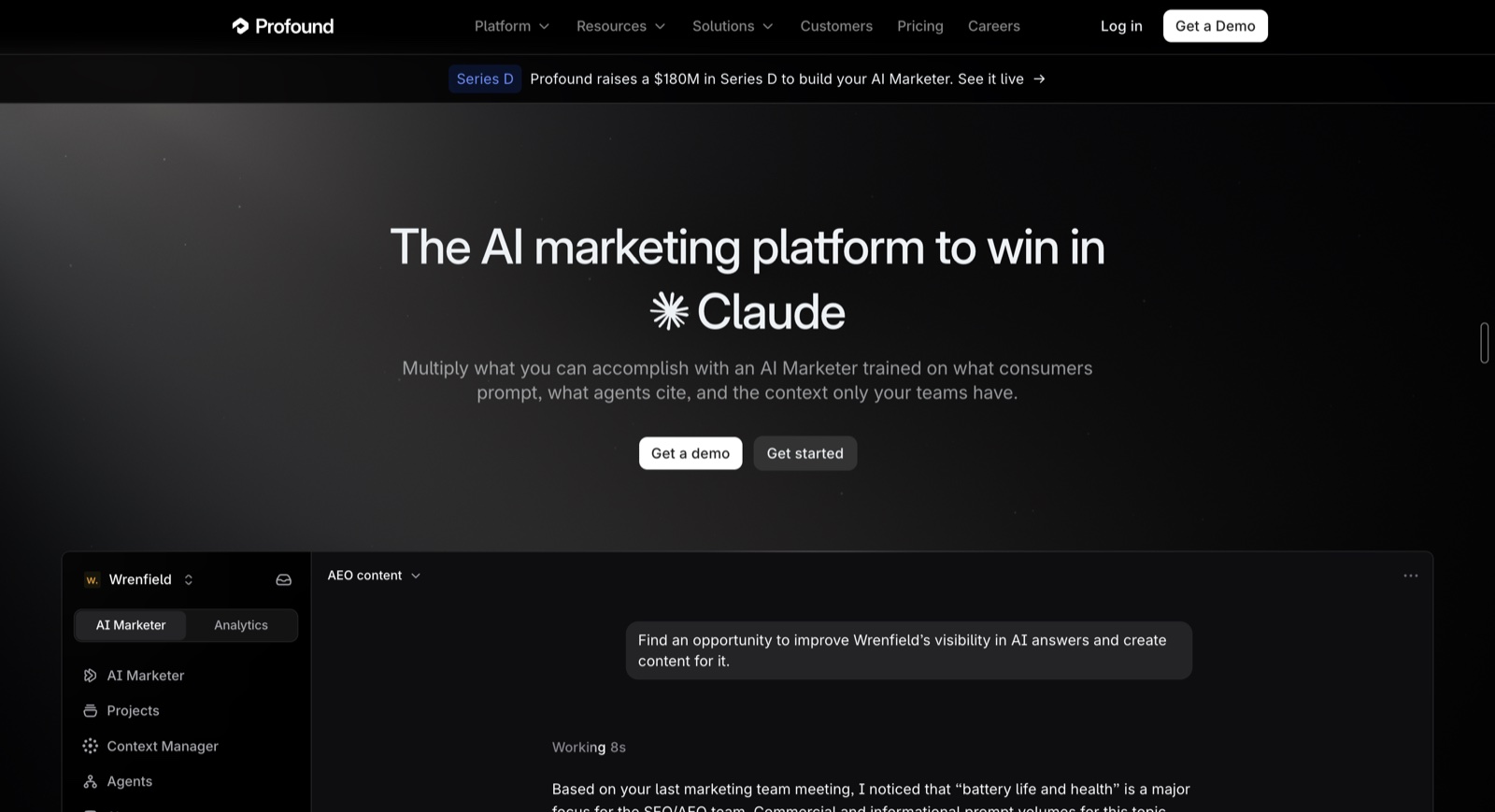
Profound's homepage the week we wrote this: a $180M Series D banner over a “win in Claude” headline.
Every page ranking for this keyword lists tools. Not one answers the question you actually have: can the number these tools sell you be moved, and what does moving it cost? We run a content platform, so we're biased toward “content wins” - we'll say that up front and steelman the other side. This is the argument me and my co-founder Emil keep having, with everything we've measured.
TL;DR
The number is real but unstable. Only ~30% of brands stay visible across back-to-back AI answers. A weekly score built on that needs thousands of runs to mean anything - which is what the expensive vendors are actually selling.
Our threshold: don't pay for a tracker until AI-assistant referrals in your free GA4 are already worth ~$500/month in expected lead value. Under $100/mo, test one whenever you like - it's nothing if you take the channel seriously.
What moves the number isn't a dashboard. Third-party trust (a review profile alone moves median AI citation rates from 1% to 53.5%), niche content that answers a specific question, and showing up where models look - which for B2B means LinkedIn, the most-cited domain for professional queries.
What is AI visibility, actually?
Plainly: how often, and how favorably, an LLM names you when it answers a question in your space. Someone asks ChatGPT for the best employee advocacy platform, or asks Claude who can turn their team into LinkedIn thought leaders - are you in the answer, and are you the recommendation or a footnote?
Everything confusing about this category comes from conflating two jobs. Measuring the number is what AI visibility tools sell: run prompts across models, count your mentions, chart share of voice against competitors. Moving the number is a completely different activity that no dashboard performs - it's content, citations, and trust signals. Keep those separate and most of the buying decision makes itself.
The number is unstable, and that matters
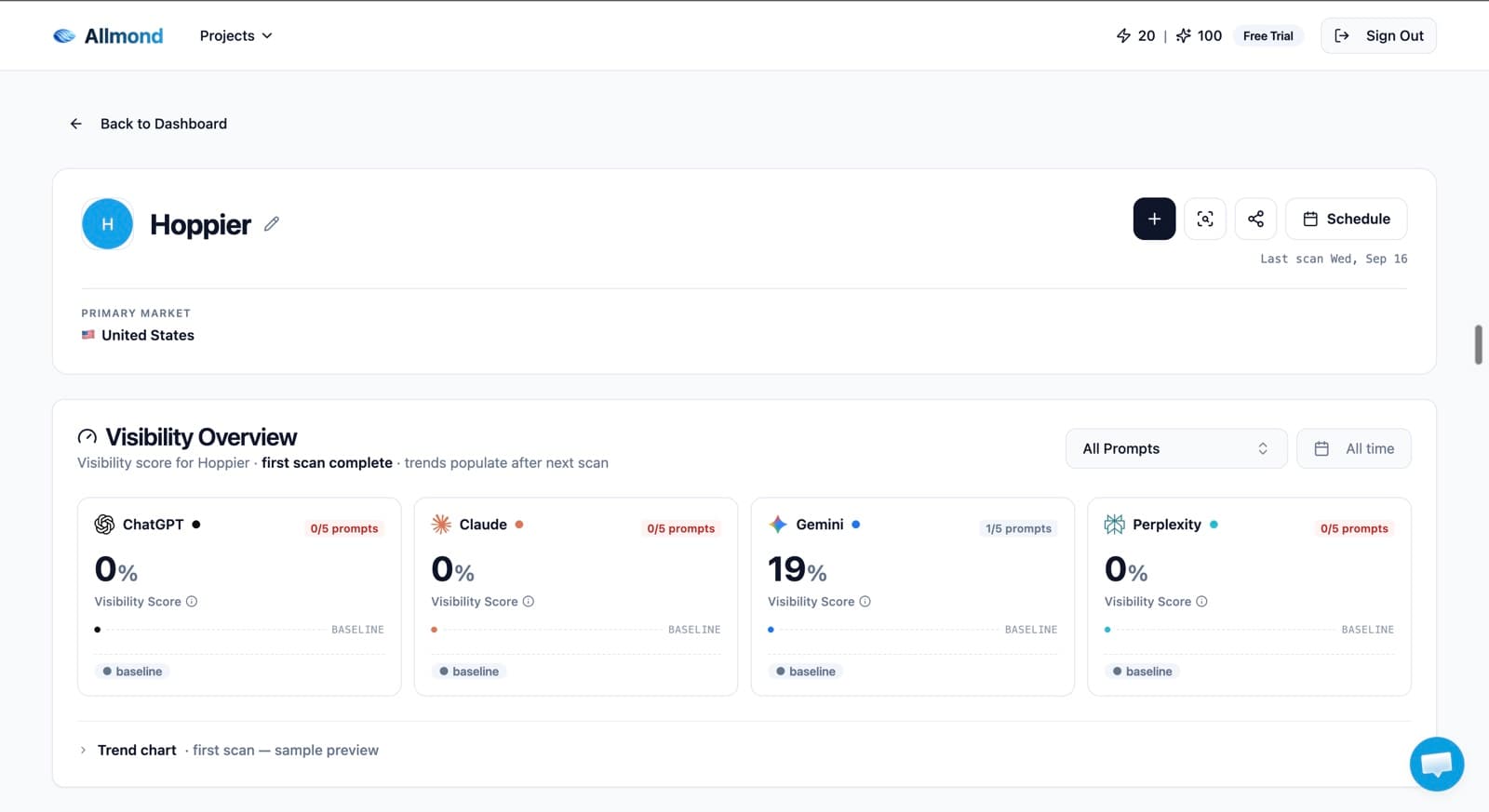
Run a scan on your own brand and you see it immediately. The header image on this post is a real Almond scan of Hoppier, my previous company: 0% visibility on ChatGPT, Claude, and Perplexity - and 19% on Gemini, in the same scan, for a profitable 11-year-old brand. Which of those numbers would you report to the board?
It's not an Almond quirk. LLM answers are probabilistic. AirOps' 2026 State of AI Search found that only about 30% of brands stay visible across back-to-back runs of the same prompt, and roughly 20% across five consecutive runs. The same question, minutes apart, returns different brands.
Emil's explanation of why, from having built against these APIs: the answer depends heavily on who's asking. With memory on and months of history, the model already knows you and answers consistently. In a clean incognito session, it re-derives the answer from mentions and live search every time - and for a competitive category with no clear winner, it might pull Reddit's favorites on one run and G2's on the next. His caveat cuts both ways though: for most categories there are still 2 or 3 clear winners that show up nearly every time. The instability lives in the long tail - which is exactly where a young company sits.
Even demand for the trackers themselves is unstable. Ahrefs shows “ai visibility tools” going from 0 searches a month in early 2025 to 3,617/mo by August 2026 - a real category that didn't exist 18 months ago - but the monthly curve is wildly spiky, and Google Trends shows interest peaking in September 2025 and fading to single-digit index values by this month. The category is cooling while the vendors are still raising. Hold both of those at once.
You could build one in a weekend. So what are vendors selling?
Almost everything marketed as an AEO or GEO tool is a tracker: a dashboard that measures. Very few products in the category produce anything. So the fair question every technical founder asks is: an LLM API loop is a weekend project - why does this cost $500 a month?
Emil has actually built one, and his answer is the most useful thing in this post: what the vendors are selling is clean, high-volume sampling. The AI platforms throttle and security-check anything that looks like systematic answer harvesting. So the real product is proxy networks that mimic different locations, devices, and fresh histories, so that thousands of runs produce a statistically meaningful picture instead of an answer biased by your own account. Think of what it took Ahrefs years to build around Google - Search Console integrations, clickstream panels, the whole data supply chain - and none of that infrastructure exists for LLMs yet.
His practical split: if you just want to know what ChatGPT thinks your company is, about 10 incognito prompts will tell you, free. If you want to track niche prompts at statistical volume, the weekend project falls apart and the vendors genuinely earn something. Whether that something is worth $500/month is the argument in the next two sections.
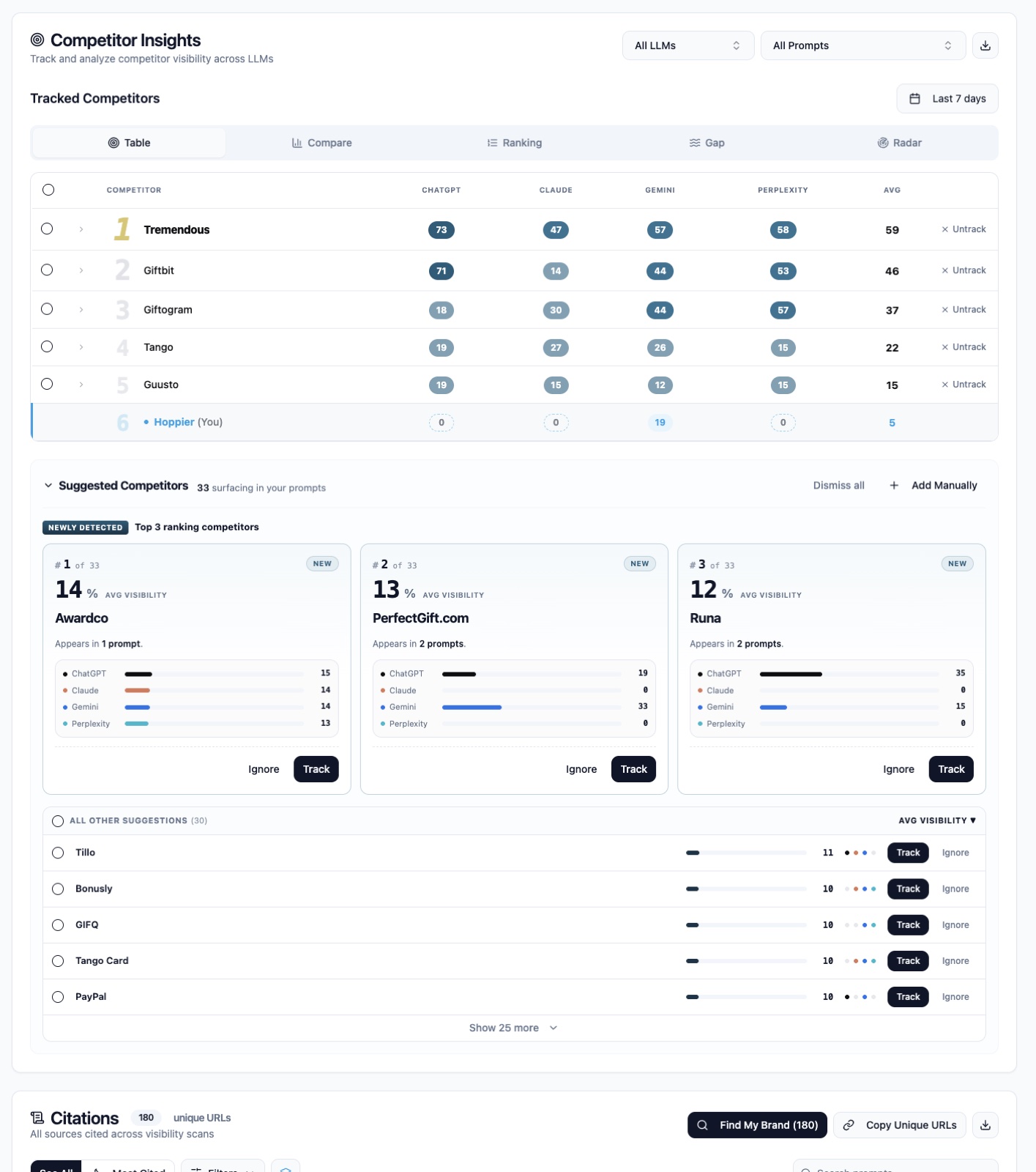
And to be fair to the category, the dashboards aren't empty. Here's the competitor view from our Hoppier scan - share of voice per model, newly detected competitors, and the 180 URLs the answers cited:
For the record, the ones we've actually touched: I've tried Peec, looked hard at Profound, and found Almond pretty good for a quick visibility read. They're selling a real product. They all also converge on the same underlying message: authority is the only thing that matters - which you already knew. And the incumbents are circling: Ahrefs and Semrush have both rolled out AI visibility features inside subscriptions you may already pay for. That's the commoditization clock ticking on the standalone trackers.
If you want to see what you'd actually be buying before talking to sales, these two walkthroughs are a faster demo than the demos. Profound first:
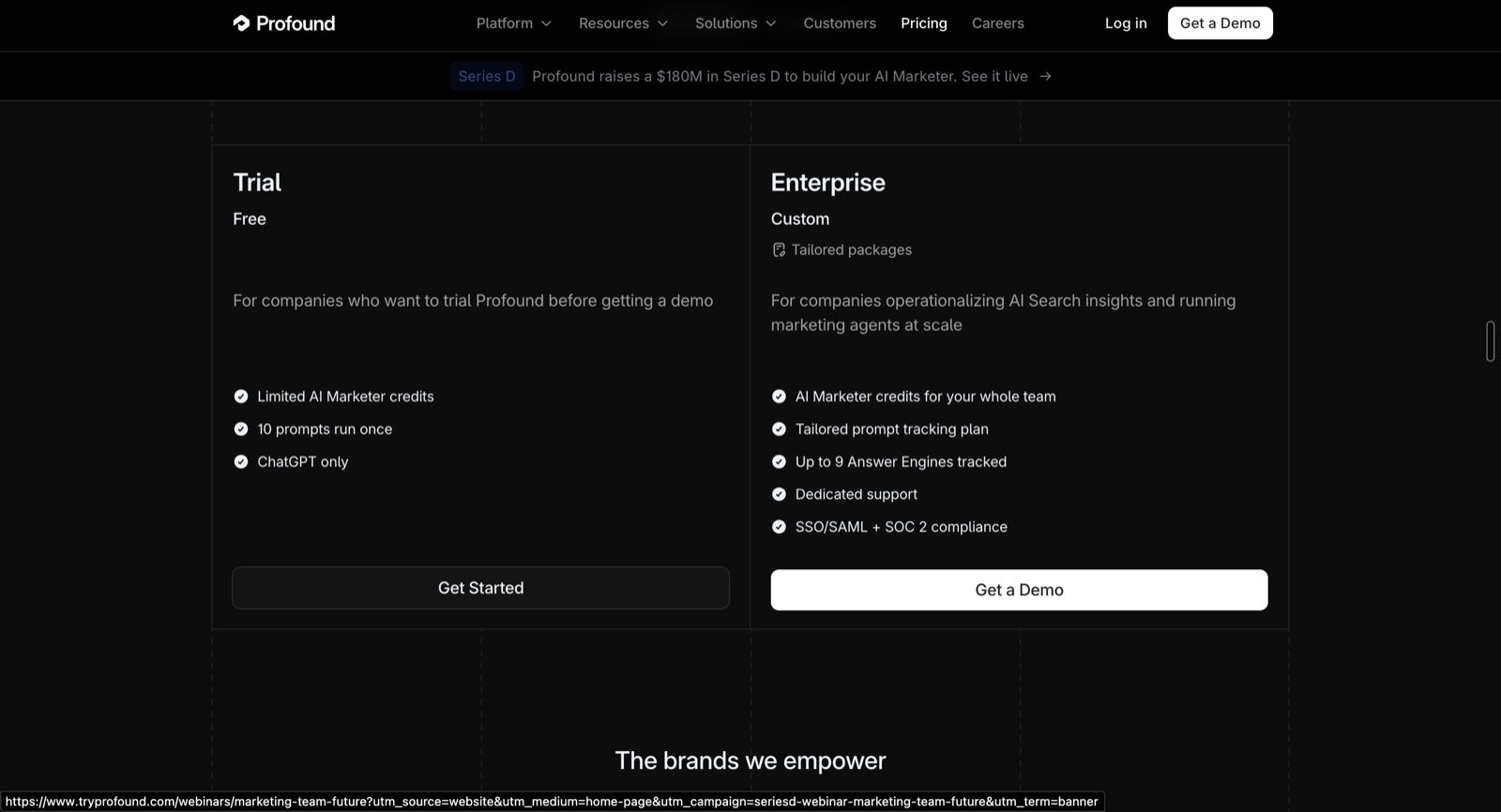
Profound's self-serve reality check, from their pricing page: the free trial is 10 prompts, run once, ChatGPT only - everything real is a demo-gated enterprise conversation:
And Peec:
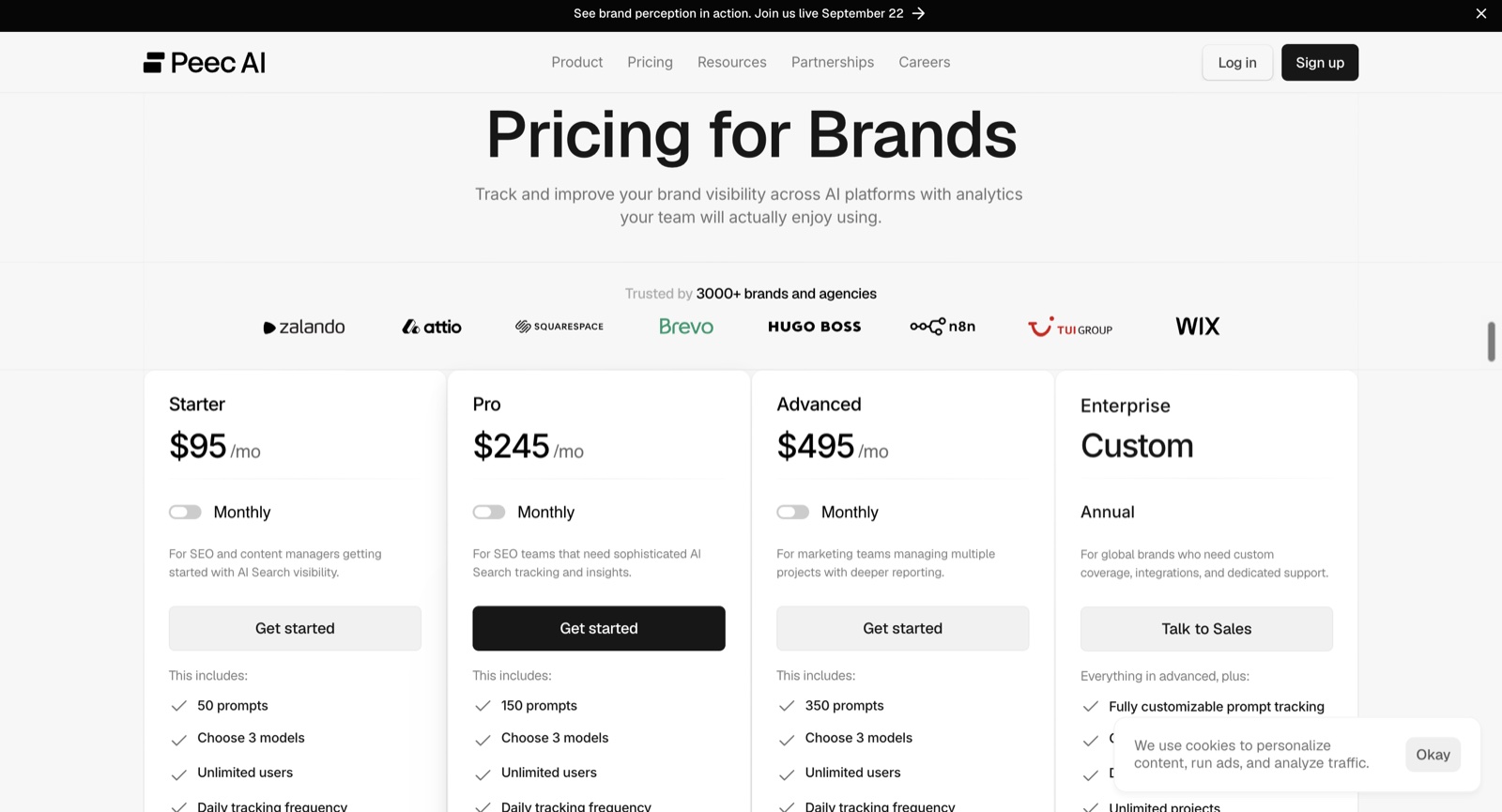
Peec's brand pricing runs $95 to $495/month before the custom enterprise tier - which is exactly the range where Emil's threshold question below starts to bite:
What actually moves the number
Here's what the listicles never get to. The inputs that change AI answers are measurable, and none of them is a dashboard:
Third-party trust signals. Seer Interactive analyzed 800K AI responses and found brands with no Trustpilot profile had a median AI citation rate of 1%. With even a minimal profile: 53.5%. (Trustpilot's own PR frames robust profiles at 75% - directionally consistent, saltier source.) Kevin Indig's read of the AirOps data points the same way: the large majority of brand mentions in AI answers come from third-party content, not your own site.
Showing up where the models look. Every model leans on a shortlist of trusted surfaces when it assembles an answer: review sites, Reddit, YouTube, established blogs - and, for anything professional, LinkedIn, which has quietly become one of the most-cited domains in AI answers. That one matters enough for B2B that it gets its own section below.
Niche content the models can actually find. Emil's theory on why our own blog went 0 to 640 monthly visits in six months with no tracker: LLMs are simply better than classic Google at matching niche mentions to niche questions. Google needed years of accumulated domain authority and backlinks before it trusted you. An LLM that finds your page clearly answering one specific question a real person asks will cite it now. The whole engine behind that growth is the same one we documented here: expertise in, specific answers out.
And the payoff data is the part nobody puts in the listicles:

That's our GA4. AI-assistant referrals convert to key events at 27.64%, versus 4.41% for organic search - and Orbit Media's 97-site, 28.9M-session study found the same shape across B2B: AI-referred visitors are ~3x more likely to convert than other organic traffic (median 7x), even though AI is still ~0.5% of sessions. We see why on sales calls constantly: buyers who found us by asking Claude or ChatGPT show up already convinced - they say some version of “I had a long conversation with my ChatGPT and it recommended you.” They trust the recommendation because the model knows them, in a way a Google results page never did.
LinkedIn: the AI visibility channel hiding in plain sight
If you sell B2B, one surface deserves more attention than every dashboard combined. Semrush analyzed 89K LinkedIn URLs cited in AI answers and found LinkedIn is the #2 most-cited domain overall, appearing in roughly 11% of AI responses. Profound's own citation data goes further: for professional queries - the ones your buyers ask - LinkedIn is the #1 cited domain across six models.
And it's compounding. In Profound's data, posts and articles - the content individual people publish, not company pages - grew from 26.9% to 34.9% of all LinkedIn citations in just three months. Every quarter, a larger share of what AI assistants cite from LinkedIn is written by individual practitioners. The models are doing exactly what LinkedIn's own 360Brew algorithm does: treating people as the credible unit of expertise, not logos.
One split worth knowing when you plan who posts what: Perplexity prefers Company Pages (59% of its LinkedIn citations), while ChatGPT-style search prefers individual people (59%). The practical read: you want both surfaces alive - a maintained company page, and executives and subject-matter experts posting in their own names.
This is the part almost nobody optimizing for AI visibility acts on: while everyone A/B tests their FAQ schema, every LinkedIn post your team publishes is a citable document in the training and retrieval path of every major model - and the citation share of exactly that content is growing quarter over quarter. Your employee advocacy program isn't just a LinkedIn reach play anymore. It's AI visibility optimization with a compounding trend behind it.
Your zone of excellence (the list that replaces the tracker)
Here's the framework I actually use instead of a visibility dashboard. Every business has a zone of excellence: the set of topics you are genuinely the most qualified voice on. For some companies that's 50 keywords; for a platform, maybe 1,000. Shopify can credibly write about anything an e-commerce entrepreneur faces - but the moment the topic is running a SaaS company, that's HubSpot's zone, not theirs, and ranking there wouldn't even serve them.
The failure mode of tool-driven content is “publish one post a week” with no answer to until what? The zone gives you the answer: enumerate the ~50 keywords and questions you should own (an Ahrefs or Semrush pass gets you volumes, and LLM demand tracks search demand closely), cover them with genuinely good pages, then maintain and update rather than endlessly producing. Alongside it, list the places of authority where your buyers actually research - the blogs, YouTube channels, review sites, subreddits, LinkedIn voices - and make sure you show up there. That list, not a share-of-voice chart, is the working document. And remember the models score reader experience the way Google does: when someone lands on your page, do they stay, do they get their itch scratched, or do they bounce back and keep searching?
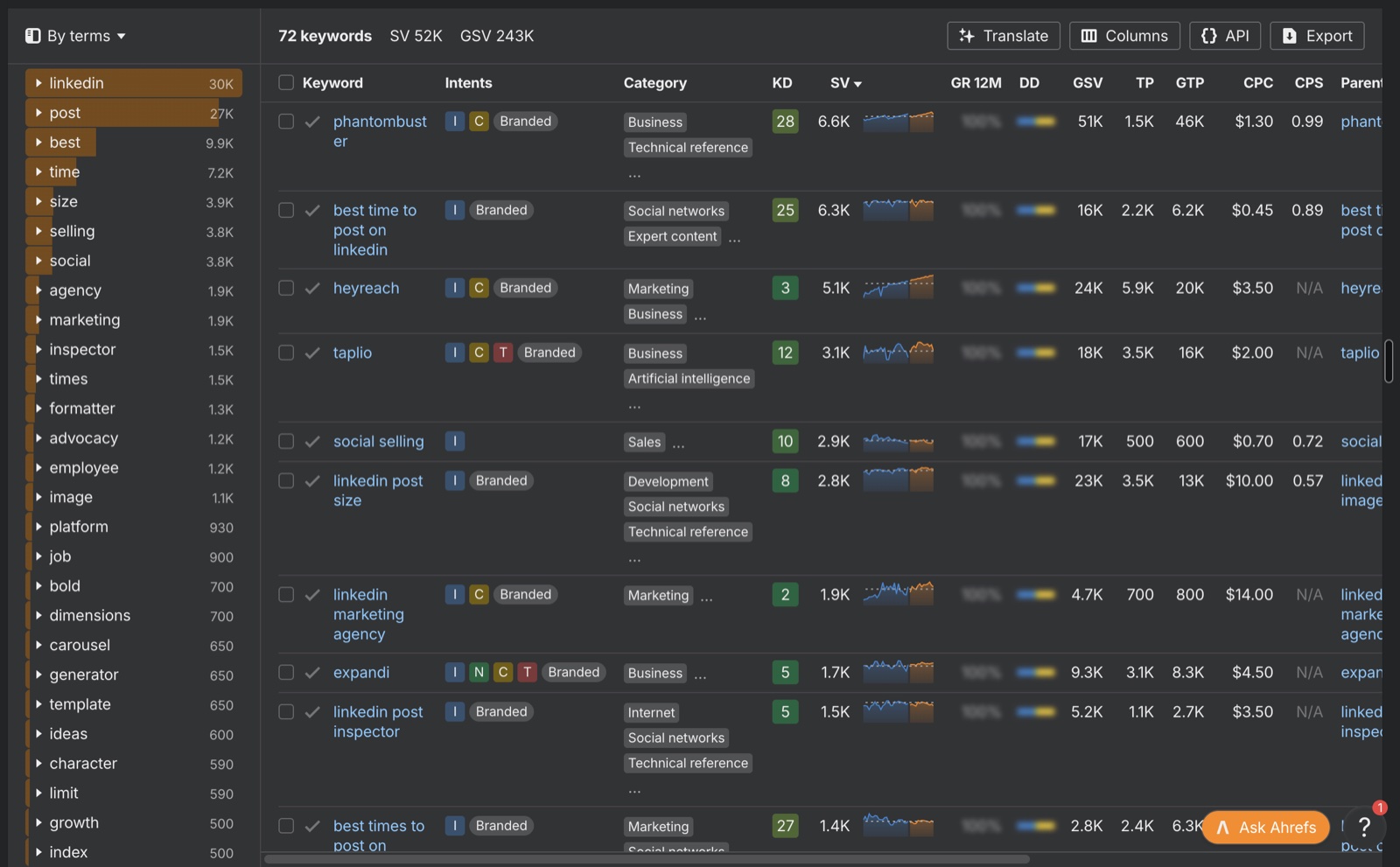
Here's what that looks like in practice - our own zone mapped in Ahrefs, 72 keywords with volumes and difficulty, grouped by term:
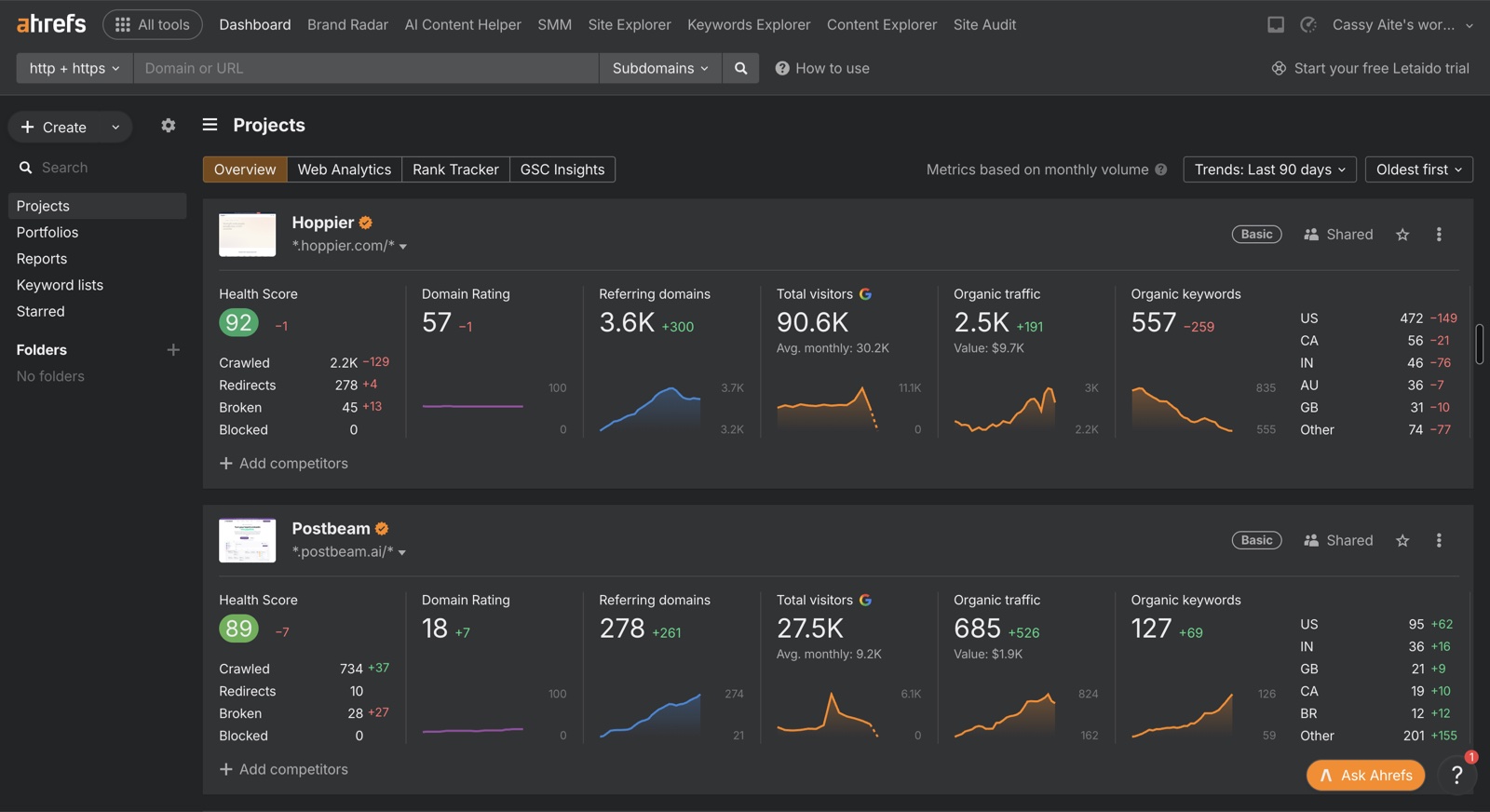
And the rank tracking I actually pay for is the boring kind - the same Ahrefs projects we run everything else from:
The disagreement: when does a tracker earn its keep?
We agreed on more than we expected, so here are the actual thresholds we landed on - the thing we couldn't find on any page ranking for this keyword.
Emil's line: pay nothing until AI-assistant referrals in your free analytics are already worth about $500/month in expected lead value - your expected close rate times lifetime value, on the leads GA4 attributes to ChatGPT, Claude, Gemini and friends. It's the Ahrefs logic: paying for Ahrefs before you have a working blog strategy is buying a speedometer for a parked car. GA4 and Search Console are free and tell you whether the channel is real for you. Past the threshold, a tracker helps you optimize; before it, it's a $6,000/year subscription to a number you can't act on.
My line: under about $100/month, just test one - that's nothing if you believe AI search is a serious channel, and I do, because our own conversion data says so. But check it every couple of months, not every day. Daily tracking of a probabilistic number is how marketing teams manufacture anxiety. The exception where close, expensive tracking genuinely pays: when one keyword is existential. The credit-card comparison sites made $10M+ a year off a single query like “best business credit card” - at those stakes, track obsessively. Most businesses don't have that keyword, and if you think you do, you probably haven't mapped your zone of excellence yet.
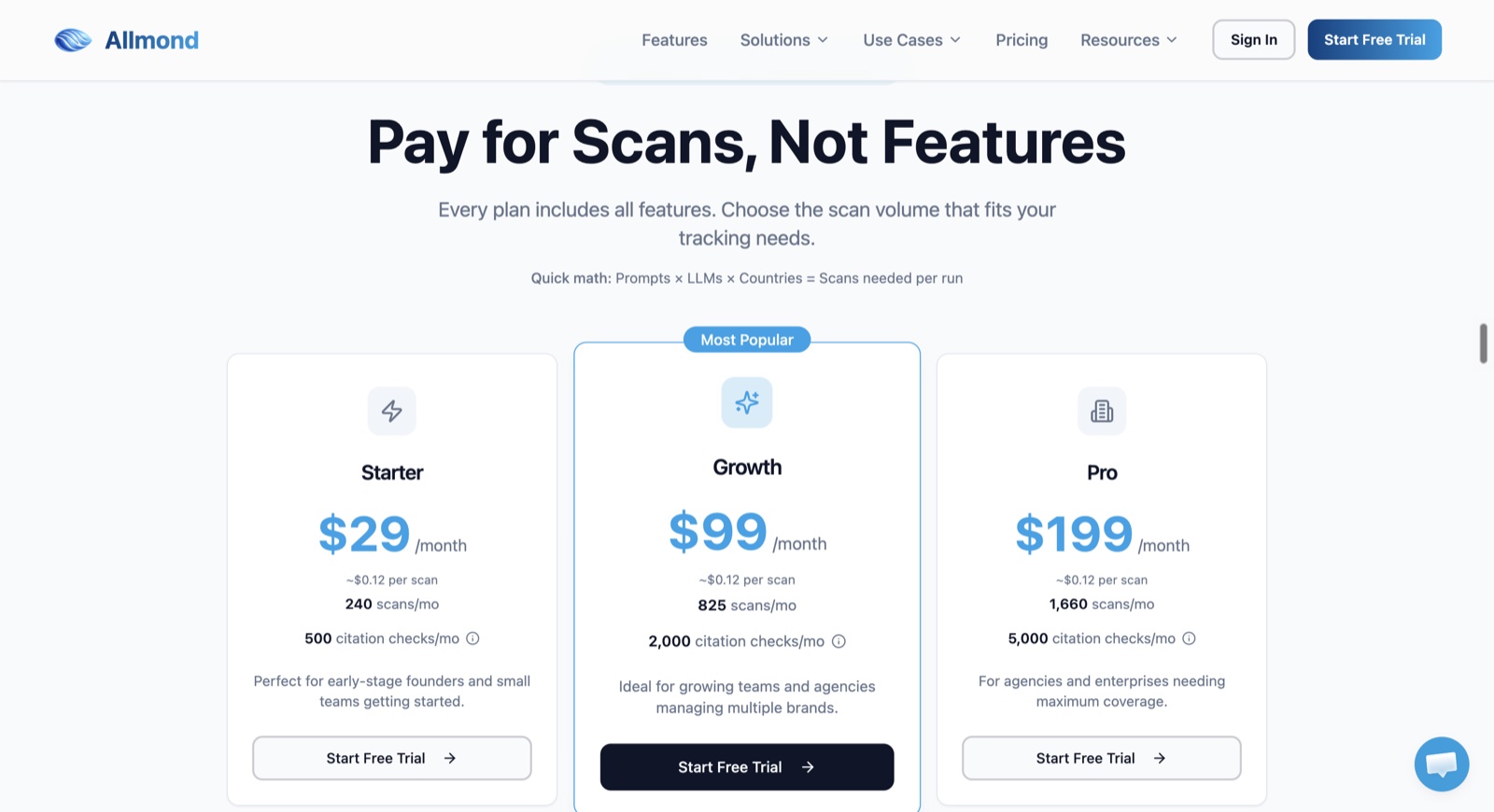
The under-$100 tier genuinely exists, for what it's worth - Almond starts at $29/month with a pay-per-scan model:
The strongest case for the trackers isn't ROI measurement at all - it's sizing the downside. A G2 survey cited by BlueJar found 69% of buyers chose a different vendor based on AI chatbot guidance, and a third bought a vendor they'd never heard of before the chat. With 68% of Google searches now ending without a click, invisibility in the answer layer is a real cost even when you can't see it in last-click attribution. That's the honest steelman. It still doesn't make the dashboard move the number.
The ending everyone senses: AEO is just becoming SEO
Emil's closing take, and we both hold it: this category exists because a new acronym opened a budget line, but the playbooks are converging fast. The best practices for getting cited by ChatGPT are already the best practices of boring, classic SEO: do something well in a specific niche, get mentioned by credible third parties, and say clearly - on your site and everywhere your buyers research - exactly which problem you solve. The real difference is speed: LLMs reward niche expertise in months where Google demanded years of domain authority. And with Gemini and AI Overviews folding into Google itself, the two disciplines are literally merging into one surface.
So the honest recommendation, from a company that admittedly sells the content side: if the tracker budget and the content budget ever compete, content wins - because content is the only input that changes the output. Run the free check in GA4 today. If AI referrals are real for you, put the money into the machine that feeds the answer engines: your expertise turned into specific, citable content across your site, Google, and LinkedIn. That's the entire thesis Postbeam is built on, and if you want a quick read on where you stand first, our free AEO checker is a 3-minute audit, not a $500/month subscription.