

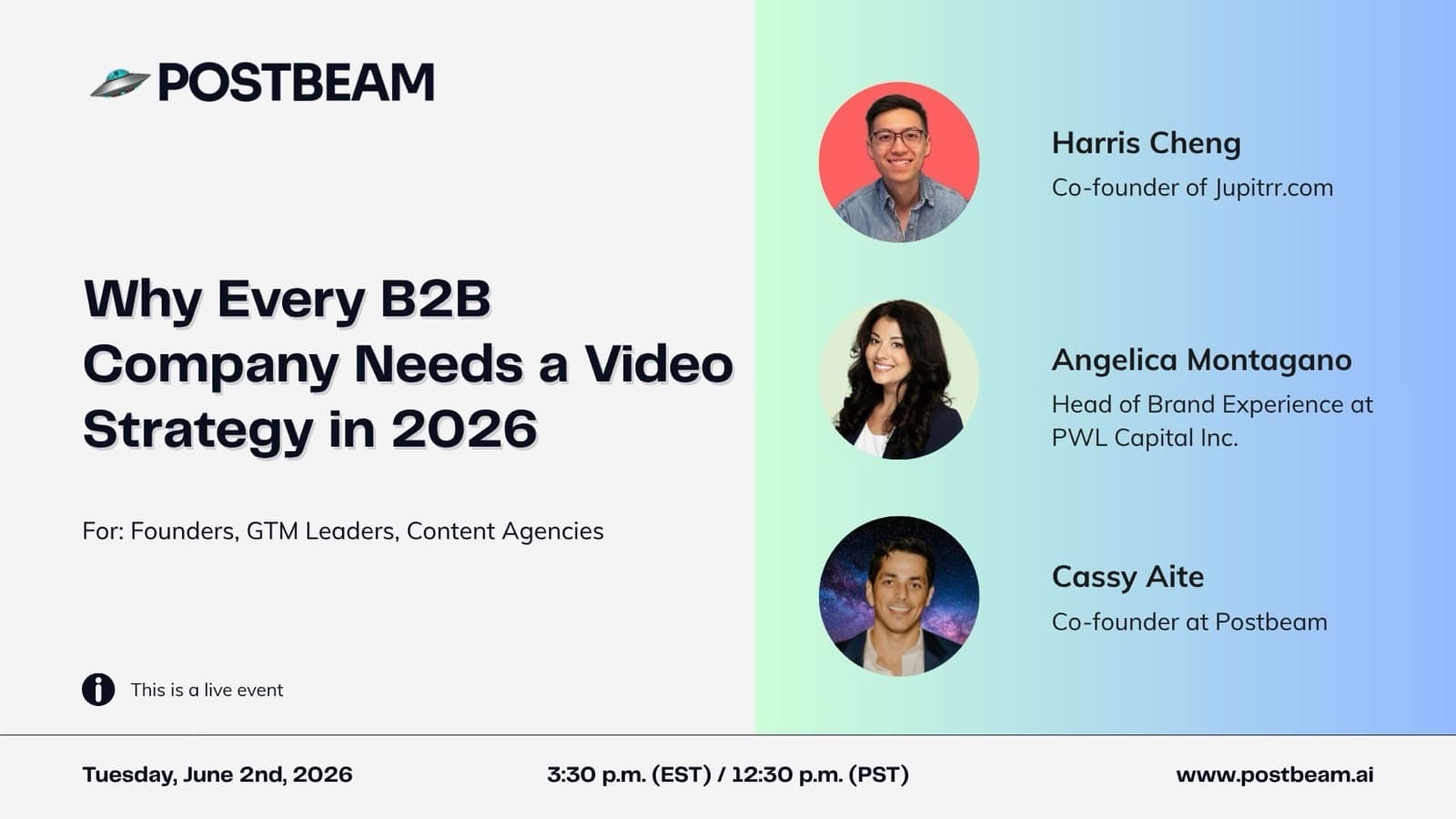
Watch the full 42-minute conversation above. Below is the recap, the key arguments, and the playbooks both guests shared.
TL;DR
Video is the most defensible format in B2B right now because AI has commoditized everything else. Features, copy, even product demos can be replicated in days. Trust and recognition can't.
Stop chasing views. 10,000 high-intent views is “viral” in B2B — a stadium full of relevant decision-makers beats a million casual scrollers.
And keep a real human on camera. AI avatars and faceless content push the wrong signal to the exact audience you're trying to convince.
The guests

Harris Cheng
Co-Founder, Jupitrr AI
Harris has spent the past 9 years building products across Hong Kong, Toronto, and London to help businesses without an existing network generate leads. At Jupitrr AI, he runs the operating system where research, scripting, recording, editing, and publishing all live in one place.

Angelica Montagano
Head of Brand Experience, PWL Capital
Angelica is a trust-based marketing strategist who built one of the most-mentioned wealth-management brands in Canada through content. Under her watch, PWL's podcast (Rational Reminder) became the largest financial podcast in Canada and the firm became the default Reddit recommendation in r/PersonalFinanceCanada.
Why video matters more in 2026 than it did two years ago
Two forces are stacking on top of each other.
Angelica's take: Gen Z has entered the workforce in numbers - Gen Z is up to 29 now - and they're running social and content teams inside modern GTM orgs. They grew up post-TikTok, so video is the default, not the experiment. The message has finally landed in B2B: your decision-makers and their teams are on social media, watching YouTube, scrolling reels. If you're not making video, you're invisible to them.
Harris' take: AI has made everything cheap. Whatever you sell - SaaS features, service offerings, even fully vibe-coded products - can be replicated in days. The only things that don't commoditize are authenticity, trust, and brand. Video is the best single format for building all three at once - and it's the engine behind every credible social selling program in 2026. Video adoption itself is compounding 20–30% year-over-year, so the companies showing up consistently now are building a moat that gets harder to cross every quarter.
The 5 B2B video formats every team should use
Harris broke it down cleanly: pick your video format based on whether you're doing push marketing (telling people things they don't know they need) or pull marketing (showing up when they already have intent). A balanced content calendar mixes both. Here are the five he recommends every B2B team work with:
1. Talking-head videos. You, on camera, sharing an opinion or insight. Push marketing. Hardest to start, easiest to scale once you build the muscle.
2. Search-based videos. “How to” videos that target a specific search query. Pull marketing. These earn recurring traffic from YouTube and Google for years. HubSpot built a content empire on this.
3. Thought leadership videos. Niche, deep, won't-go-viral content. Performs best on LinkedIn - and even better when you nail the timing. The people who actually understand your domain will rate you and trust you for it.
4. Skit videos. Role-play, scripted, often funny. One person playing two characters works well (tl;dv does this constantly). High shareability when it lands, but only fits certain brands.
5. Product demos and launches. Loom-style walkthroughs for product updates. Higher-budget cuts for major launches. The biggest cheat code: get your product marketer or marketing lead on camera doing these, not a faceless screen recording.
Brand first, format second
Angelica's counterpoint: don't pick a format off the list and run with it. Pick your brand first, then choose the formats that fit. A skit video is great if your brand is irreverent. It will torch a luxury or traditional brand on contact.
And then there's the website video trap. Far too many B2B sites ship a beautifully-shot, overly aesthetic 60-second video that tells you absolutely nothing about what the company does. She blames Apple. The fix:
“If someone commits to watching a three-minute video on your website, that's a huge commitment. Don't waste it on aesthetics. Tell them who you are, what you do, and what they should walk away with. And please — no jargon.”
How video actually drives revenue (not just views)
The PWL playbook: when Angelica joined, the firm was mentioned on Reddit roughly twice a year. They had a white paper. That was the strategy. She brought an “influencer strategy” - borrowed from beauty and lifestyle creators - and applied it to wealth management: low-CTA, high-information videos focused on building community first. (It's the same shape as the beehiiv employee-advocacy playbook we've broken down before - different industry, same compounding trust loop.)
A few years later, PWL is the default recommendation in r/PersonalFinanceCanada. Ben Felix, one of their advisors, has been on Diary of a CEO. Eight out of ten times someone asks “I need a financial advisor in Canada,” the top reply is PWL. None of that is attributable in any analytics tool. It all shows up as direct traffic. It's also the entire pipeline.
Harris added the founder-side version: prospects who watch his videos before a sales call show up already convinced. They tell him in the first five minutes that they've seen his content. Those deals close in one call instead of two or three. That's the concrete revenue impact of trust-building video - a shorter sales cycle, not a magic conversion lever. (If you want the warm-lead detection side of this - knowing which viewers are heating up so you can reach out before they ghost - that's what LinkedIn analytics in Postbeam surface.)
What “viral” actually means in B2B
Harris' reframe is the most useful single takeaway from the whole call:
“In B2B, 10,000 views is viral. Imagine 10,000 people in a stadium. That's how many people are actually seeing you. And they're high-intent.”
Stop trying to compete with cat videos. Aim for relevant. Aim for evergreen. Search-based videos in particular keep paying out for years - every time someone searches “how do I fill in a [X],” your video shows up again, drives traffic to your site again, and converts again. That's the model HubSpot built a company on, and it works as well for a five-person startup as it does for a public company.
Where AI belongs in B2B video (and where it doesn't)
Both guests landed in the same place: use AI to speed up your workflow, not to replace yourself on camera.
Harris' pushback on faceless content is direct: the whole point of B2B video is trust. AI avatars and faceless content signal the exact opposite. The only exceptions he'll grant are architectural mock-ups where the human is incidental, or scrappy B2C ad accounts where there's nothing to lose.
Angelica was even more direct on AI-generated ad videos: she had a colleague double down on AI talking-head ads on the logic that they could pump out 100 a day. Her response: that would kill the brand entirely. The cultural shift is toward more authentic, more human, more real. The right move with AI is to use it to make scripts, edits, and publishing 10x faster - then put your face on camera anyway.
Audience Q&A: the highlights
What's the best platform for B2B video on LinkedIn?
Angelica: think about where your decision-makers spend time, not just where you're most comfortable. LinkedIn is the obvious choice for B2B, but those same buyers are also on Instagram, YouTube, and TikTok. The highest-performing LinkedIn videos she sees are often personal - the founder talking about their weekend, what motivates them - not corporate updates.
Harris: LinkedIn videos work best when they feel genuine and go niche enough that your first-degree network engages. If your first degree doesn't interact, second-degree reach never happens - so target your immediate audience deliberately. Your Social Selling Index is a decent proxy for how warm that first-degree network is right now.
Do AI talking-head clones work in B2B yet?
Both guests: not really. The audience clocks it instantly, and trust evaporates. Use AI to speed up the production pipeline, not to replace your face.
Should you run AI-generated B2B video ads?
Angelica: she'd rather you run a static image ad than an AI talking-head video ad. Harris' devil's advocate: if you're a five-person startup with nothing to lose, you can test UGC-style AI ads - just never admit the account is yours. For anyone with a brand to protect, the answer is no.
Webinar offer: 50% off your first month of Postbeam
Use code VIDEO50 at checkout. Postbeam helps founders, GTM teams, and agencies turn LinkedIn engagement into pipeline - track who's warming up to your content and surface them as leads before they reach out.
Related reading
- B2B content marketing: the ultimate guide for 2026 (where video fits in the full mix)
- 50+ LinkedIn post ideas for founders and B2B operators
- What is social selling? A 2026 playbook
- The best time to post on LinkedIn in 2026
- How to build an audience in the age of AI (our latest webinar)
- All Postbeam webinars →