

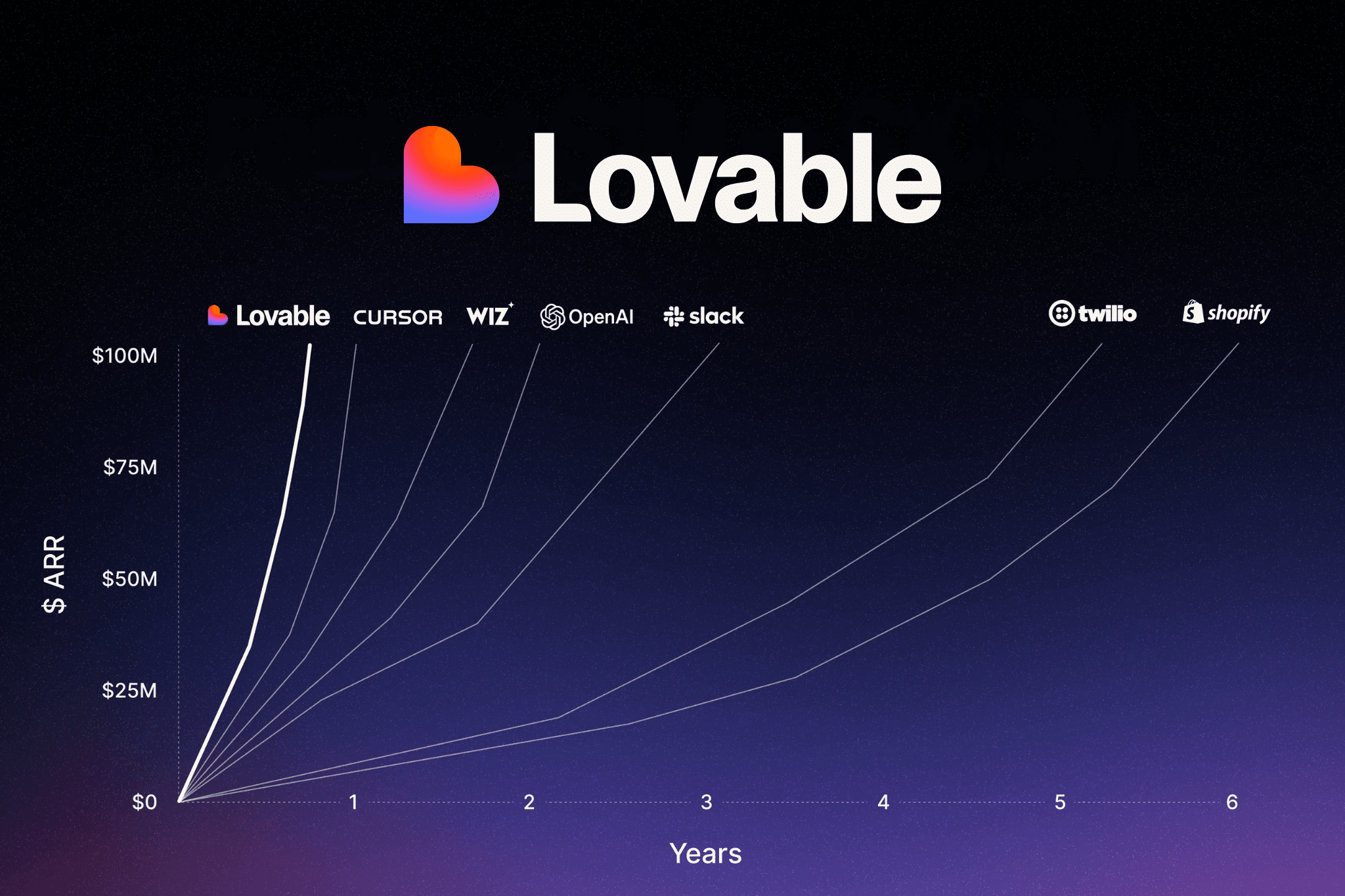
Eight months after launching, Lovable went from zero to $100M in ARR - the run TechCrunch wrote up as one of the fastest ever. Three months later it passed $200M. Today it's past $500M, having raised roughly $550M within its first year. Numbers like these usually mean a decade of compounding. Lovable did it in a year and a half.
If you haven't used it: Lovable is the vibe coding tool. You type what you want in plain English and watch AI build a working app - no code, no setup, built for people who've never programmed. On the latest GTM Breakdown, Emil and I dug into how it happened: the founders, the open-source origin, the swarm playbook, and every channel they run. This is the full writeup.
TL;DR: Lovable by the numbers
- Revenue: $0 → $100M ARR in 8 months → $200M three months later → $500M+ today.
- Funding: ~$550M raised within roughly the first year after launch.
- Traffic: 34-40M monthly visits, ~65% of it direct. 5.18 pages per visit, 7:31 average session.
- Origin: GPT Engineer, a weekend project, became one of GitHub's fastest-growing repos ever at 51K+ stars.
- Launch: #1 on Product Hunt and Hacker News the same day; $10M ARR two months later with 15 people.
- Team reach: ~460K LinkedIn followers across a handful of employees; every post swarmed by the company within 2 hours.
- Category: “Vibe coding” - Collins Dictionary's 2025 word of the year - is theirs.
The founders
Anton Osika and Fabian Hedin are two Swedes who've been building software since they were kids - they started coding at 10 and 12. Anton was the first technical hire at Sana Labs, then CTO and co-founder of Depict AI, which raised $20M. Fabian sold a proptech company while still in high school, then worked on Stephen Hawking's communication interface and accessibility tech alongside ex-SpaceX engineers. Not a normal founding bench.
The origin story: a weekend project with 51,000 stars
After ChatGPT made AI code generation feel suddenly possible, Anton spent a weekend building GPT Engineer - a tool that turned plain English into working web apps - and pushed it to GitHub. He woke up the next morning to thousands of users and an inbox full of messages from non-coders who had just built their first apps. GPT Engineer became one of the fastest-growing repositories in GitHub history, passing 51,000 stars.
So he quit his job, recruited Fabian, and spent the next twelve months turning a code-heavy CLI tool into a visual product anyone could use. In November 2024 they rebranded GPT Engineer to Lovable and launched the public beta - #1 on Product Hunt and Hacker News on the same day. Two months later: $10M ARR with fifteen people, at the time the fastest-growing startup Europe had ever recorded.
Emil's take on the open-source origin is worth pausing on: publishing GPT Engineer was the only way to validate that demand existed for AI programming before the world believed it. Two years ago, “you can program with ChatGPT” was a fringe idea. 51,000 stars said otherwise - and every one of those developers became the top of Lovable's funnel.
The growth timeline
Anton builds GPT Engineer in a weekend, pushes it to GitHub, and wakes up to thousands of users. It becomes one of the fastest-growing repos in GitHub history at 51,000+ stars.
Lovable is incorporated. The next 12 months go into turning a code-heavy CLI tool into a visual product anyone can use.
GPT Engineer rebrands to Lovable and launches in public beta - #1 on Product Hunt and Hacker News on the same day.
$10M ARR two months after launch, with a team of 15 - at the time, Europe's fastest-growing startup ever recorded.
$100M ARR eight months after launch (the TechCrunch story that made everyone look up).
$200M ARR - the second hundred million came in a third of the time the first one took.
$500M+ ARR, roughly $550M raised within the first year, and 34-40M monthly visits to lovable.dev.
And the hiring machine is running flat out to keep up - 146 open roles as of Q2 2026, with engineering and sales openings up ~140% in six months:
.png)
.png)
The market did the heavy lifting - and they capitalized
Let's be honest about the biggest factor: timing. Hiring good developers used to be nearly impossible, and writing code took enormous effort. Then suddenly everyone could build software - and a market that used to be “professional developers” became “anyone with an idea.” Even the plumbing business needs an app now. Lovable is riding one of the biggest demand waves software has ever seen.
But timing only pays out if you capitalize on it, and that's where the GTM playbook comes in. Everything below is what they layered on top of the wave.
1. Building in public: Anton was the marketing team
In the early days there was no marketing department. Anton posted on Twitter and Hacker News, shared how fast they were growing and what they were building, and let the story compound. When your audience is builders - people creating businesses and products themselves - a founder narrating a rocket ship in real time is addictive content. It snowballed into the company's best channel.
It still runs today: Anton averages 800-1,000+ reactions per LinkedIn post. And notably, Emil couldn't find a trace of boosted posts or thought-leader ads behind him - that reach is organic. If you're a founder wondering how to start this motion at your own scale, we broke the playbook down in our executive thought leadership guide and on the LinkedIn for founders page.
2. The team swarm: every engineer is a marketer
This is the channel we find most interesting, because it's the one almost any B2B company can copy. Elena Verna - Lovable's head of growth, previously growth at SurveyMonkey, Miro, Amplitude, Superhuman, and Dropbox - has described the system herself:
“We have a channel called bee swarming where employees post their content and everyone goes to amplify it. We try to turn every engineer into a marketer.”
Employees are expected to build apps and post content, and every new post gets dropped into that Slack channel. When it fires, the whole company floods the post with comments, likes, and shares within two hours - before organic reach starts to decay.
The results are visible in the follower counts. Across just a handful of employees, Lovable's team holds roughly 460K LinkedIn followers - Elena Verna at 181K, Anton at 142K, angel investor and designer Felix Haas at 82K, plus a long tail of teammates in the five figures:
.png)
We've seen this pattern in other breakout companies - beehiiv ran the same play. Founder-led content never went away; it got transferred to the whole team. It's a lot more effective with a hundred people than with one founder. (If you want to run this motion yourself, it's exactly what we built the Postbeam Employee Advocacy add-on for - Slack pings when anyone posts, plus a leaderboard of who engages most.)
3. Content clipping
The founders and team have done a long run of podcasts - Lenny's Podcast, 20VC, and plenty more - and the long-form interviews get sliced into clips and repurposed across every short-form channel they post to. One hour of founder talking becomes weeks of distribution - the same clipping engine we covered in why every B2B company needs a video strategy.
One honest caveat from the episode: the podcast circuit works for Lovable because the company itself is the story - a once-a-generation growth curve run by quasi-celebrities. For most small companies, chasing podcast appearances won't move the needle the way it does for them.
4. Launch culture: lightning strikes on schedule
The first customers came from posting on Product Hunt and Hacker News - #1 on both, the same day. They've launched on Product Hunt repeatedly since, and every major release is treated as a distribution moment: the David Sacks “lightning strike” playbook, where each ship is newsworthy, keeps the team accountable, and never lets the brand fade from the feed. It's the Apple release model run at startup speed. (We wrote a full guide on how to launch on Product Hunt if you want to run the same play.)
5. Community, affiliates, and ambassadors
Discord and community events, affiliate programs, ambassador community builders, events for their most active users, campus leaders in university communities, and “built with Lovable” tags spreading through everything users ship. They're entrenching themselves in every community where a potential builder hangs out - the long game.
Emil's framing: UGC and affiliate programs are really just paid ads where you go direct. Instead of letting Meta or Google be the market maker, you find your own creators and pay them directly - and the economics usually work out better. Nearly every fast-growing company we've broken down runs some version of this, even the ones spending almost nothing on traditional ads.
6. Owning “vibe coding”
Andrej Karpathy gets the credit for coining the term, but Lovable jumped on it instantly - and arguably was describing the behavior before the phrase existed. By 2025, Collins Dictionary named “vibe coding” its word of the year, and if there is one company synonymous with it, it's Lovable - even though Claude and ChatGPT are vibe coding tools too.
It's the category-ownership play: Salesforce had “no software,” Drift had “no forms,” Lovable has vibe coding. They even run search ads straight to lovable.dev/ai/vibe-coding. When the category name is yours, every mention of the trend is a mention of you.
7. Paid ads: $0 until $300M ARR
Here's the stat that should recalibrate how you think about paid acquisition: Lovable didn't spend a dollar on it until they were past $300M in ARR. Now that they do spend, the mix is deliberate.
Google (~3,000 ads live): the bulk of the spend, aggressive high-intent search - “vibe coding,” “build websites with AI,” app builder terms - plus around 900 video ads and, surprisingly, no image display at all.
.png)
Meta (~290 ads): UGC-style talking heads showing example apps, “it used to cost $10K+, now you can do it yourself” display creative, and creator partnerships. Emil's read: the display-heavy mix looks like retargeting - catching the people who came in through search or direct and reminding them to come back.
.png)
LinkedIn (~113 ads): almost entirely boosted employee posts promoting free workshops and webinars - “Build it Live” sessions, a Google Cloud co-webinar. Curious signups enter the funnel, and the bigger business leads get identified inside those workshops.
.png)
8. The SEO surprise: DR 90 with barely any SEO
Here's the counterintuitive one. For a site with 34-40M monthly visits, Lovable's organic search traffic is tiny - around 230K visits a month, and almost all of it branded: “lovable,” “lovable AI,” “lovable pricing.” People aren't finding Lovable through Google. They're typing the URL.
.png)
.png)
And yet lovable.dev has a domain rating of 90 - territory shared with Facebook, Forbes, and Fortune. For reference: Hoppier, our last company, spent ten years and thousands of backlinks earning a DR of 57, one of the highest in its niche. Ninety in two years should be impossible.
The trick is structural: every project built on Lovable ships on a lovable.dev subdomain unless the user adds a custom domain. When someone's mini-app goes viral, the traffic and links flow to Lovable's domain. Emil's takeaway for everyone else: if your product includes a widget, a hosted page, or anything that lives on your domain out in the wild, your users become your link-building team - and that authority compounds whether or not you ever write a blog post.
The website evolution: landing page → product → GTM machine
The Wayback Machine tells the story of a company maturing at fast-forward speed. In 2024, lovable.dev was just a black page with floating hearts and a vision statement.
.png)
.png)
Through 2025 the site became a product: “Idea to app in seconds,” a prompt box front and center, community projects below. Only near the end of 2025 did a real go-to-market motion appear - a pricing page, then an enterprise-shaped nav.
.png)
.png)
The pricing page followed the same arc - simple credit tiers (Free, Pro $25, Business $50) growing into an enterprise page with platform fees, SSO, and volume pricing:
.png)
On attribution: when everything works, stop measuring everything
Emil raised the obvious question: with this many channels running at once, attribution should be a nightmare. Our answer from the episode: at this stage you only watch two things. Is revenue growing in a healthy proportion, and is total lifetime value rising against customer acquisition cost? If yes, lots of things are touching the customer journey - content, ads, community, events - and the right move is to invest in all of it. When product-market fit is this strong, attribution stops being the bottleneck. You trust that traffic is up, revenue is up, and LTV beats CAC - and you can afford to be more laissez faire about tracking every click.
All 9 channels, recapped
1. Building in public
Anton was the marketing team: Twitter, Hacker News, and growth numbers shared as they happened. The founder story became the content engine.
2. The team swarm
A Slack channel where every employee's post gets flooded with comments, likes, and shares within two hours - every engineer is a marketer.
3. Employee celebrities
~460K LinkedIn followers across a handful of team members, anchored by Elena Verna (181K) and Anton (142K). The Lovable mafia in the making.
4. Content clipping
Long-form podcast interviews sliced into clips and repurposed across every short-form channel.
5. Launch culture
Product Hunt and Hacker News on day one, then every major release treated as a lightning-strike distribution moment.
6. Community + ambassadors
Discord, affiliate programs, campus leaders, top-user events, and 'built with Lovable' tags entrenching the brand everywhere.
7. Vibe coding, owned
Karpathy coined it, Collins made it 2025's word of the year, and Lovable became the company synonymous with it.
8. Paid ads - late
$0 on paid acquisition until past $300M ARR. Now ~3,000 Google ads, ~290 Meta ads, ~113 LinkedIn ads running.
9. DR 90 without SEO
Only ~230K organic visits/month and mostly branded keywords - but user projects hosted on lovable.dev built a 90 domain rating for free.
More GTM breakdowns
Frequently Asked Questions
How fast did Lovable grow?+
Who founded Lovable?+
What is vibe coding and who coined the term?+
How did Lovable get its first users?+
Does Lovable run paid ads?+
What is Lovable's main growth channel?+
Steal the swarm playbook
Lovable's whole company amplifies every post within two hours. Postbeam's Employee Advocacy add-on runs that same motion for your team: Slack pings the moment anyone posts, a leaderboard that rewards the most engaged, and warm leads surfaced from every post.
Start Your 7-Day Free Trial →