

Cluely is the most viral company in B2B - and one of the most divisive. Roy Lee compressed what usually takes years of GTM into about 90 days using rage-bait, a 50-intern content factory, and a founder willing to monetize his own expulsion from Columbia.
It worked for the fundraise: a $5.3M seed and a $15M a16z Series A within months, and a reported ~$5.2M ARR in under a year (after Roy admitted to inflating the headline number). Whether it worked for the company is still an open question - the pivot from "cheat on everything" to "AI meeting notes" is the tell.
We mapped eight growth channels. The most fileable lesson: you can buy attention for free with controversy. You can't buy trust the same way - which is exactly why Roy says the one channel he can't crack is LinkedIn.
Cluely at a glance
Founded
2025 (Interview Coder, 2024)
Founders
Roy Lee, Neel Shanmugam, Alex Chen
HQ
San Francisco
Total raised
~$20.3M
Lead investors
a16z, Susa, Abstract
Valuation
~$120M (post Series A)
Revenue
~$5.2M ARR (~$6.3M run rate)
Core team
~10–15 (LinkedIn shows ~70+)
Pricing
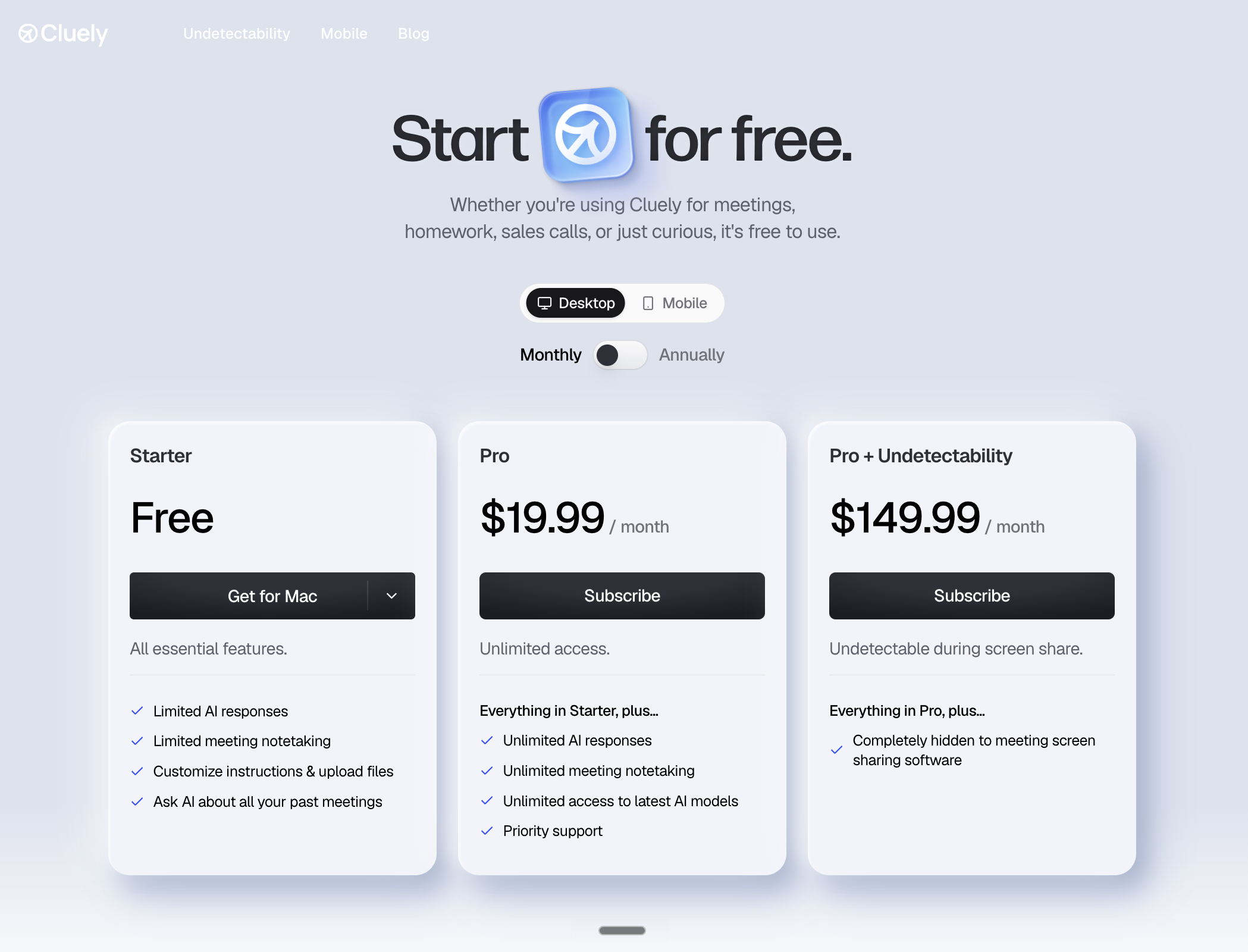
Free / $19.99 / $149.99
The origin story (it's the whole strategy)
Chungin "Roy" Lee grew up in Atlanta, a first-generation Korean American. By his telling, he was accepted to Harvard as a high-school senior and then had the offer rescinded for sneaking out on a field trip. For a family that ran a college-prep agency, that was a genuine disgrace. He did a year at a Bay Area community college, then transferred to Columbia for computer science, where he met co-founder Neel Shanmugam (Alex Chen rounds out the founding trio).
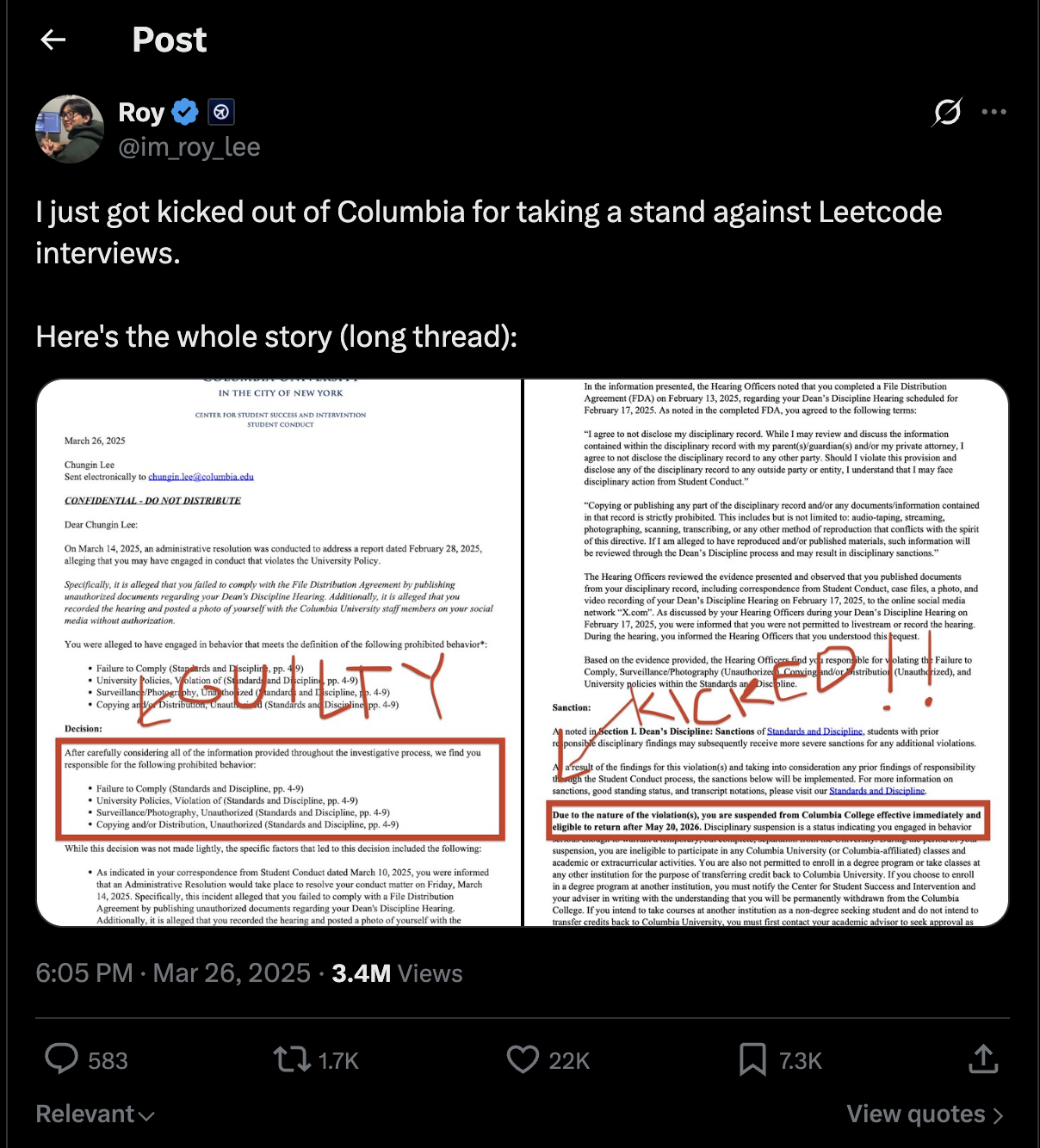
In June 2024 he built Interview Coder - a translucent, "undetectable" desktop overlay (plus a Chrome extension) that fed you answers during live Leetcode interviews. He used it to land offers at Amazon, Meta, and TikTok, and filmed the whole thing. In March 2025 an Amazon exec saw a video, complained, and Columbia suspended him for a year. Instead of going quiet, Roy posted the disciplinary letter on X and dropped out.
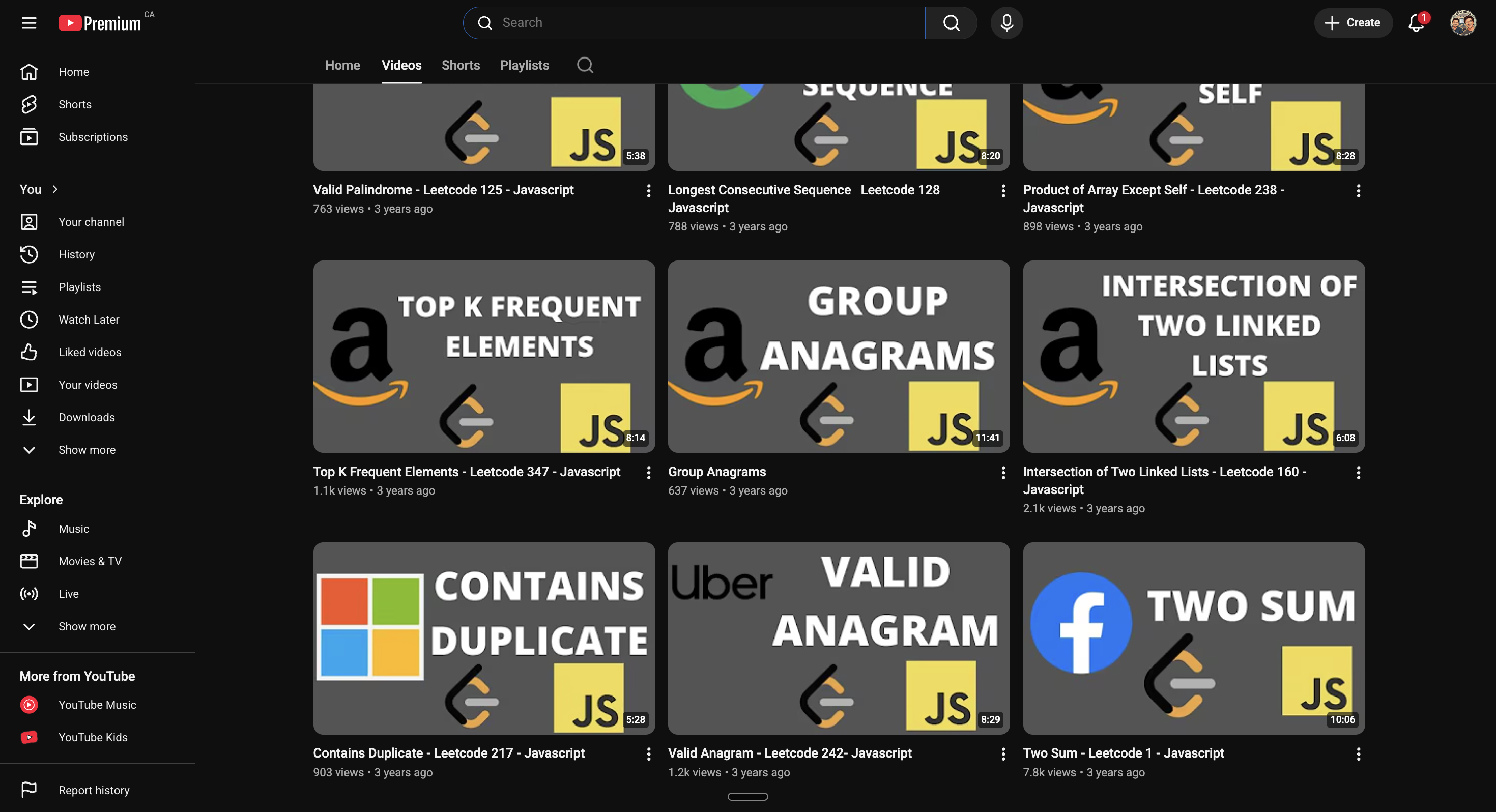
Here's the part most people miss: Roy had been posting Leetcode tutorials on YouTube since 2022 - roughly three years before Cluely. He built the audience first, noticed nobody actually wants to grind Leetcode, and realized the real product was helping people skip it entirely. The company is downstream of the content, not the other way around.
The timeline: from a viral suspension to a16z-backed
Roy Lee posts his first "how to pass a Leetcode interview" tutorial on YouTube - almost three years before Cluely exists. The audience came first; the product came later.
Roy builds Interview Coder - a translucent, "undetectable" desktop overlay (plus Chrome extension) that fed AI answers during live Leetcode interviews. He uses it himself to land offers at Amazon, Meta, and TikTok, then films it.
An Amazon exec sees the video and complains. Columbia suspends Roy for a year (ending May 2026); he drops out instead - and posts the disciplinary letter publicly on X. That kayfabe-breaking moment lights up the algorithm.
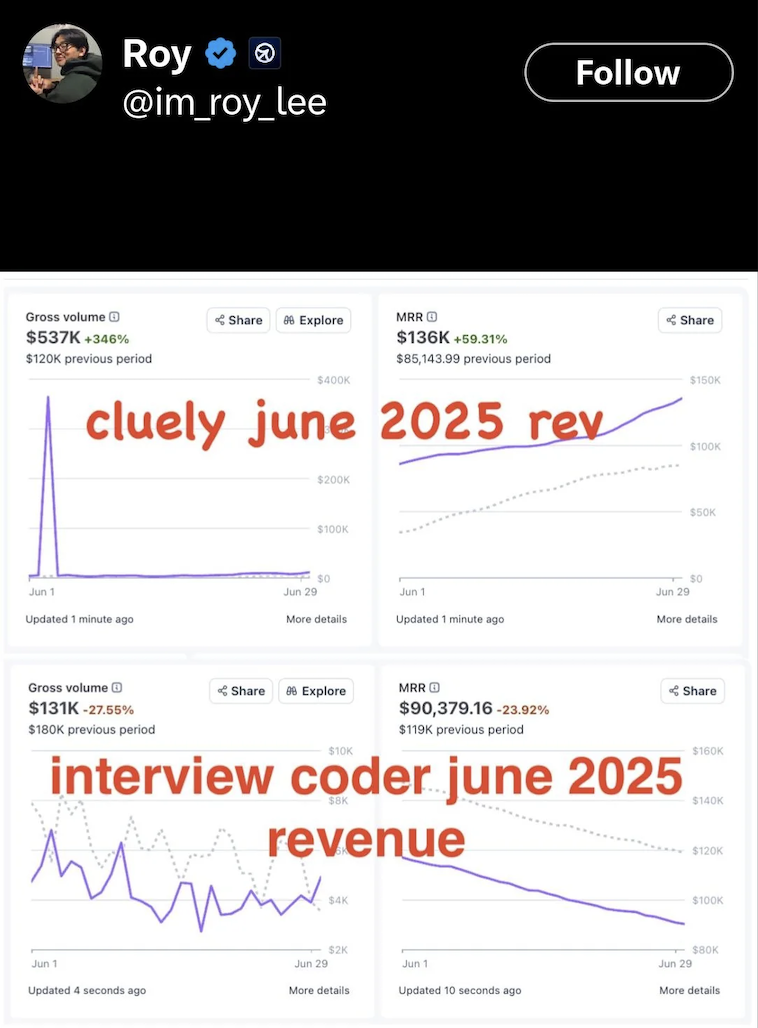
A classic revenue-porn tweet. Take the exact figure with a grain of salt, but the signal is real: the audience was already converting before Cluely launched.
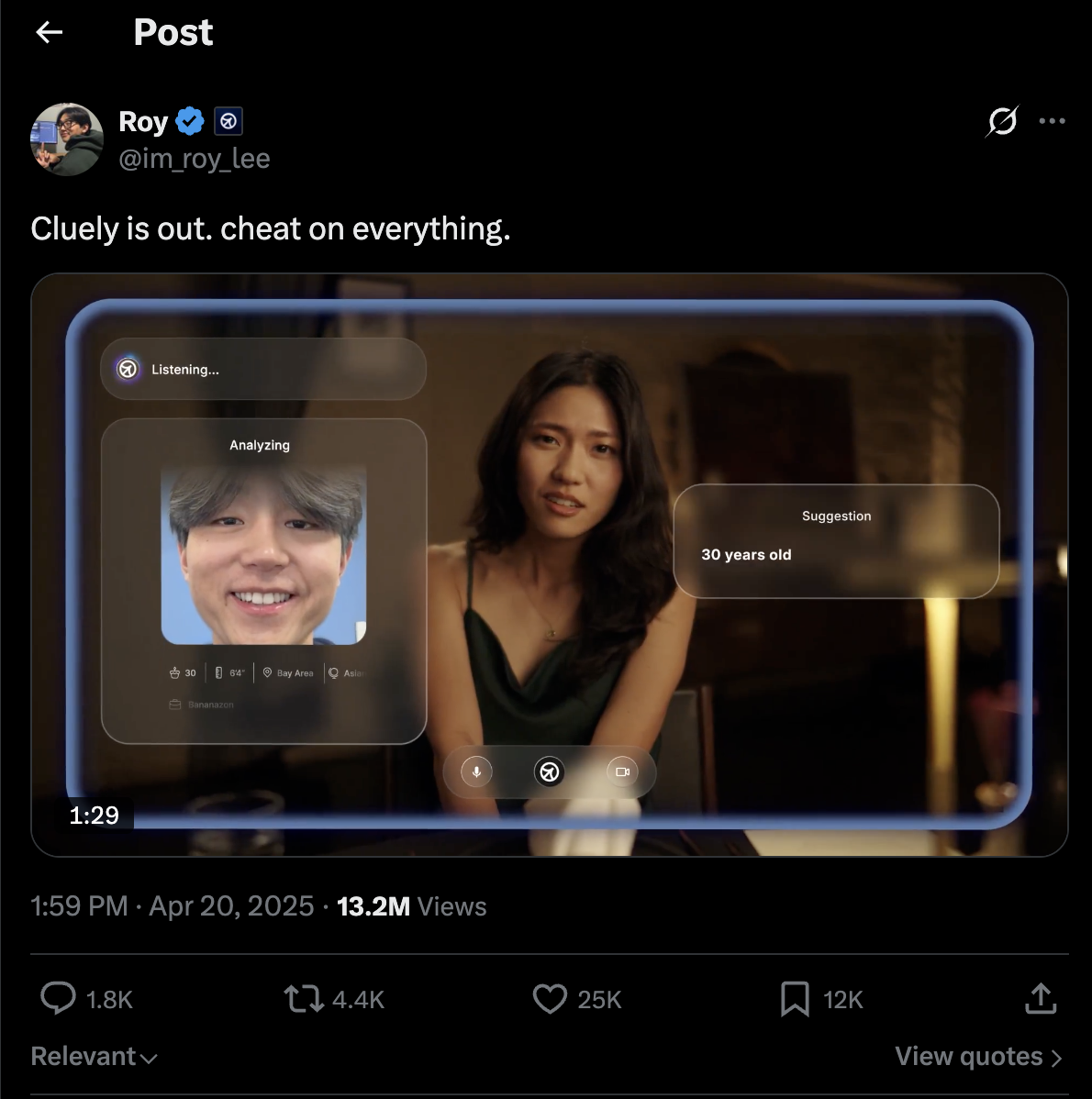
On 4/20, Cluely launches with the "blind date" video - Roy uses Cluely to lie about his age, job, and interests until his date walks out. 13M+ views on X within days.
One day after launch, announced inside the same viral thread: a $5.3M seed co-led by Abstract Ventures and Susa Ventures.
The launch goes mega-viral - 70,000 signups in the first week, with what was almost certainly very high churn behind it.
Andreessen Horowitz (Bryan Kim) leads a $15M Series A at a ~$120M post-money valuation. Total raised: ~$20.3M - notably less than a comparable $5M-ARR AI tool would normally raise. They traded equity for attention, not the other way around.
Roy claims Cluely hit $7M ARR and doubled in a week. It's the high-water mark of the revenue-porn era - and the number he later has to walk back.
A data breach exposes ~83K users. Around the same time, Cluely quietly repositions from "cheat on everything" to "AI meeting assistant" - now competing with Otter, Fireflies, and Gong.
Roy publicly admits on X that the $7M ARR figure was inflated by ~35%; the real number was ~$5.2M. He calls it "the only blatantly dishonest thing I've said publicly" - and says the company is profitable.
Cluely revenue: what's actually true
Cluely's revenue is the most-searched and most-contested part of the story. The honest version: Cluely went 0 → ~$5M ARR in about three months - genuinely one of the fastest consumer-AI ramps on record. The reason they didn't just lead with that real number is the whole point: the growth engine depended on momentum mattering more than truth. Roy posted Stripe screenshots in mid-2025, the Cluely and Interview Coder figures didn't cleanly corroborate, and he eventually retracted the "$7M, doubled in a week" claim - admitting the real figure was ~$5.2M ARR (~$6.3M run rate), roughly 35% lower. It's the opposite of a company like Instantly, which grew quietly and published verified revenue dashboards.
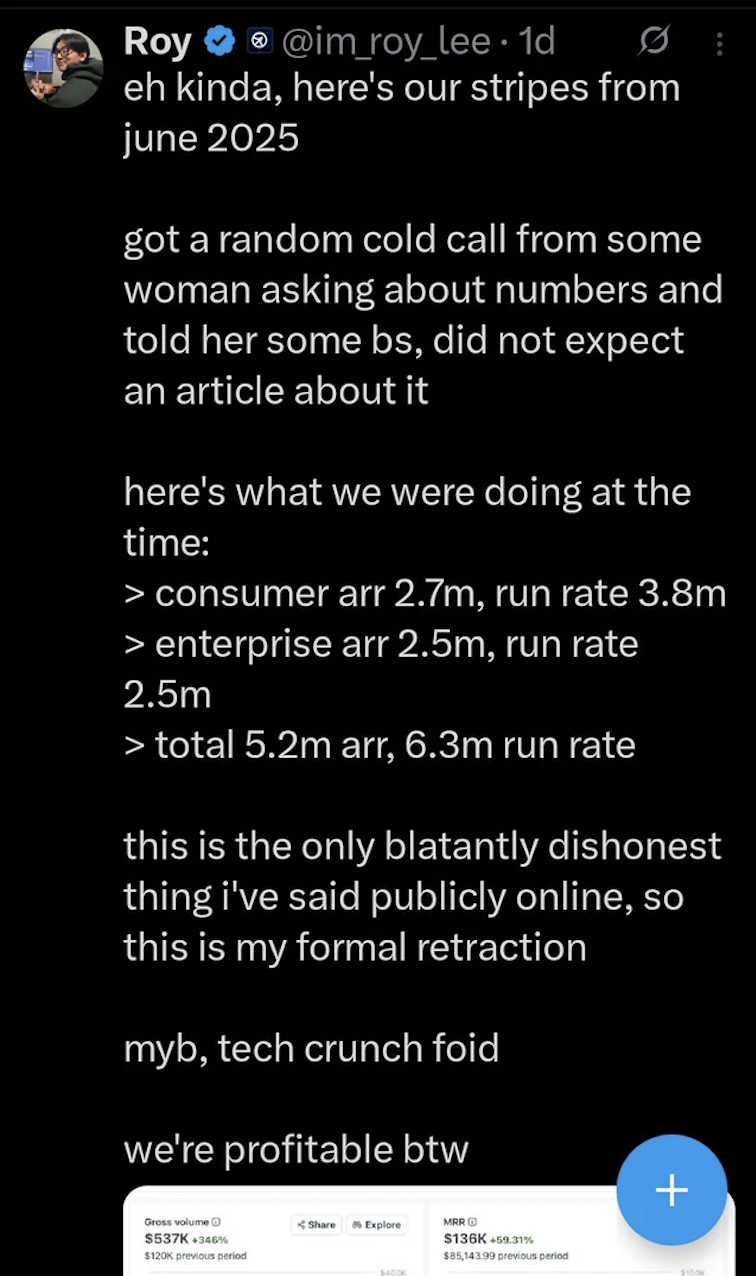
Key insight:
70K signups in a week is an attention number, not a revenue number. The gap between the viral signups and the (much smaller, contested) ARR is the whole lesson: virality fills the top of the funnel, but if the product and positioning don't retain, it's a leaky bucket. Cluely's later pivot is them patching the bucket.
The positioning pivot: "cheat on everything" → meeting notes
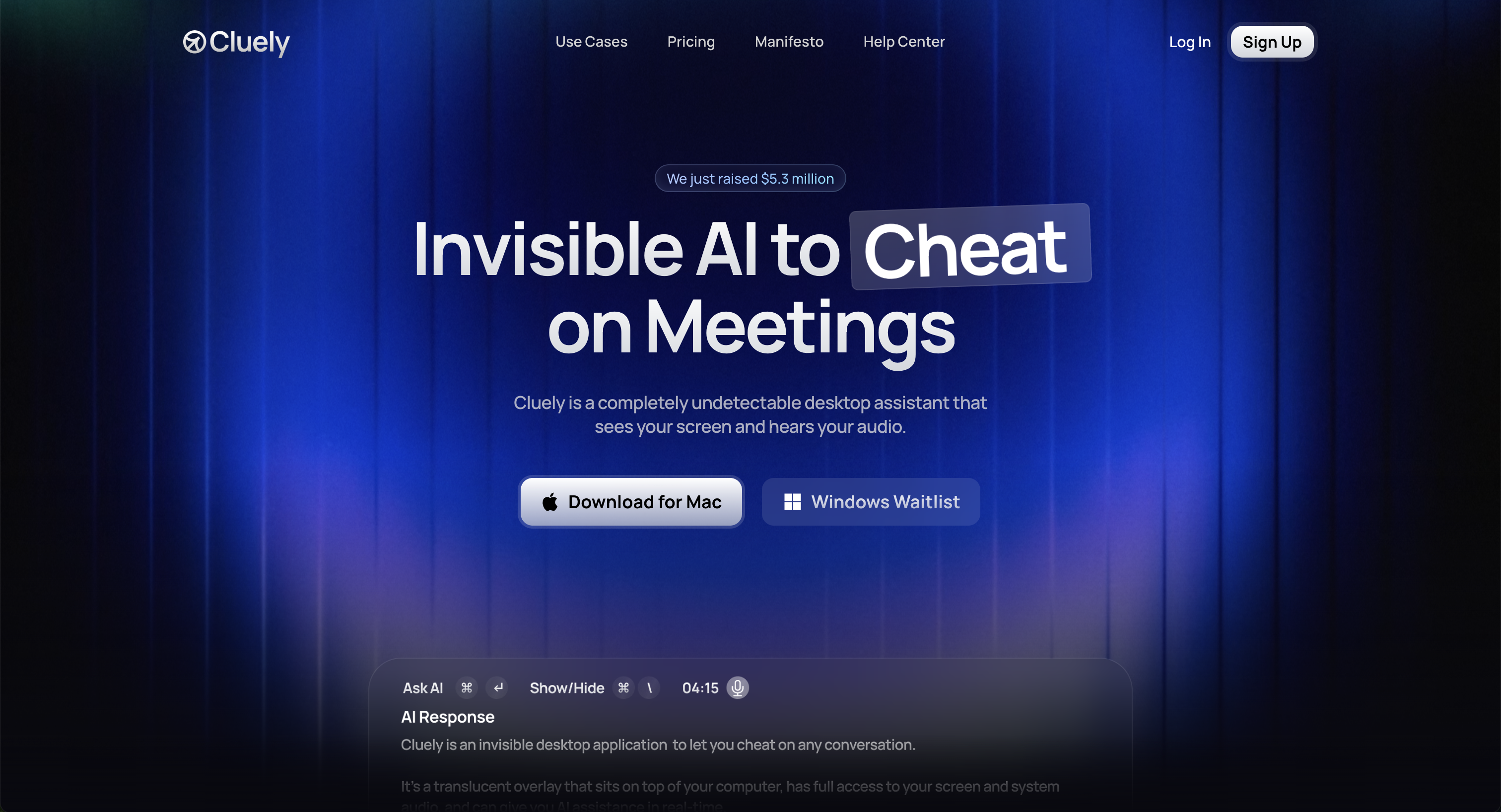
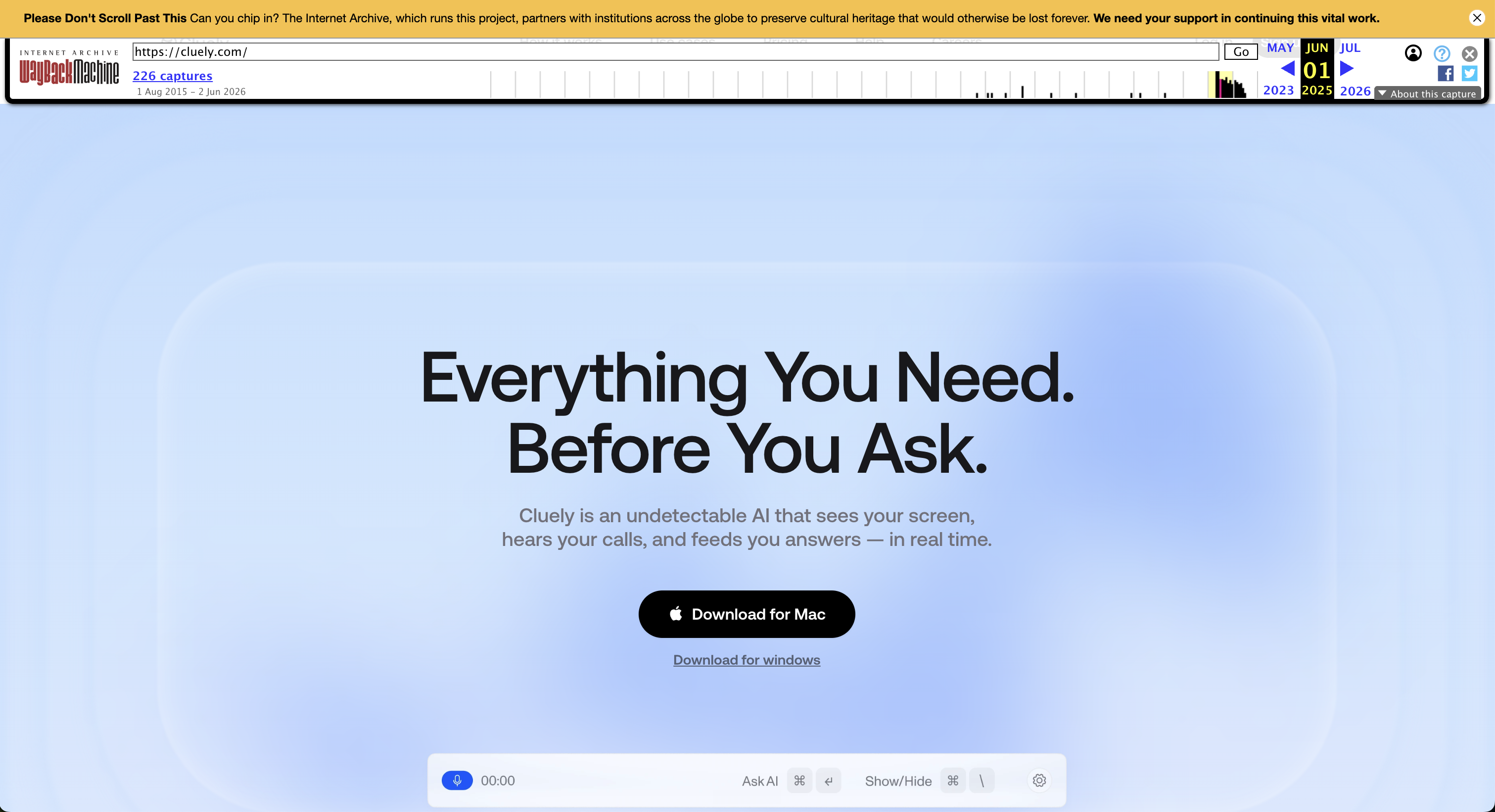
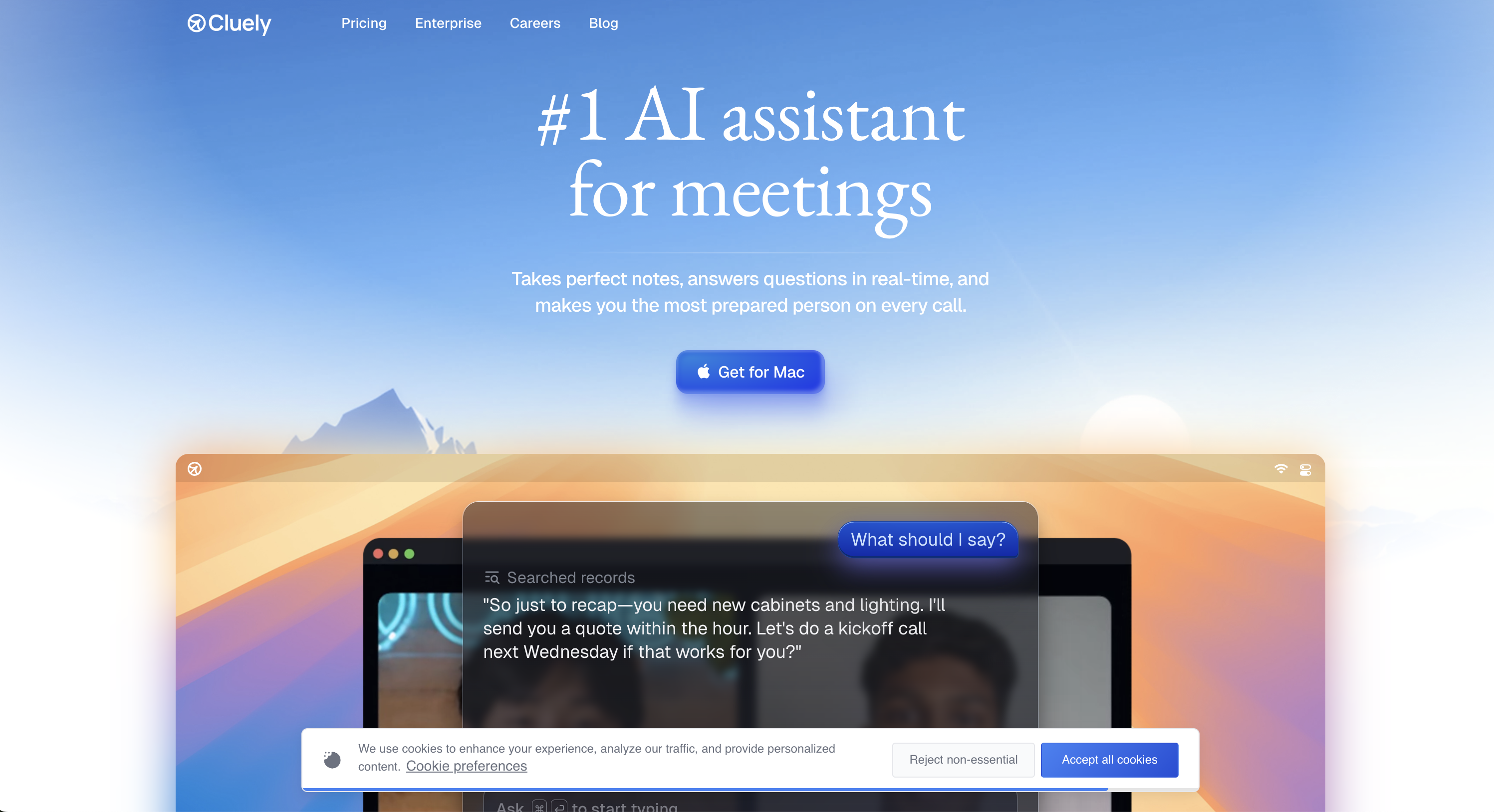
Internet Archive snapshots show Cluely walking back its own edginess over 2025. They started as "undetectable AI for technical interviews," escalated to cheat on everything, then de-escalated all the way to an AI meeting notetaker. That's not a retreat - it's a smart commercial move.
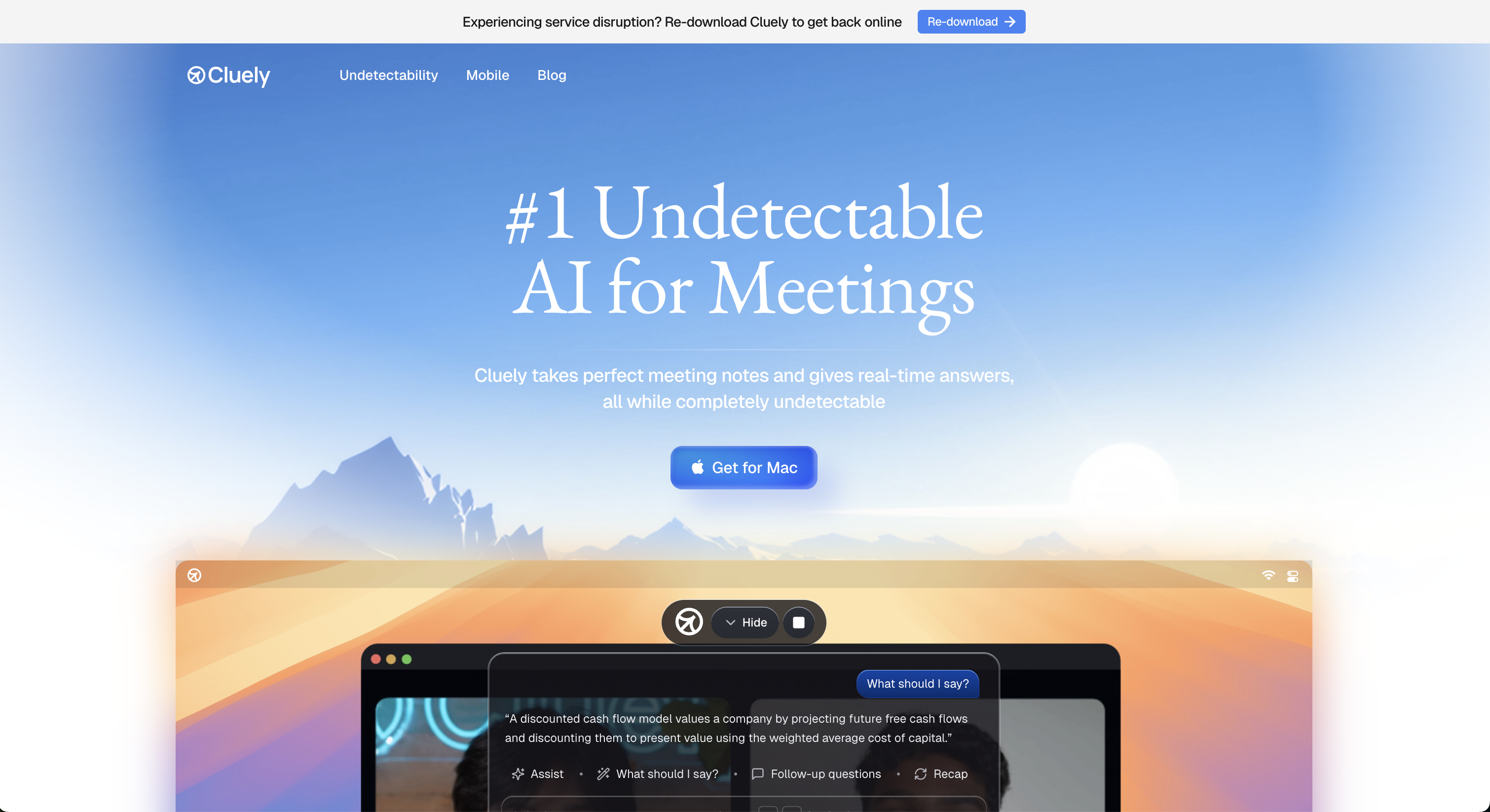
"Undetectable AI for technical interviews"
The Interview Coder era. Narrow, illicit, and crystal-clear about what it did. This is the seed of the entire brand.
"Cheat on everything"
The manifesto: "It sees your screen. Hears your audio. Feeds you answers in real time. While others guess - you're already right." Maximum controversy - interviews, exams, sales calls, dates.
"Invisible AI to cheat on everything"
Under scrutiny, they quietly remove "undetectable AI assistance for every interview." Still aggressive, deliberately vaguer.
"Live AI Meeting Assistant"
The pivot. Explicit cheating language disappears. Cluely starts describing itself as a meeting tool - perfect notes, real-time answers.
"Real-time meeting notes & AI insights"
Almost indistinguishable from Otter or Fireflies. Crucially, this slots Cluely into an existing B2B budget line buyers already pay for.
Key insight:
"Cheat on everything" is a great hook and a terrible budget line. By repositioning as an AI meeting assistant, Cluely landed in a category buyers already pay for (Gong, Granola, Otter) - so a champion can expense it without explaining a brand-new concept to finance. Same product, far easier sale and lower churn. With a16z in their corner, they had the data to know exactly which category was heating up.
The 8 growth channels
We mapped eight channels behind Cluely's growth. One sits above all the others - content - and everything else amplifies it. A few channels they run hard; a few they deliberately ignore. And one - the one most B2B companies rely on - Roy says he can't crack.
1. Content (the #1 channel - everything else amplifies it)
Content is the whole engine. Every other channel exists to distribute it. It runs on one rule - Roy's virality test, in his own words:
“If every single person in the world saw this, 50% would have a very strong negative reaction. If the number's not 50, then you're probably not being ballsy enough.”
He's equally blunt about the mechanism: "I think I'm particularly good at framing myself in a way that's controversial." The fight is the distribution, and it's an explicit Overton-window play: "Initially it will feel like cheating, but if we win, nobody will think this is cheating." Roy then splits content into two tracks.
Track 1 - hive-mind content
Highly produced films that sell a worldview, not a feature. Roy has cited Avi Schiffman's friend.com launch video as the bar. The blind-date launch film - Roy feeding himself lies through Cluely until his date walks out - is the entire brand identity in 90 seconds, and it hit 13M+ views on X.
The other half of the hive-mind track is the "Cluely Universe." Roy's sharpest insight: don't treat content as one-off launches - treat it like a TV show with a recurring cast. He borrowed the idea from Duolingo's mascot universe, building recurring, reality-TV-style characters around the marketing team (CMO Daniel Mints among them) so viewers form a parasocial bond a single viral video never could. The Daniel-Mints-getting-a-lap-dance clip was meant as an episode in that series. Crucially, this is produced in-house - the hive-mind machine, not the creator army.
The results are absurd: @im_roy_lee went from ~0 to hundreds of thousands of followers in weeks, TikTok racked up 38M+ combined views under #cluely in the first six weeks, and "Cluely" went from zero to a top trending tech term.
Track 2 - conversion content
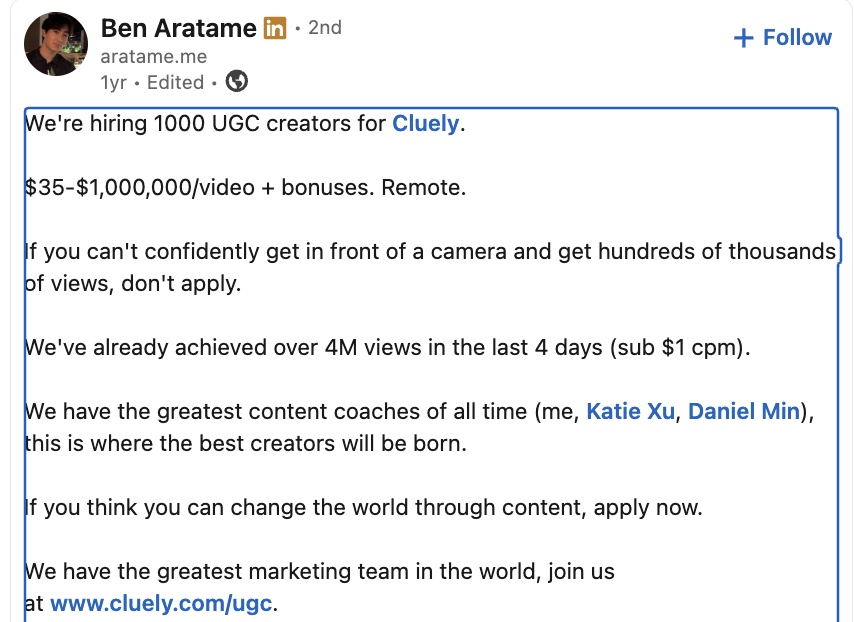
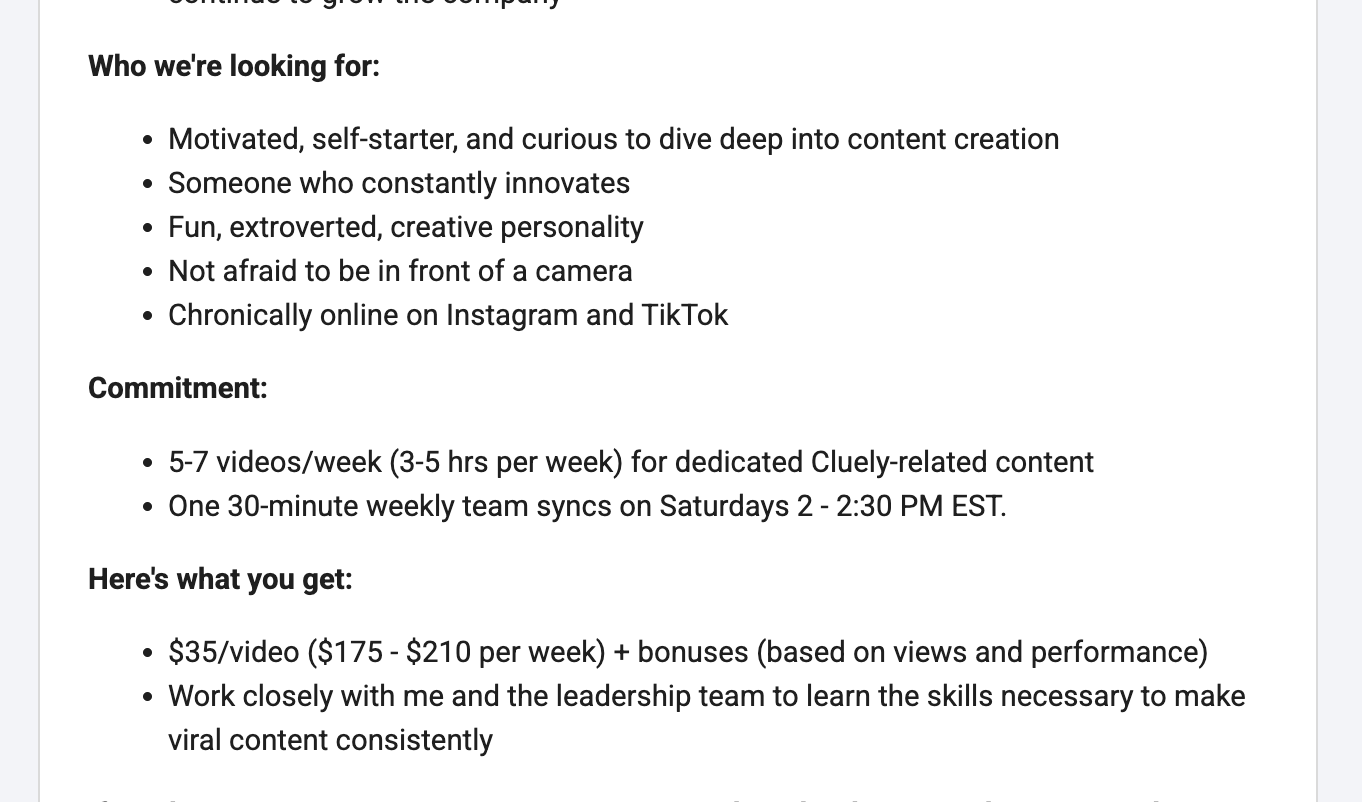
The scrappier "here's what it does, sign up" material - the stuff that actually drives installs. And that's almost entirely UGC, produced by an external creator army rather than the in-house team. It's big enough to be its own channel.
2. UGC (the conversion engine everyone copies)
The conversion track runs on an army of external creators - not the in-house "universe" cast. The factory:
- ~50 "growth interns," each required to have 100K+ followers, posting ~4 TikToks/day - ~200 videos/day baseline.
- ~700 clippers slicing Roy's long-form content (podcasts, streams, threads) into shorts and reposting everywhere - the model the neon/streamer world pioneered for B2C.
- ~60 paid UGC creators producing branded videos.
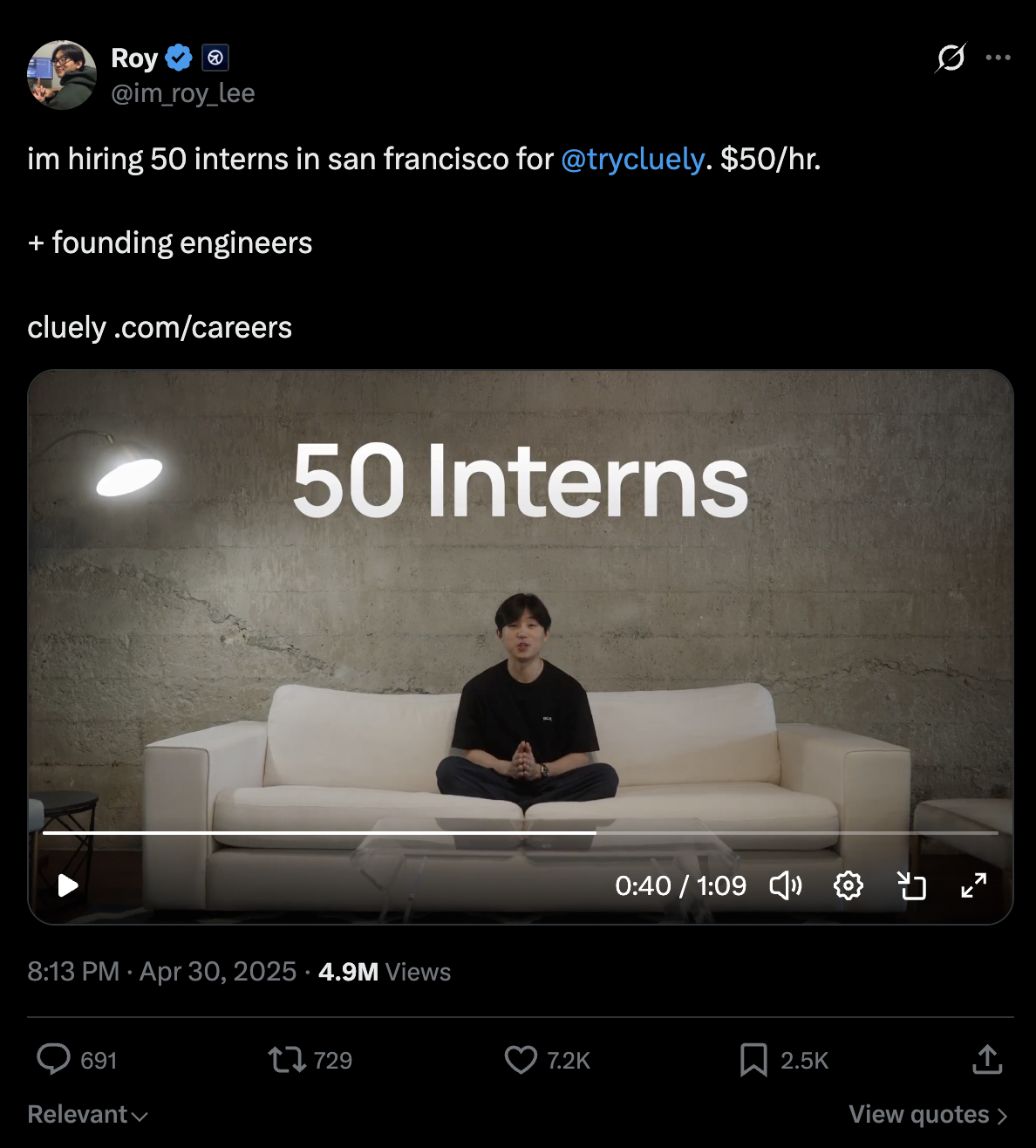
The operating formula, per Roy: "Make 100 different videos, one will go viral. Repost that across 100 accounts, 20–30 of them will also go viral." The result: 20M+ views in a two-week window and a total ecosystem past 1B+ views in three months. Even the stunts feed it - the "50 interns in SF at $50/hr" video did 4.9M views and doubled as a recruiting funnel for the content machine.
3. Out-of-home (billboards as content)
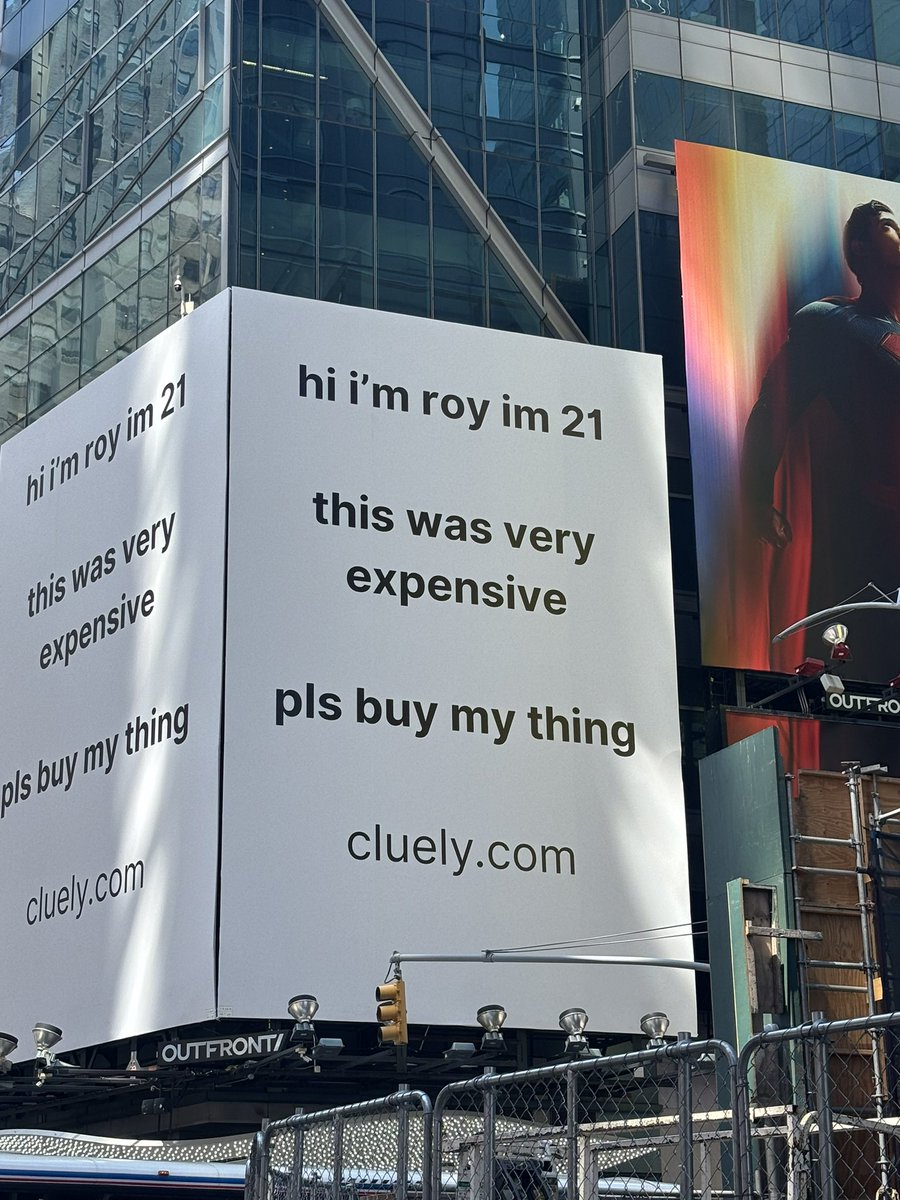
In August 2025 Cluely ran a Times Square billboard - white background, lowercase: "hi i'm roy im 21 / this was very expensive / pls buy my thing." Anti-advertising as advertising. Per their own claims it quadrupled site traffic the next day, alongside subway and wild-posting around NYC and SF. The billboard isn't the ad - the tweet of the billboard is.

4. The podcast circuit
Roy shows up everywhere: the a16z podcast (Bryan Kim), The Cognitive Revolution (Nathan Labenz), the Product Growth podcast (Aakash), A Product Market Fit Show (Pat Walls), and more. Notice the targeting: he goes after founder/builder audiences, not consumers. The goal of each appearance is to get more SaaS founders copying the rage-bait playbook - which amplifies Cluely organically - plus the authority and backlinks each credible domain provides.
5. Paid ads (minimal, by design)
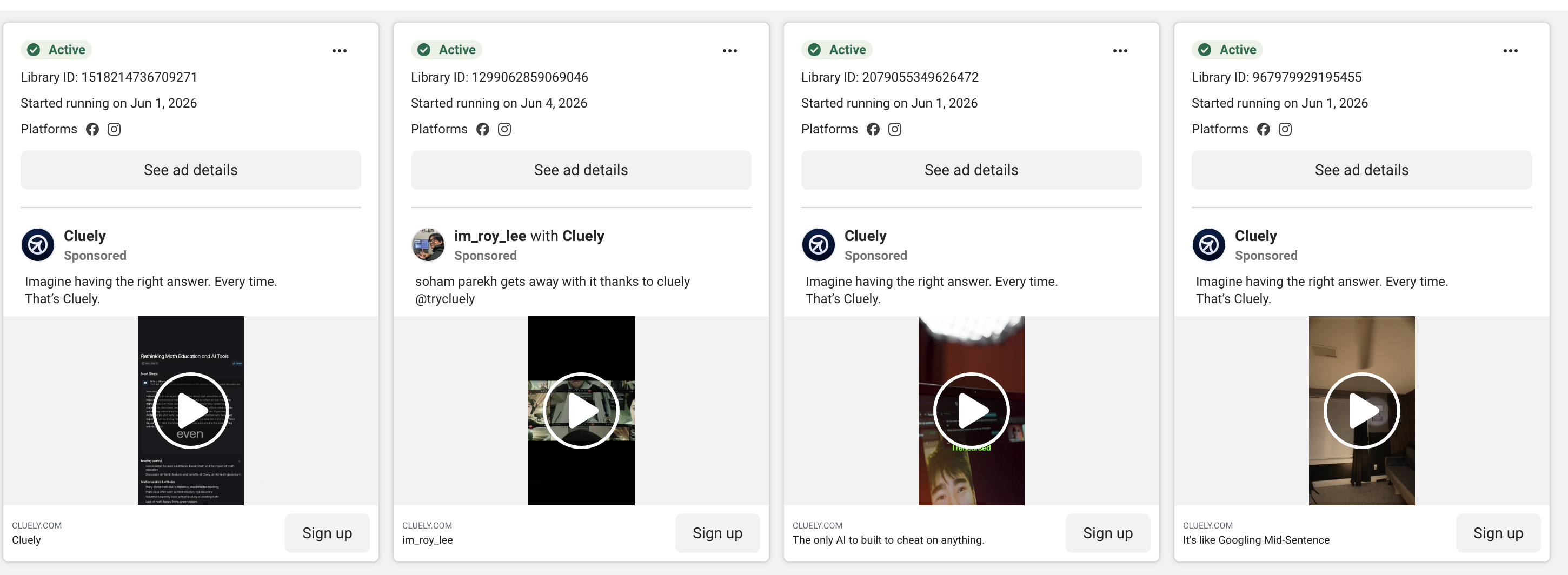
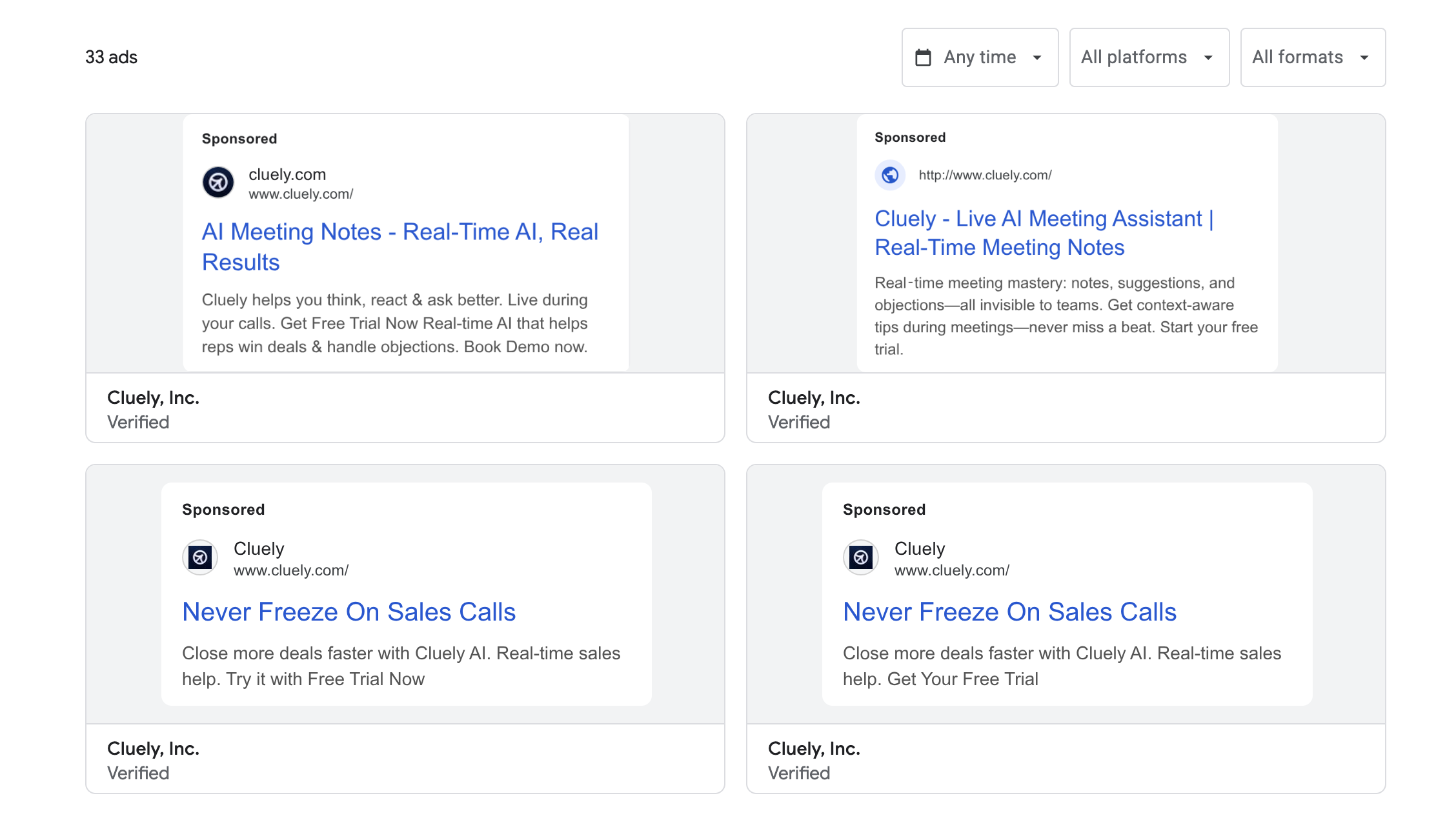
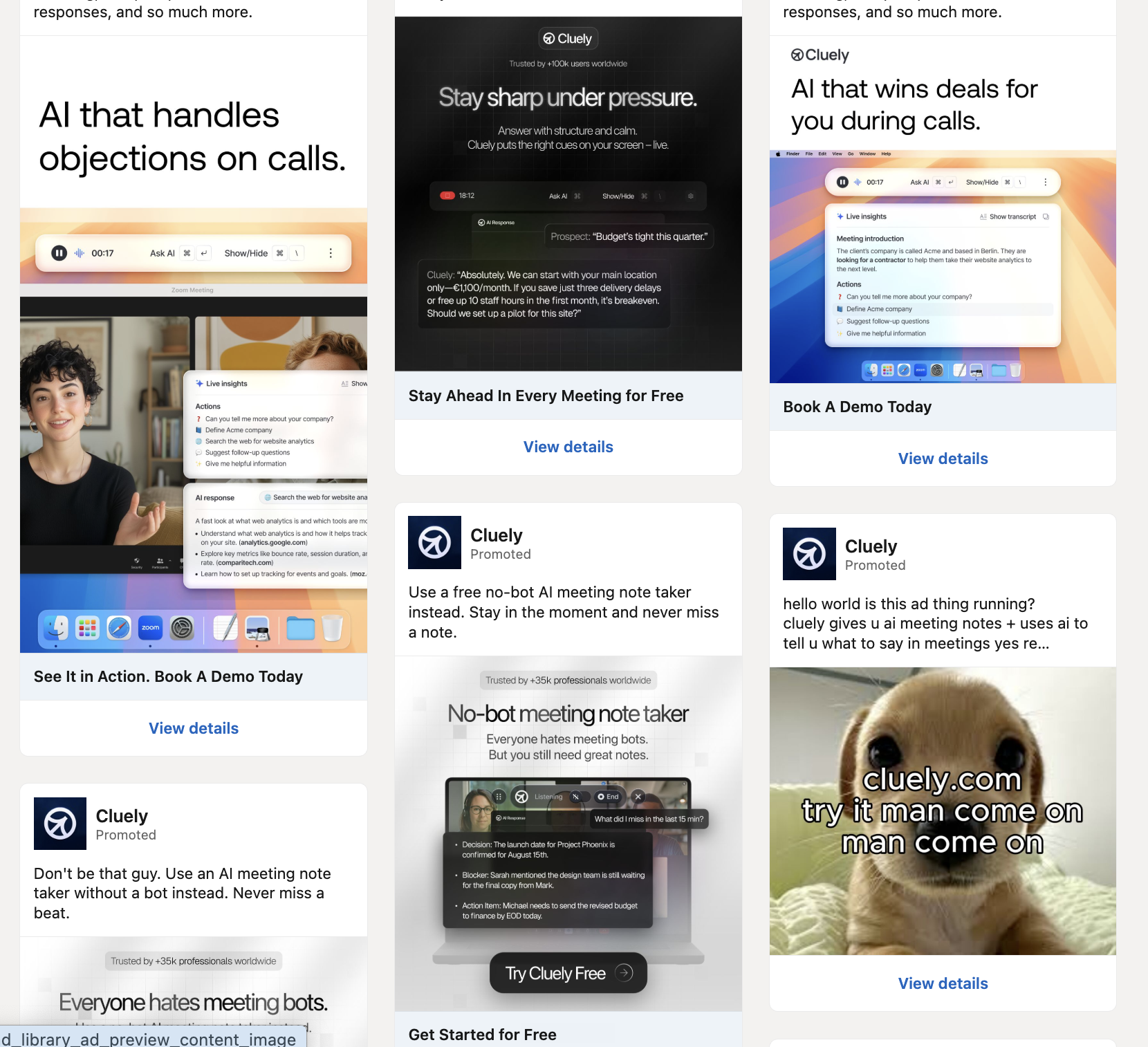
For a company this loud, the formal ad account is small and inconsistent - and that's deliberate. The thesis is explicit: organic beats paid because the whole brand depends on feeling authentic and anti-corporate. A polished Meta ad would break the spell. What they do run: ~24 active ads on Meta (all UGC-style video), ~33 on Google (mostly search text), ~14 on LinkedIn (mostly images), plus TikTok Spark Ads boosted from the intern accounts (cheaper than brand ads, and they keep the organic look).
6. SEO (weak - by design)
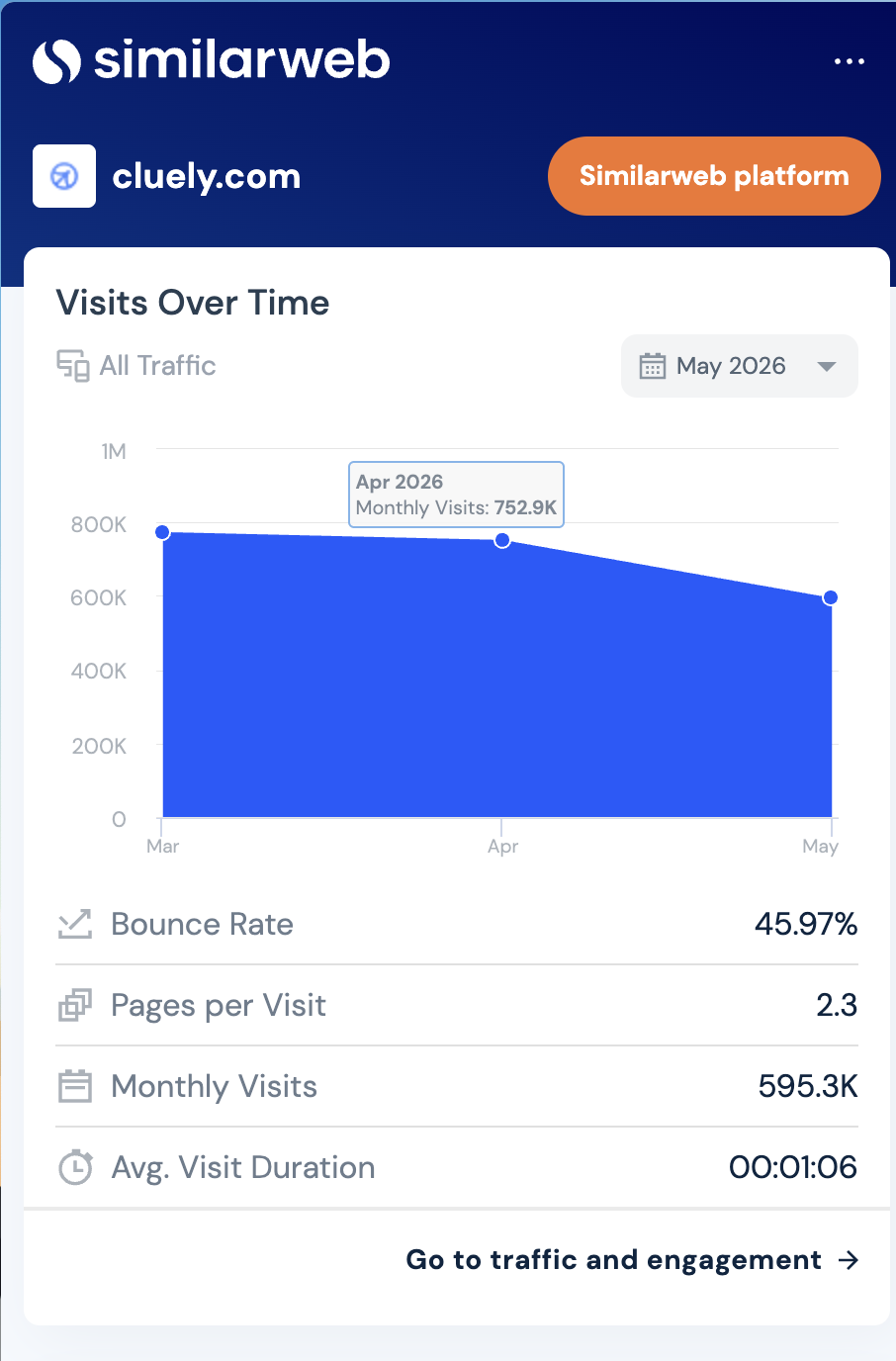
Despite ~600K–800K+ monthly visits, Cluely ranks for only about 55 keywords, almost all branded. There's no programmatic SEO, glossary, or resource hub. Worse, the long-tail "Cluely alternative" results are dominated by competitors (Glass, Pickle, Natively, Final Round AI) - Cluely is losing on its own brand searches. That's the cost of the strategy: when your brand is the controversy, you don't own the post-controversy SEO surface.

7. Cold outreach (deliberately none)
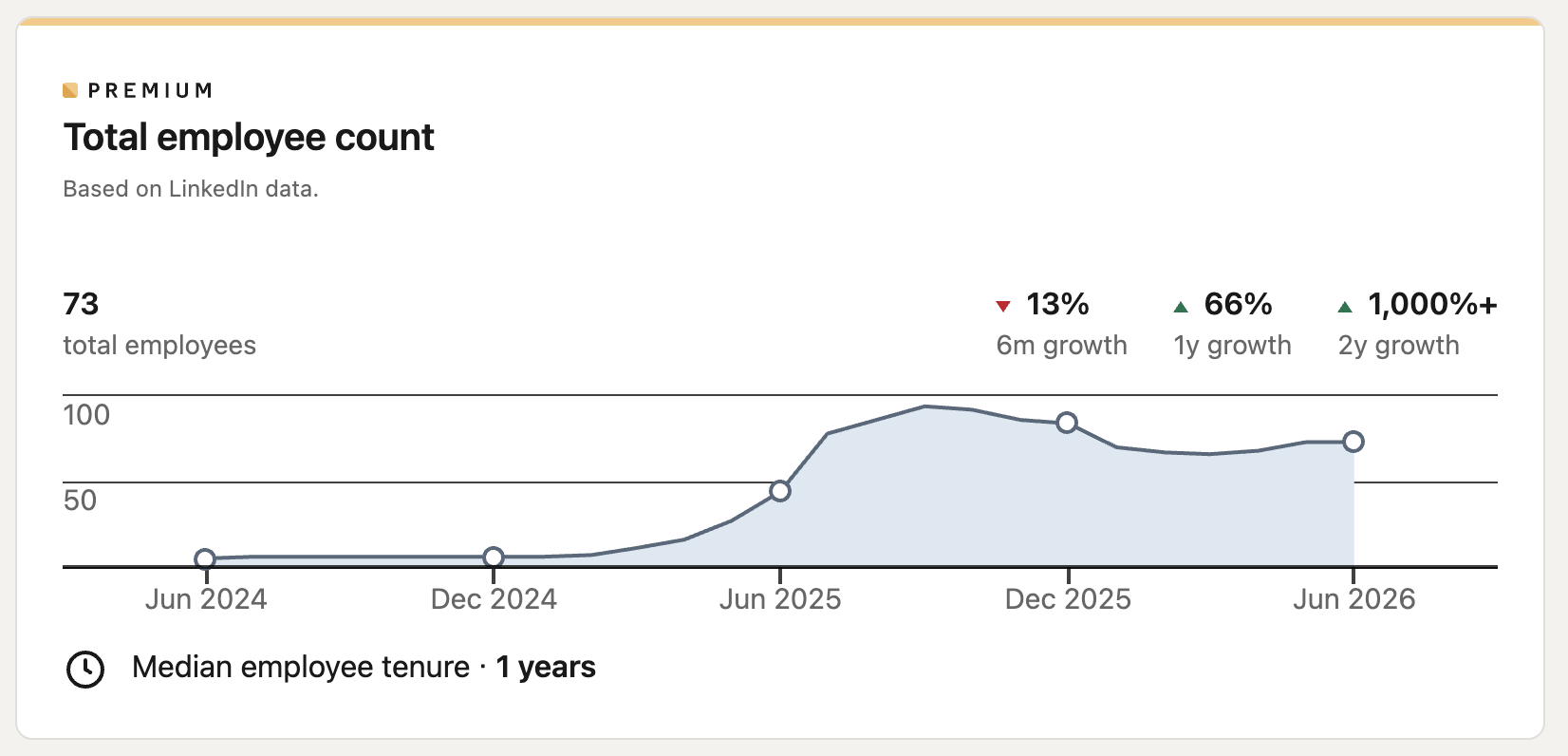
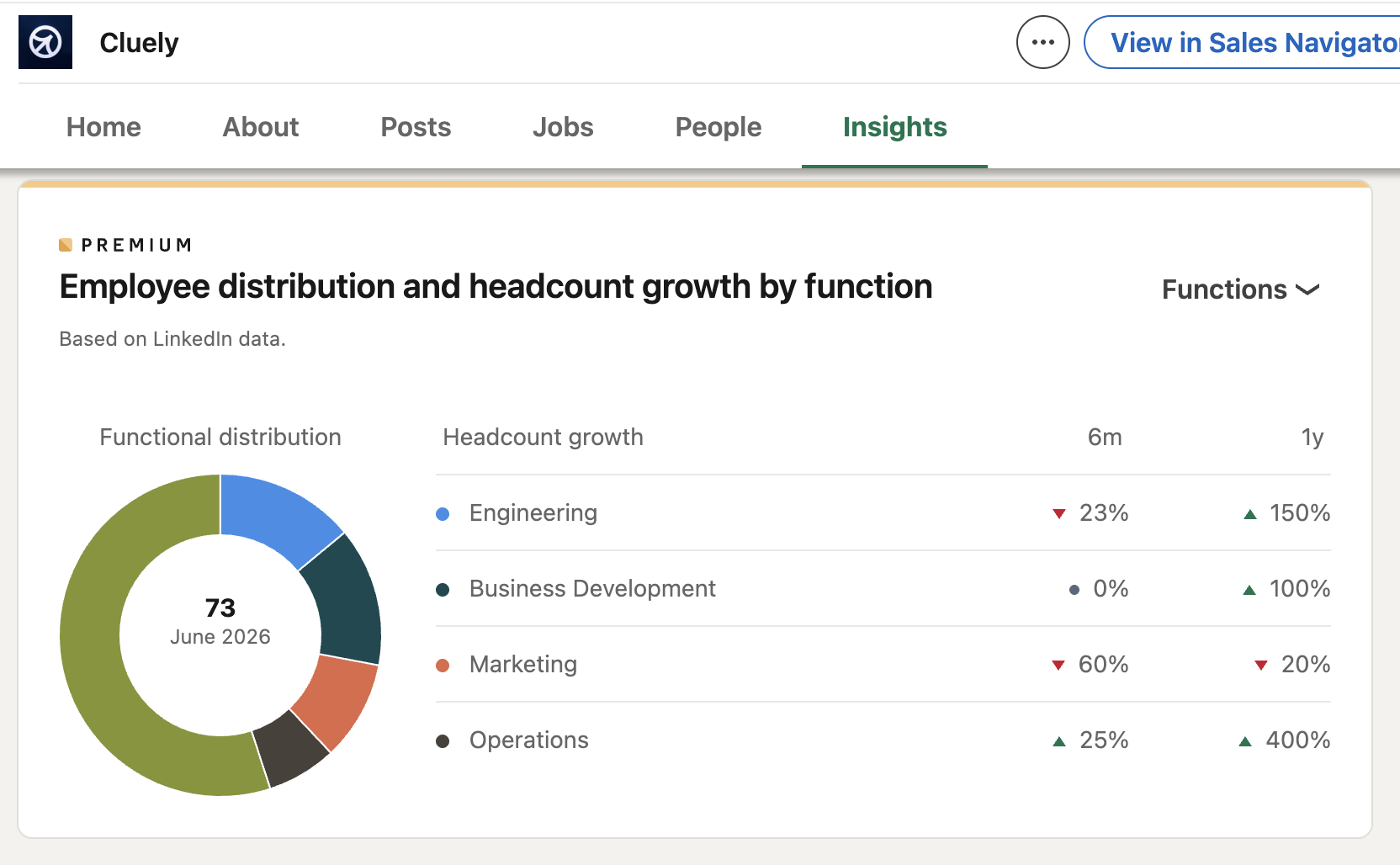
There's no real outbound motion and no SDR team. Growth is PLG via virality. LinkedIn shows ~70+ "employees," but a lot appear fake or unaffiliated - the real team looks closer to 10–15 people. Even the enterprise deals they've disclosed (including one ~$2.5M contract) look like inbound generated by all the noise.
8. Community (deliberately thin)
There's almost no owned community - no Discord at scale, no Slack, no template gallery. The "community" is X, and even then it's a Roy community, not a Cluely community. It's consistent with their bet on people over property, but it's the most obvious gap: a billion views and very little they actually own.
Pricing (the $149.99 tier is a marketing asset)
The free tier is basically a demo (5 responses/day, capped outputs). Pro is $19.99/month. But the $149.99 "Pro + Undetectability" tier is the one that gets screenshotted endlessly - a pricing-page line item that doubles as a marketing campaign. Nobody writes about Otter's pricing page. That one row is the Cluely thesis, sitting in a Stripe checkout.
The second act: the controversies that forced the pivot
The rage-bait engine had a bill attached. Three things, in particular, made "become a normal SaaS company" the only move left:
The data breach (mid-2025)
~83K users exposed - interview transcripts, screen captures, PII. Reported root cause: an admin password file committed to a public GitHub repo, plus a client-side paywall check and weak GraphQL protection. Cluely's response: DMCA takedown notices to the security researcher who disclosed it.
Enterprise blacklisting
Banned at Amazon, Anthropic, and dozens of Fortune 500 firms. SOC 2 Type II is table stakes for AI meeting tools at the enterprise tier - and Cluely doesn't currently clear that bar.
The Glass / Pickle clone
Pickle (YC) launched Glass, a free, open-source Cluely clone, in mid-2025. The open-source pressure helped force Cluely's pivot away from 'undetectability' as a selling point.
The ARR retraction (Mar 5, 2026)
Roy publicly retracts the $7M ARR claim, admitting the real number was ~$5.2M. He frames it as a 'fractionally wrong' mistake; TechCrunch frames it as the inevitable consequence of building a brand on hype.
Key takeaways for B2B teams
Build the audience before the product
Roy posted for ~3 years before Cluely existed. The launch worked because the distribution was already there.
Controversy is a distribution strategy - if you can back it up
The 50% rule reliably manufactures reach. But attention only compounds if the product and positioning retain. Otherwise it's a very loud leaky bucket.
Run content like a TV show, not a launch calendar
The 'Cluely Universe' of recurring characters builds parasocial loyalty a one-off viral hit never will. Pair it with a clipper army and one founder becomes omnipresent.
Position into an existing budget line
'Cheat on everything' was a great hook and an unsellable category. 'AI meeting notes' slots into a budget buyers already have. Same product, easier sale.
You can buy attention with controversy - but not trust
The breach, the enterprise bans, and the ARR retraction are all the same bill: hype gets you in the door; trust is what closes enterprise and compounds. They're not the same currency.
The verdict: the one channel Cluely can't crack
Here's the most useful part of the whole breakdown. Roy has openly said the single platform he hasn't cracked is LinkedIn. Everywhere else - X, TikTok, Instagram - the algorithm feeds on controversy: a spicy take, an intentional typo, a fight in the comments. On LinkedIn, that same playbook falls flat.
That's not a bug in Cluely's strategy - it's what makes LinkedIn different. LinkedIn rewards consistent, credible, value-first posting from real people, not manufactured outrage. You can't clip your way to trust there. Which is exactly why it's the highest-intent B2B channel - and the one most worth getting right.
If a company as good at attention as Cluely can't shortcut LinkedIn, the lesson for the rest of us is clear: win it the way it's meant to be won - your team showing up consistently, posting in their own voice, and turning the people who engage into warm pipeline.
That's exactly what Postbeam is built for - turning your team's LinkedIn posts into ICP-matched warm leads, without the manual coordination. (You can even run it from Claude or ChatGPT via our LinkedIn MCP.)
Related reading
How Instantly.ai Hit $40M ARR in 4 Years →
Cold email, AppSumo, and a 40% affiliate program - a very different GTM playbook.
How beehiiv Grows: GTM Breakdown →
Turning every employee into a LinkedIn influencer to hit $2M/mo.
How to Win Product Hunt in 2026 →
Arunabh (Leni) on hitting #3 on his first launch - the Kitty Points math founders miss.
How ElevenLabs Grows: GTM Breakdown →
From a hijacked beta to $600M ARR - every growth channel, broken down.
How GameStrat Grows: GTM Breakdown →
Two students, 1,000+ football teams, fully bootstrapped.
How Wispr Flow Grows: GTM Breakdown →
150x revenue in a year - endorsements, UGC, and zero outbound.
Employee Advocacy for B2B Teams →
Turn your team's LinkedIn presence into your #1 growth channel.
Frequently asked questions
Who is Roy Lee and what is Cluely?+
What is Cluely's revenue?+
How much has Cluely raised?+
How did Cluely grow so fast?+
Was Cluely involved in a data breach?+
What is Cluely's valuation?+
Is Cluely legit, and does it actually work?+
What is Cluely's pricing?+
Sources
- →TechCrunch - ongoing Cluely coverage (funding, the $7M ARR claim, and Roy Lee's retraction)
- →Andreessen Horowitz (a16z) - Cluely investment
- →Wikipedia - Cluely
- →Roy Lee on X (@im_roy_lee) - launch thread, revenue posts, and retraction
- →Cluely - product, pricing, and manifesto
Revenue and valuation figures are based on the founder's own public statements (including a retraction) and press coverage; Cluely has not published audited numbers.

Cassy Aite
Co-Founder at Postbeam · GTM & LinkedIn social selling
Cassy breaks down how the fastest-growing B2B companies actually go to market. Postbeam turns LinkedIn engagement into warm leads and pipeline - the durable version of the attention game Cluely plays.
Win the channel Cluely can't
You don't need to go viral to win on LinkedIn - you need to show up consistently and turn engagement into pipeline. Postbeam helps your whole team do exactly that.
Start Your 7-Day Free Trial →