

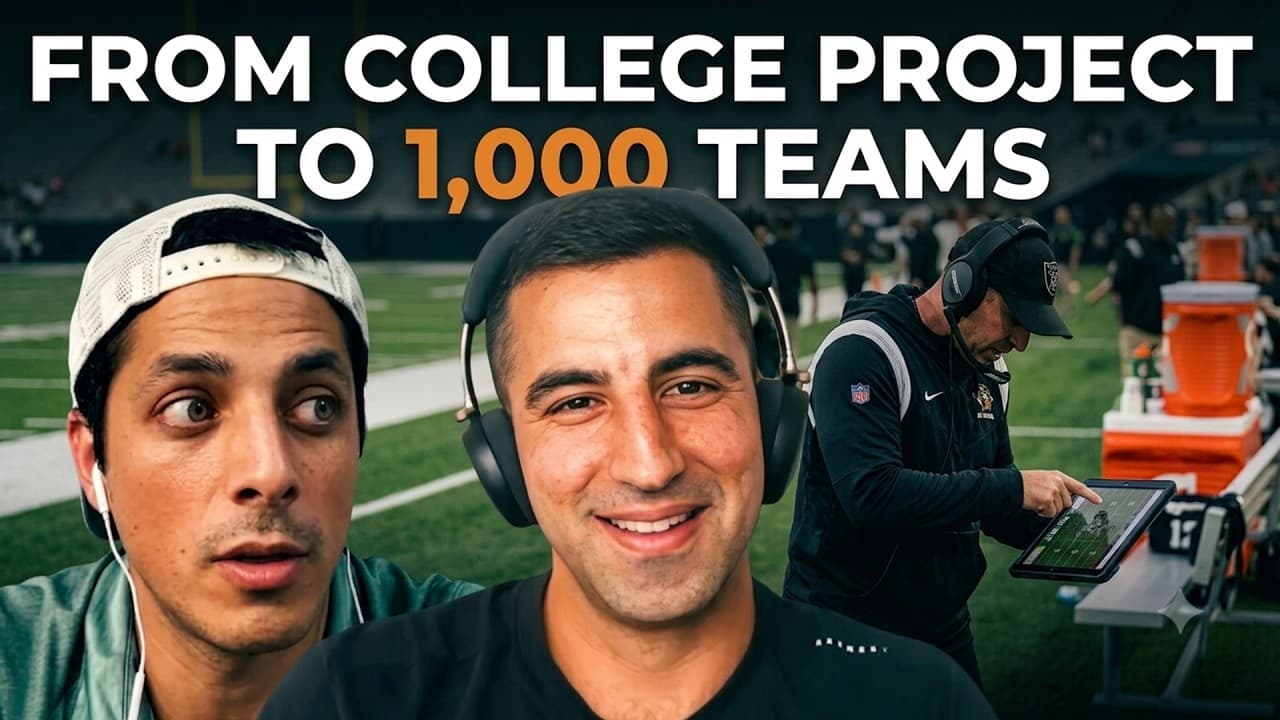
Some of the best businesses come from noticing a duct-tape workaround. In 2014, a university football coach in Ottawa was paying someone to sit in the press box and literally text photos of the field from one iPad to another on the sideline. Two software engineering students - one of them on the team - saw it, built the real version as their capstone project, and turned it into GameStrat: real-time sideline video analysis now used by over 1,000 high school and college football teams across the US.
Seven figures in revenue. Fully bootstrapped. In one of the hardest-to-reach markets in B2B: football coaches who barely touch email, let alone LinkedIn.
I've known co-founder Tanvir for about ten years, and this conversation is a masterclass in niche GTM: selling through trust, demoing where your market gathers, pitching your own rivals, and the mindset shift that makes founder-led sales work.
Watch the full interview:
TL;DR: GameStrat by the numbers
- What: real-time sideline video replay for football - the NFL tablet experience for high school and college teams.
- Origin: a University of Ottawa capstone project, inspired by a coach texting press-box photos to the sideline.
- First revenue: 2016, at roughly $500-600 per team.
- Scale today: 1,000+ teams across the US, seven figures in revenue.
- Funding: none - bootstrapped from day one, first employee in 2019.
- Hardest part: a market you can't reach by email, LinkedIn, or cold calls.
What GameStrat actually does
If you've watched an NFL sideline, you've seen coaches huddled around tablets reviewing the last drive. That's the product: GameStrat delivers real-time video replay to iPads on the sideline, so coaches can review plays seconds after they happen and adjust before the next snap.
The NFL got tablets in 2013. GameStrat brings the same capability to high school and college programs, using software plus off-the-shelf hardware - standard cameras and iPads - so a team doesn't need an NFL budget to run an NFL-style sideline.
The origin: watch what people duct-tape
The idea wasn't brainstormed - it was observed. When the NFL legalized sideline tablets, Tanvir's own head coach improvised a version: a person in the press box manually texting and emailing photos down to an iPad on the field.
When someone is paying a human to be a worse version of your future product, that's validation. Tanvir and Elijah built the real thing as their final-year capstone project - and their first user was the team Tanvir played for.
The trust ran deep enough that during one preseason game, the coach pulled Tanvir off the field - as he was about to run on for special teams - to fix the app mid-game. That's what founder-led customer support looks like when your first customer can bench you.
Early GTM: demos, showcases, and selling to rivals
The first paying customer came in 2016 - the same team, now paying a few hundred dollars, along with a handful of other universities. How do you go from one warm relationship to a market?
Two moves stand out. First, face-to-face demos: scheduling in-person demonstrations with coaching staffs, because this market doesn't buy from an email. Second, showcasing where the whole market gathers: they ran GameStrat for free at the East-West All-Star game, putting the product in front of every coach and player in the region at once. After that, cold conversations weren't cold anymore.
And the counterintuitive one: they pitched their own on-field rivals first.
“Those are the best, easiest people to go after, actually. We ended up working with quite a lot of them - and still do to this day.”
It makes sense the moment you hear it: your rivals have exactly your problems, they've seen you up close, and nobody wants the team across the field to have a sideline advantage they don't.
Selling to a market that ignores email
Most B2B playbooks assume your buyer is reachable: LinkedIn messages, cold email, a phone number that gets answered. Football coaches break every one of those assumptions. Many aren't on LinkedIn. Most don't respond to email. Some are local celebrities with a wall of staff around them - and the actual buying decision often involves athletic directors and administrators, not just the coach.
GameStrat's answer was to stop optimizing for reach and start optimizing for presence: be at the games, the showcases, the coaching clinics. It's slower, it doesn't scale like an outbound sequence - and in this market, it's the only thing that works. Knowing exactly who your target is means nothing until you find the channel they actually live in.
The GameStrat timeline
The NFL allows tablets on the sideline
The rule change that creates the category. Suddenly every football coach has seen real-time replay on an iPad - but only NFL teams can afford the setup.
The duct-tape version appears
Tanvir's head coach at the University of Ottawa puts someone in the press box who literally texts and emails photos from one iPad to another on the sideline. The problem is validated by watching people hack around it.
The capstone project
Tanvir and co-founder Elijah, both software engineering students (and Tanvir a uOttawa football player), build the real product as their final-year capstone project - then realize it might be a real opportunity.
First user: their own team
uOttawa football starts using GameStrat, unpaid. The coach trusts them because they're on the roster - to the point of pulling Tanvir off the field mid-game to fix the app.
First revenue
uOttawa becomes a paying customer, and a few other universities join the same year at roughly $500-600 per team. "People are willing to pay for something we have - even though it's just software."
Full-time (and first small salaries)
Tanvir goes properly full-time. The founders pay themselves a small amount for the first time - years after starting. Growth is a slow grind: a few more customers each year, shipping hardware out of his parents' basement.
Growth clicks + first employee
The year things start compounding. First hire. Momentum builds - and then COVID cancels football seasons and slows everything back down.
Consistent growth, narrowed focus
After exploring other sports, GameStrat deliberately narrows back to football only. Growth has been consistent ever since - fully bootstrapped the whole way.
1,000+ teams, 7 figures
Over 1,000 high school and college football teams across the US run GameStrat on their sidelines, generating seven figures in revenue with no outside funding.
The bootstrapped reality: basements and zero salaries
For the first few years, GameStrat shipped hardware out of Tanvir's parents' basement - a mini warehouse of equipment next to the laundry machine. The founders paid themselves nothing until 2017-18, and even then only a small amount. Growth was a few customers a year until it suddenly wasn't.
That trajectory mirrors ours at Hoppier almost exactly: our parents' living room full of boxes, zero salary for the first two years, stuck at $10K MRR while paying ourselves nothing, and finally taking modest salaries long after we probably should have. The pattern repeats across bootstrapped companies: you stay part-time until the business can replace your income, you underpay yourself past the point you need to, and the compounding only becomes visible in hindsight.
Tanvir's honest take on the tradeoff: there's a real correlation between going all-in and figuring things out faster. But going all-in is a privilege of low expenses - as students with no mortgage, they could afford years of patience that a founder with a family can't. If that's you, the answer isn't recklessness; it's keeping the day job until the business can carry its own weight.
The sales mindset that closes deals
My favorite part of the conversation was Tanvir on founder-led sales - specifically, on the fear of rejection that keeps new founders from picking up the phone:
“If you knew that every person you were going to call was going to be a close, how fast would you call every single one of those deals? If you truly believe in what you're selling, there's no reason why the person you're calling doesn't want your product.”
It reframes the entire activity. Fear of rejection makes you slow, hesitant, and apologetic. Assumed success makes you fast and enthusiastic - and enthusiasm is contagious in a demo. You can't fake it, which is why it only works when you genuinely believe the product delivers.
6 takeaways for B2B founders
Build where you already have trust
GameStrat's first user was Tanvir's own team, coached by someone who could pull him off the field to fix a bug. Your unfair advantage is the market that already knows you - start there, then expand outward.
Sell to your rivals
Asked if they pitched their on-field competitors, Tanvir didn't hesitate: "Those are the best, easiest people to go after." Your competitors' rivals have identical problems and a built-in reason to care - if one team has an edge, every team they play wants it too.
Demo where your whole market gathers
When your buyers ignore email, go where they physically are. GameStrat ran their product for free at the East-West All-Star game - every coach in the region saw it working live, and cold conversations became warm ones.
Some markets can't be emailed
Football coaches barely use LinkedIn, rarely answer email, and some are local celebrities with layers of decision-makers around them. GameStrat grew anyway - through face-to-face demos, showcases, and referrals. Pick the channel your market actually lives in, not the one that scales prettiest.
Niche down, then niche down again
They tried other sports and then deliberately went back to football only. A thousand teams in one sport beats a hundred teams across five - depth compounds, breadth dilutes.
Bootstrapped patience is a strategy
Zero salaries for years, shipping out of a parents' basement, staying part-time until revenue could carry them. There's a real correlation between going all-in and figuring things out faster - but only once the business can survive you doing it.
Follow Tanvir and GameStrat
Tanvir is on LinkedIn, GameStrat is on LinkedIn as well, and the company is most active on X - search for GameStrat on either platform. He's happy to connect and help where he can.
More GTM breakdowns
How ElevenLabs Grows →
From a hijacked beta to $600M ARR - every channel, broken down.
How Wispr Flow Grows →
150x revenue in a year with zero cold outreach.
How Cluely Grows →
$0 to ~$5M ARR in 3 months on pure controversy.
How to Launch on Product Hunt →
The 3-phase playbook behind a #3 Product of the Day.
Frequently Asked Questions
What is GameStrat?+
Who founded GameStrat?+
How big is GameStrat?+
Is GameStrat venture-funded?+
How did GameStrat get its first customers?+
Founder-led sales starts with showing up consistently
GameStrat grew on presence and trust. If your market does live on LinkedIn, Postbeam turns consistent posting into warm leads - AI drafts in your voice, scheduling, and ICP-matched engagers on every post.
Start Your 7-Day Free Trial →