

TL;DR
Product Hunt rankings aren't about upvote count. They're about Kitty Points — a weighted score where an upvote from a high-Karma user is worth 5x what a new account's upvote is worth. Most founders don't know this, which is why they get stuck on #8 with more total upvotes than the #3 launch.
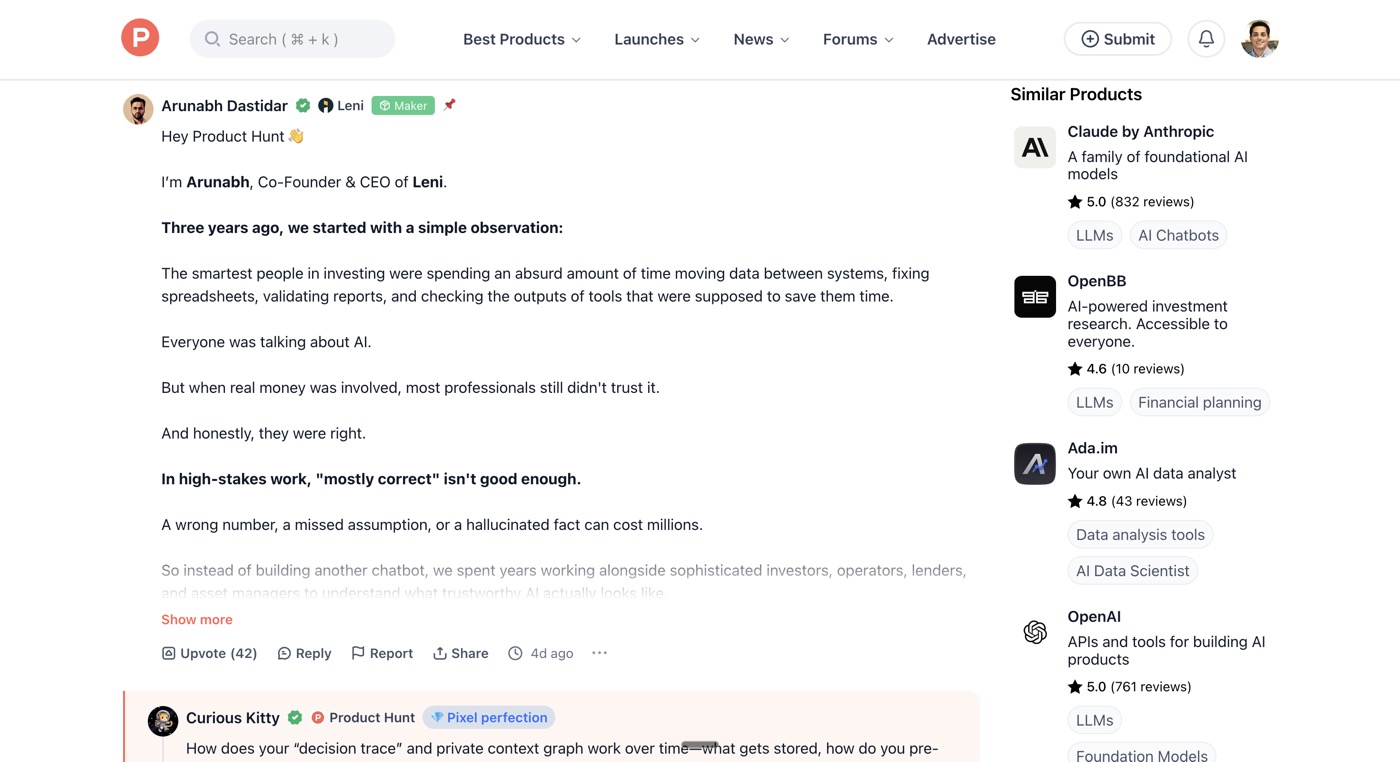
Arunabh Dastidar (Co-Founder & CEO of Leni) hit #3 Product of the Day on his very first Product Hunt launch — beating Google Labs and dozens of established teams. In this conversation, he breaks down what worked, what he'd change, and the specific tactical moves that compound into a top-3 finish.
Reading this before your launch saves you from the most common mistake: spending weeks chasing upvotes that don't actually count.
What that translated to for Leni: 300+ signups on launch day, 1M+ Twitter views, 30K+ LinkedIn reach, ongoing inclusion in Product Hunt's newsletter, and a “Featured on Product Hunt” badge that keeps producing leads weeks later.
What hitting top-3 actually produced
Before we get into the playbook, here's why this matters. Leni's #3 finish translated to real numbers on the day and compounding distribution afterward:
300+
Signups on launch day
1M+
Twitter views (launch campaign)
30K+
LinkedIn reach (launch campaign)
#3
Product of the Day · beat Google Labs
Plus a permanent “Featured on Product Hunt” badge for the homepage, inclusion in Product Hunt's weekly newsletter (sent to hundreds of thousands), and signups that kept rolling in for weeks afterward via the newsletter feature.
That's what's achievable. Now here's how Arunabh did it.
The guest

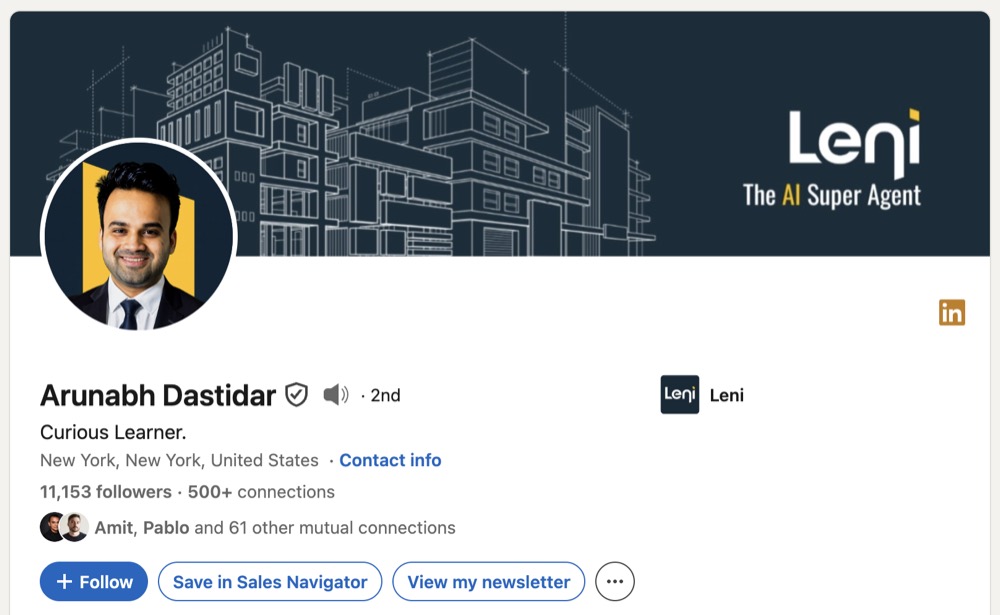
Arunabh Dastidar
Co-Founder & CEO, Leni
Arunabh has been building software since he was 12 (his first sale was on a floppy disk in exchange for internet hours). He sold his first company at 26 — a hyperlocal delivery algorithms business — to private equity. Today he runs Leni, the most accurate AI for investment back office work, born out of research at MIT and University of Toronto. Their latest launch hit 1M+ views on Twitter, reached 30,000+ people on LinkedIn, and landed at #3 Product of the Day on Product Hunt.
Follow Arunabh: LinkedIn · X (@arunabh_D)
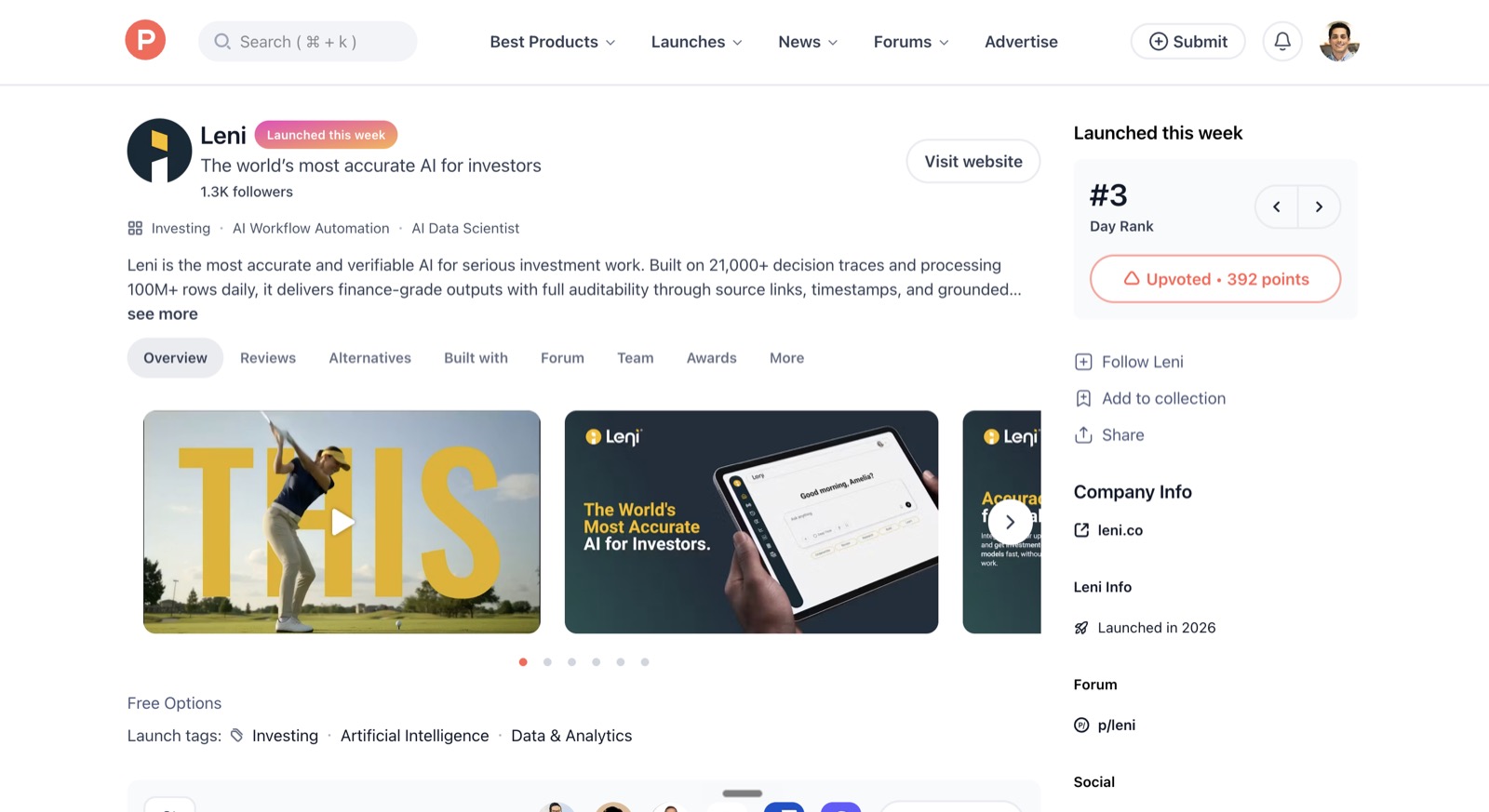
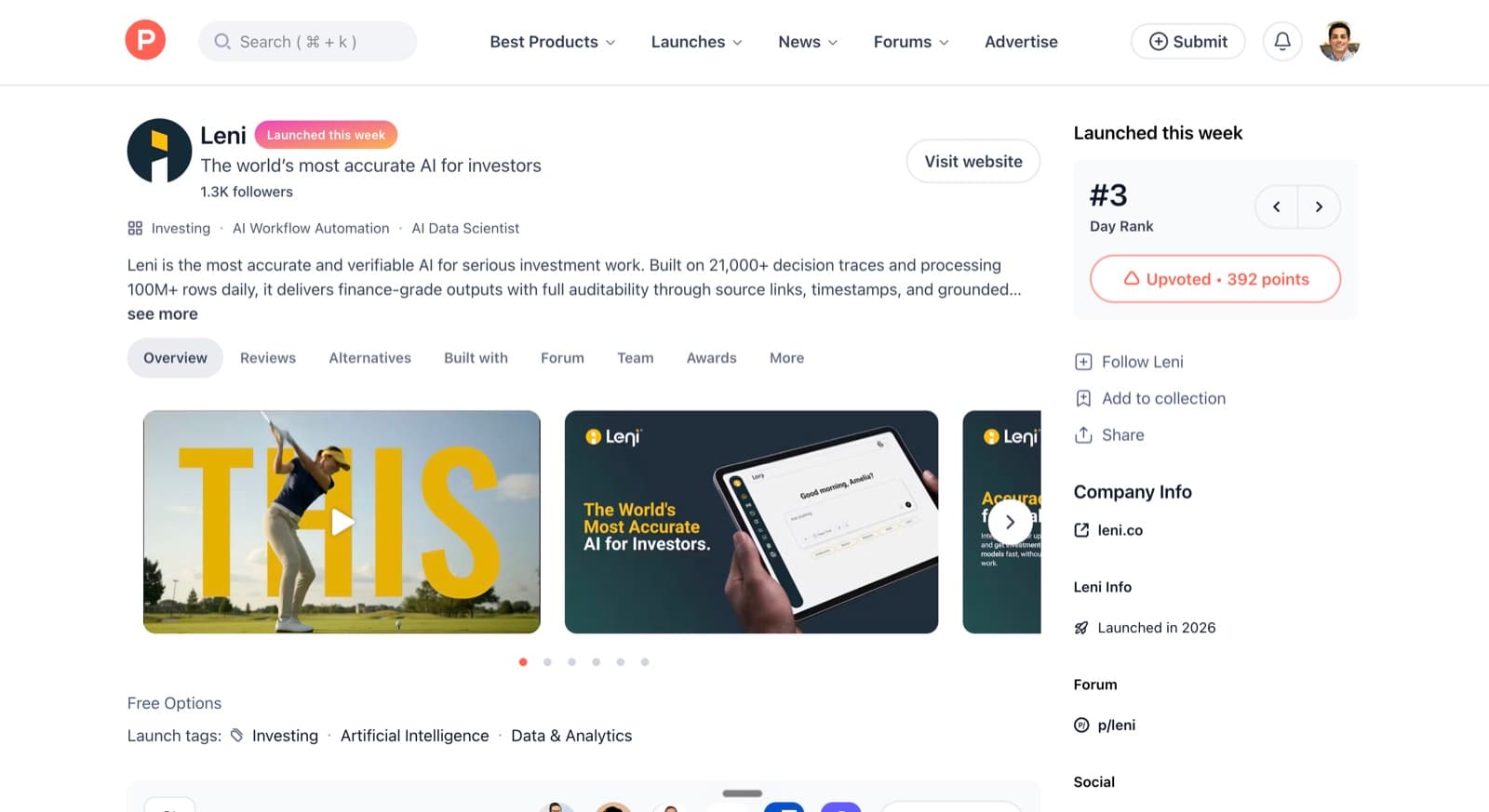
The result: #3 Product of the Day, ahead of Google
Leni launched on June 5, 2026 and held the #1 slot until roughly 5pm Eastern, when launches with West-Coast-heavy audiences started waking up. They finished at #3 — behind SellerClaw (an established e-commerce tool on their third launch) and Minimi — but ahead of Veltrix AI and a Google Labs product the same day.
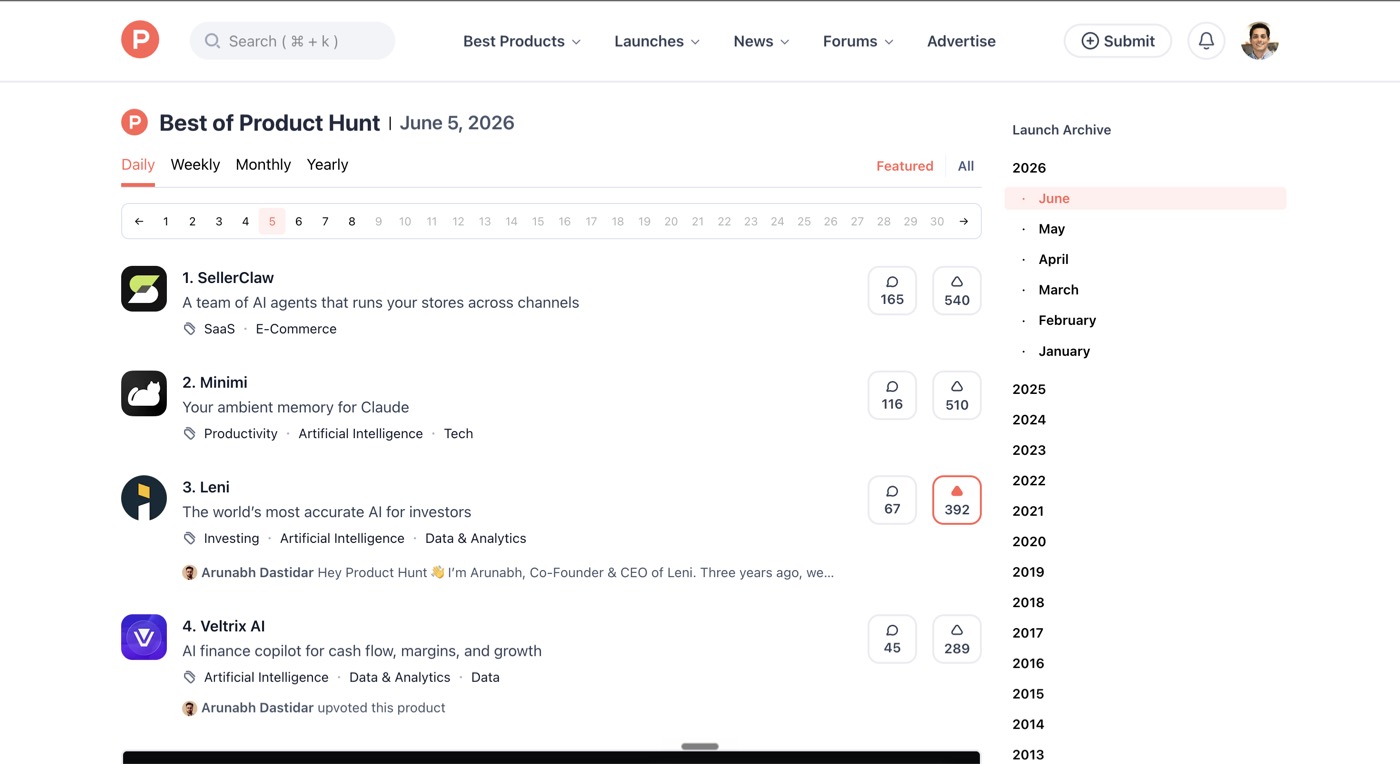
Crucially: Leni didn't have the most upvotes on the day. Some launches further down the page had more raw upvotes but fewer Kitty Points. That distinction is the entire game on Product Hunt, and it's where most founders go wrong.
The Kitty Points system (the part nobody explains)
Here's the single most important thing Arunabh learned from his launch:
“Not every upvote is a point. A lot of people don't realize it. What Product Hunt shows on the homepage is a point, not an upvote. And it's not like every upvote counts as equal to one point. Upvotes are basically counted in 0.2 multiples — usually 0.2, 0.4, 0.8, 1, or more.”
Translation: a new Product Hunt account upvoting your launch contributes roughly 0.2 points. An upvote from a top-Karma user like Ryan Hoover (founder of Product Hunt, all-time top-3 in Karma) is worth a full point or more. That's a 5x difference per click.
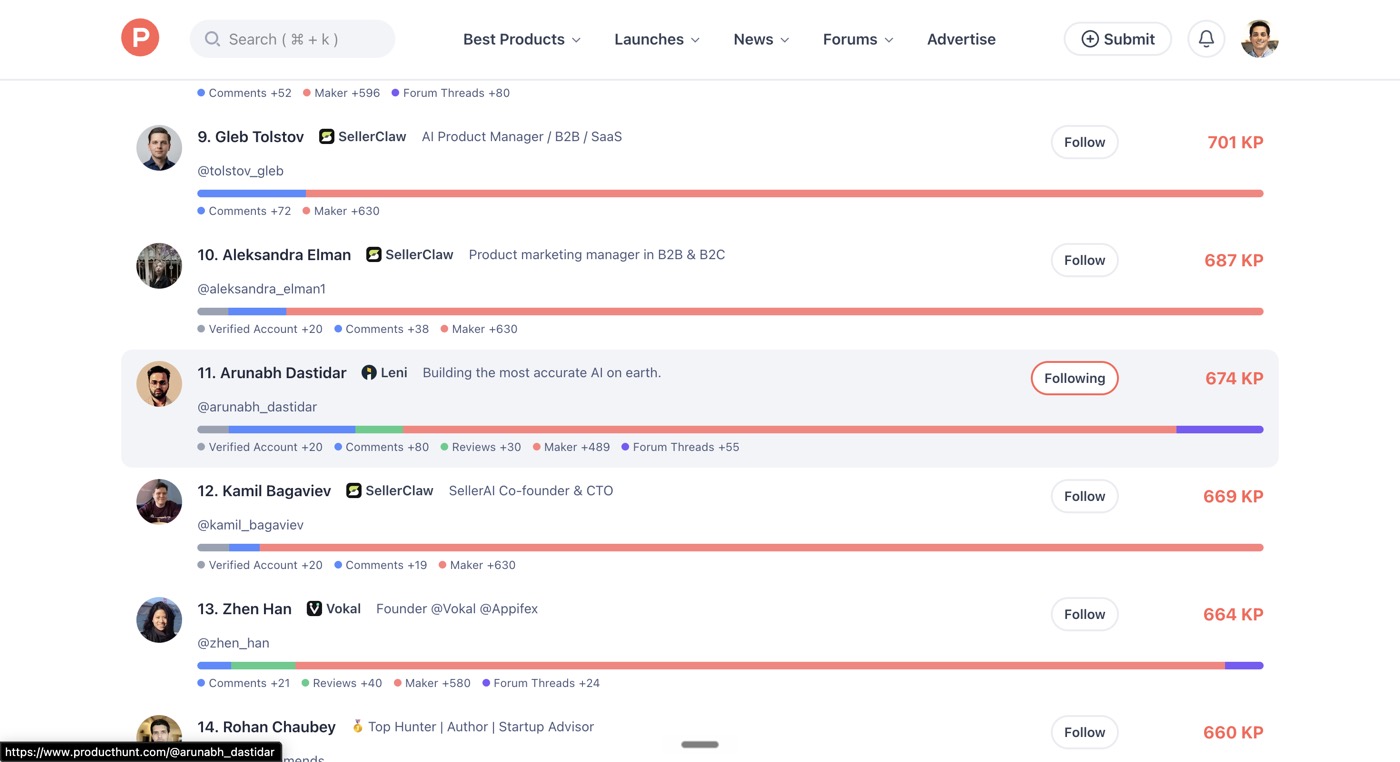
Leni's launch was upvoted by Ryan Hoover and the current CEO of Product Hunt. They got real distance from that — but most of their team's upvotes came from fresh accounts (Leni's audience is investors and operators, not the typical Product Hunt power user). So while they may have had more total upvotes than the #1 launch that day, their points were lower because the weighting cut deeply.
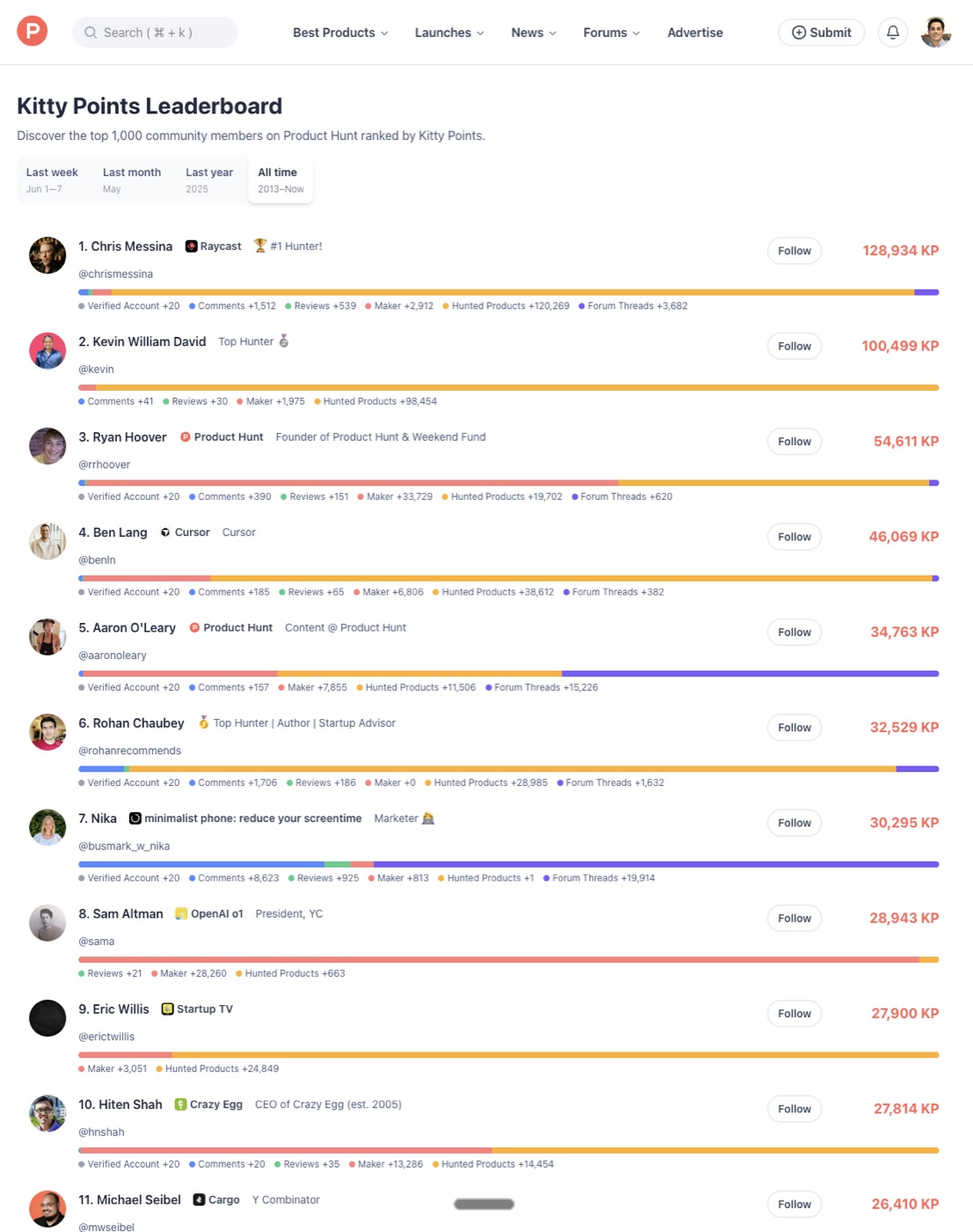
You can find this leaderboard at Product Hunt → Forums → Kitty Points Leaderboard. The “All time” tab shows top-Karma users; the “Last week” tab shows founders whose launches just finished (they're warmed up and often reciprocate).
Case study: why Fundraisly crushed #1 the same week
The launch that won the week Leni launched in: Fundraisly. They cleared 1,000 Kitty Points — well above what most launches accumulate.
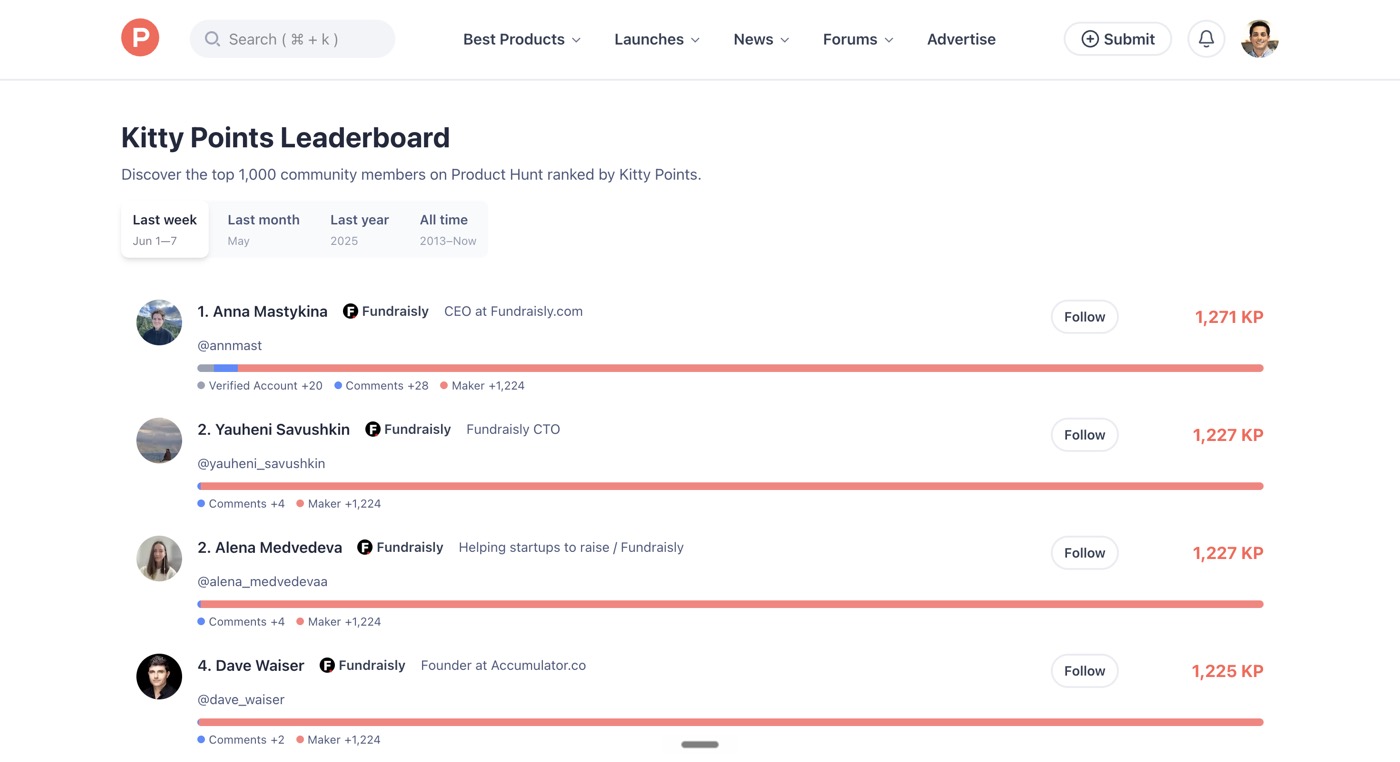
Notice the pattern: the top four entries on the week's Kitty leaderboard are all from Fundraisly's team (Anna Mastykina, Yauheni Savushkin, Alena Medvedeva, Dave Waiser). Each one accumulating 1,200+ Karma points.
Why that matters: Fundraisly is a company that helps founders raise money. Their entire audience is Product Hunt-native founders who already have warmed-up accounts. So when they ran their launch, every upvote from their audience was already worth 0.6-1.0 points instead of 0.2.
The lesson: the strength of your network on Product Hunt specifically matters more than the size of your network overall. A 10K-follower founder whose audience is Product Hunt-active will outrank a 100K-follower founder whose audience is on Twitter or LinkedIn.
The 3-phase playbook (per Arunabh)
Phase 1 — The 2-3 weeks before launch
Most of the work happens before launch day. The rankings on the day are largely set by what you did in the previous fortnight.
- Build a great product page. Strong hero image, a video walkthrough, multiple makers listed, and shoutouts to other products you've worked with or used. This is what the editorial team looks at when deciding to feature you on the homepage.
- Get featured. If your launch isn't featured, no other step matters — visitors don't scroll past the home page to find launches. Featuring is an editorial decision, so the product page needs to look serious (not a solo-dev side project).
- Warm up your team's accounts. New Product Hunt accounts contribute ~0.2 points per upvote. If your team's accounts are 3+ months old with some comment activity, that climbs. Don't create new accounts the day of your launch.
- Reach out to high-Karma users individually.Pull the Kitty Points all-time leaderboard. Identify 20-30 people whose work overlaps with yours. Send a personal heads-up 1-2 weeks before launch — no pitch, just a soft “we're launching X on date Y, would love your support.”
- Befriend the founders from last week's launches. Their accounts are warm, they're active on the platform, and they often reciprocate support for the founders launching after them.
Phase 2 — Launch day (you have 24 hours)
The Product Hunt ranking window is exactly one day. After 24 hours, the points stop accumulating and you're ranked permanently against everything else that launched that day. On the day itself:
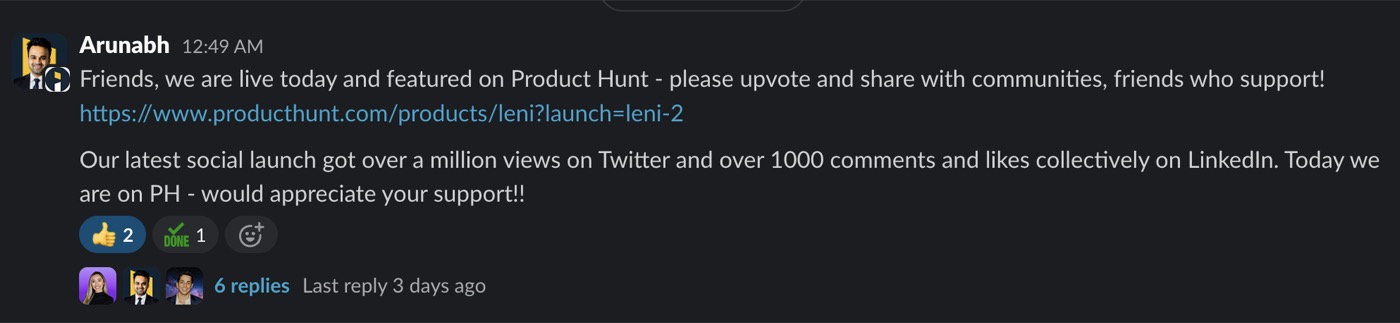
- Activate every channel at the start. Slack communities, LinkedIn, Twitter, founder WhatsApp groups, newsletters, anything you have. Front-load the upvotes — early momentum matters because the homepage rank itself drives more upvotes.
- Personally message every high-Karma contact you warmed up. Send the link. Time the message for when they're likely online (early Pacific time is the most Product-Hunt-active window).
- Reply to every comment. Comments compound in two ways — they keep the launch active on the page, and the engagement itself contributes to your Kitty Point total on top of upvotes.
Phase 3 — After the launch
The PR work doesn't stop when the day ends. Top-3 launches:
- Get included in Product Hunt's newsletter (massive distribution, sent to hundreds of thousands of subscribers).
- Get a permanent “Featured on Product Hunt” badge you can put on your homepage, signup flow, and pitch deck.
- Continue accumulating signups for weeks afterward via direct referral and the newsletter feature.

The honest postmortem
Beyond the 300+ signups and the headline numbers we teased at the top, Arunabh's candid postmortem: nothing broke on the day (their infrastructure held), the conversion rate was healthy, and the warm-lead pipeline that came in continues to convert weeks later. The Product Hunt feature itself is now a passive lead generator on their homepage — visitors who land on leni.co see the badge and treat it as third-party validation.
The compounding value: the top-3 launch keeps producing weeks after launch day. Inclusion in the Product Hunt weekly newsletter (hundreds of thousands of subscribers) sent a second wave of traffic. The “Featured on Product Hunt” badge on their homepage lifts conversion on cold traffic by an estimated 10-20%.
What Arunabh would do differently next time
He told us he'll hit #1 on the next launch — and the reason it didn't happen this time comes down to one miscalculation:
“The reason we actually got #3 is we had a lot of our team and their friends upvoting us, but they were very fresh accounts. We probably would have gotten more upvotes than the first launch — but the points didn't translate the same because they were fresh accounts with lower Karma points.”
Two-month-old accounts with even minimal comment activity on Product Hunt are worth several times what fresh accounts contribute. Arunabh's next launch will be backed by a team that's been quietly active on the platform for weeks before the launch date.
The LinkedIn pre-launch (where Postbeam fits in)
Leni's pre-launch built audience on LinkedIn and X weeks before they ever submitted to Product Hunt. By the time launch day arrived, they had:
- 1M+ Twitter views warming up their broader audience
- 30K+ LinkedIn reach turning posts into warm leads
- A roster of founders and investors who already knew the product was coming
That pre-launch traction is what makes the Product Hunt day pop. If you're trying to do the LinkedIn pre-launch side of this — building audience, turning post engagement into ICP-matched warm leads, scheduling team-wide content in each person's voice — that's what we built Postbeam for. You can even run it straight from Claude or ChatGPT with our LinkedIn MCP.
Connect with Arunabh and Leni
- Website: leni.co
- LinkedIn: /in/arunabhadastidar
- X: @arunabh_D
- Leni on X: @leni_analyst
Frequently asked questions
How does Product Hunt actually rank launches?+
What is the most important thing to do before launching on Product Hunt?+
How far in advance should I start preparing my Product Hunt launch?+
How can I find high-Karma Product Hunt users to support my launch?+
What's the difference between an upvote and a Kitty Point?+
Do I really need a video on my Product Hunt page?+
What results does a top-3 Product Hunt launch produce?+
Related reading
- How Instantly.ai hit $40M ARR — the full GTM breakdown
- How beehiiv grew to $2M/mo by turning every employee into a LinkedIn influencer
- What is social selling? (2026 guide)
- How Cluely went from $0 to ~$5M ARR in 3 months
- How ElevenLabs grew to $600M ARR in 3 years
- GameStrat: how 2 students built a 7-figure football software company
- How Wispr Flow 150x'd revenue in a year with zero cold outreach
- 50 LinkedIn post ideas for founders and B2B operators
- LinkedIn MCP — connect Claude & ChatGPT to LinkedIn
- All Postbeam blog posts →
Want pre-launch traction like Leni's?
The Product Hunt day is one moment. The audience you build before it is what makes it work. Postbeam turns your team's LinkedIn posts into ICP-matched warm leads so you walk into launch day with the right people already paying attention.
Start your 7-day free trial →