

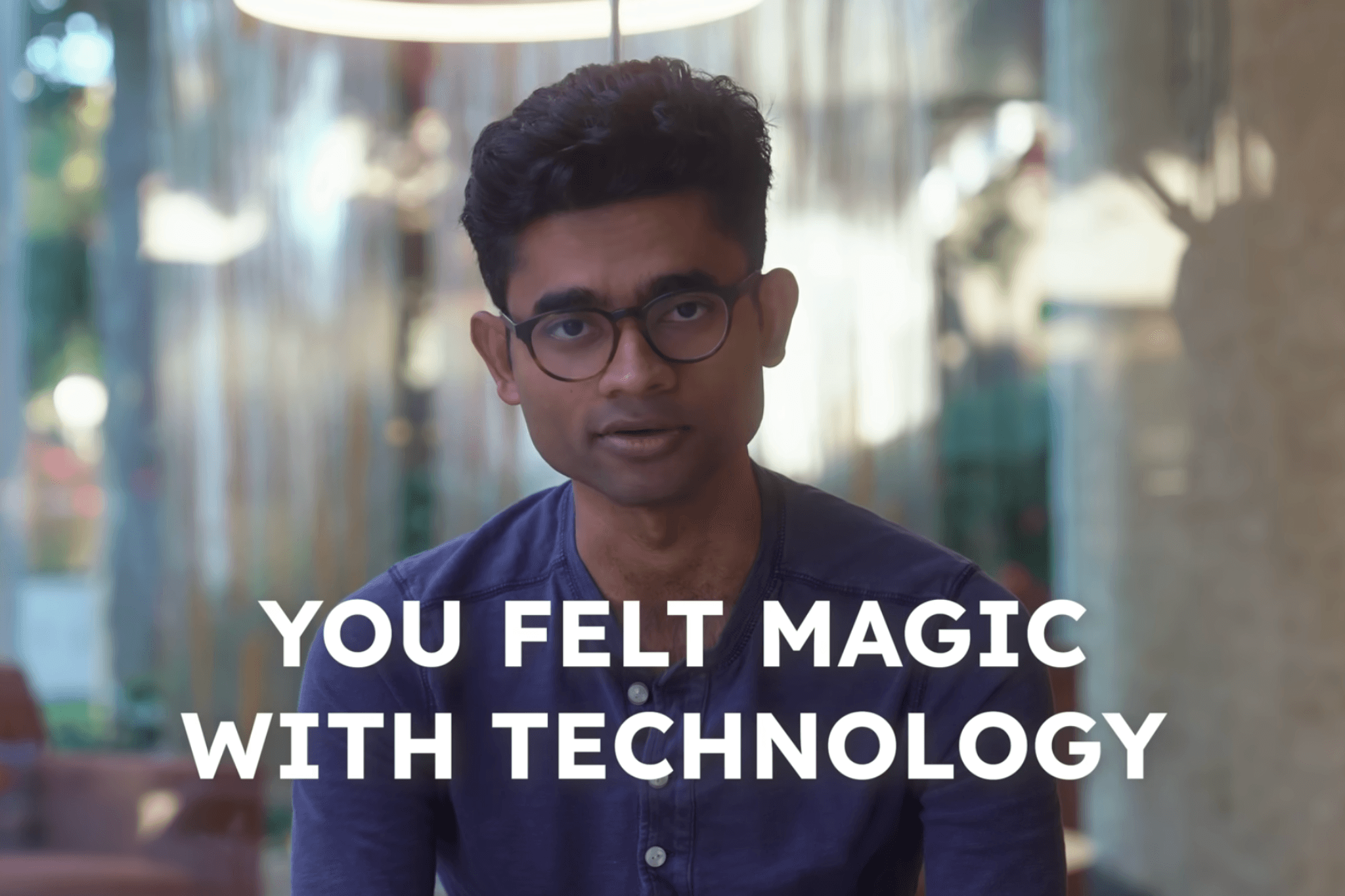
Four years after founding, Windsurf was the object of one of the strangest weekends in startup history: OpenAI tried to buy it for $3B, Microsoft blocked the deal, Google paid $2.4B just to license the tech and hire the founders, and Cognition, the makers of Devin, bought everything that remained. Three days, three outcomes, one company split into pieces.
On this GTM Breakdown, Emil and I dug into how they grew in the first place, and it is the most unusual one we have done. Not because of a secret channel. Because there barely were channels: almost no ads, no founder audience, no outbound machine in the early days. And because, unlike Instantly or beehiiv, this is the first breakdown where the revenue curve goes down before the exit. That is the interesting part.
TL;DR: Windsurf by the numbers
- Revenue: ~$12M ARR (end 2024) → ~$100M (April 2025) → $82M at the July 2025 acquisition. The only precise ARR figure the company itself ever stated is the $82M.
- The exit: ~$2.4B from Google for a non-exclusive license plus the founders, then Cognition acquired the company itself. Roughly $1.2B to investors, $1.2B to employees.
- The wedge: free for individual developers for roughly two years. “Free now, free forever” was homepage copy.
- Distribution: the VS Code marketplace, Chrome store, JetBrains, 40+ IDE directories, and GitHub, not search, not ads.
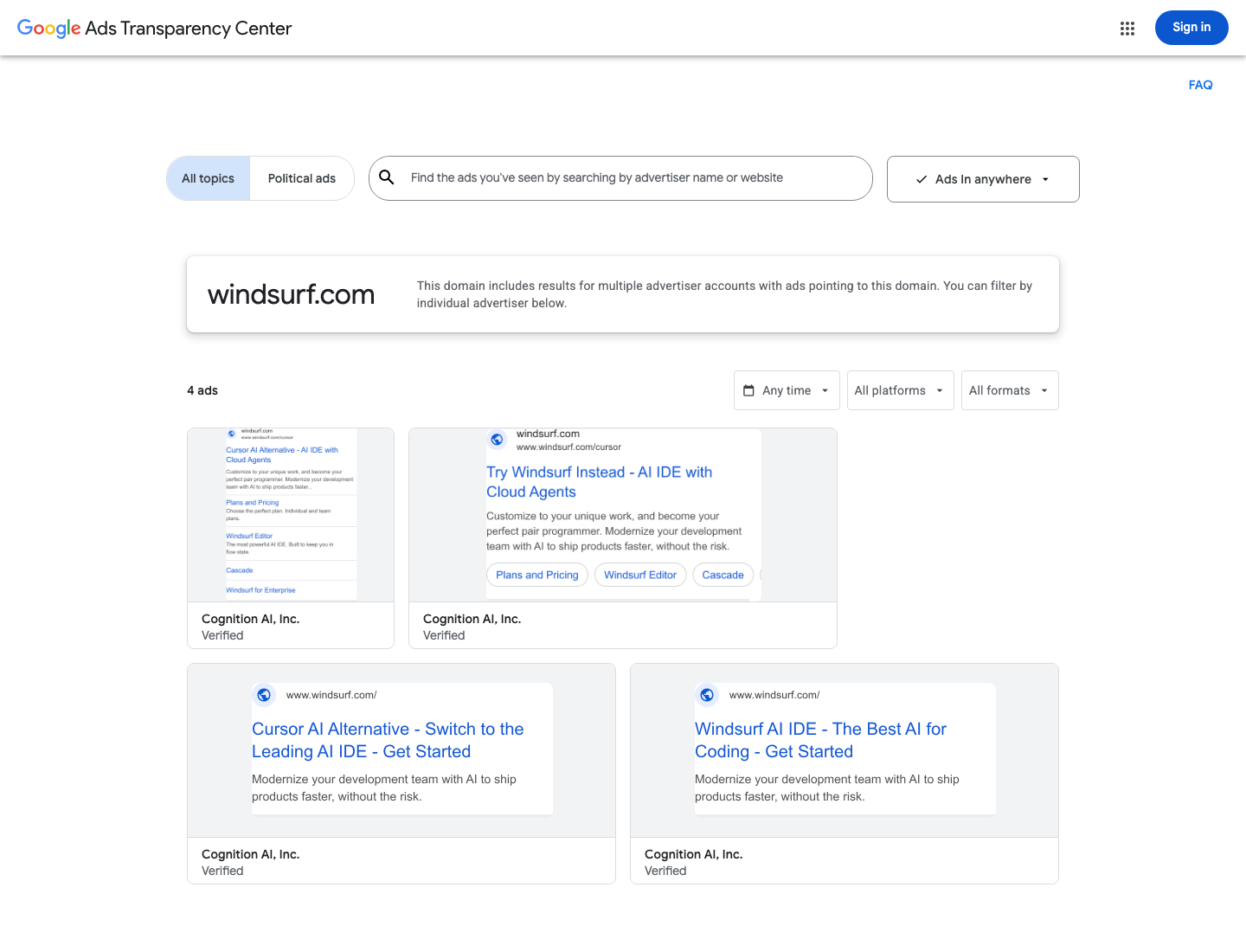
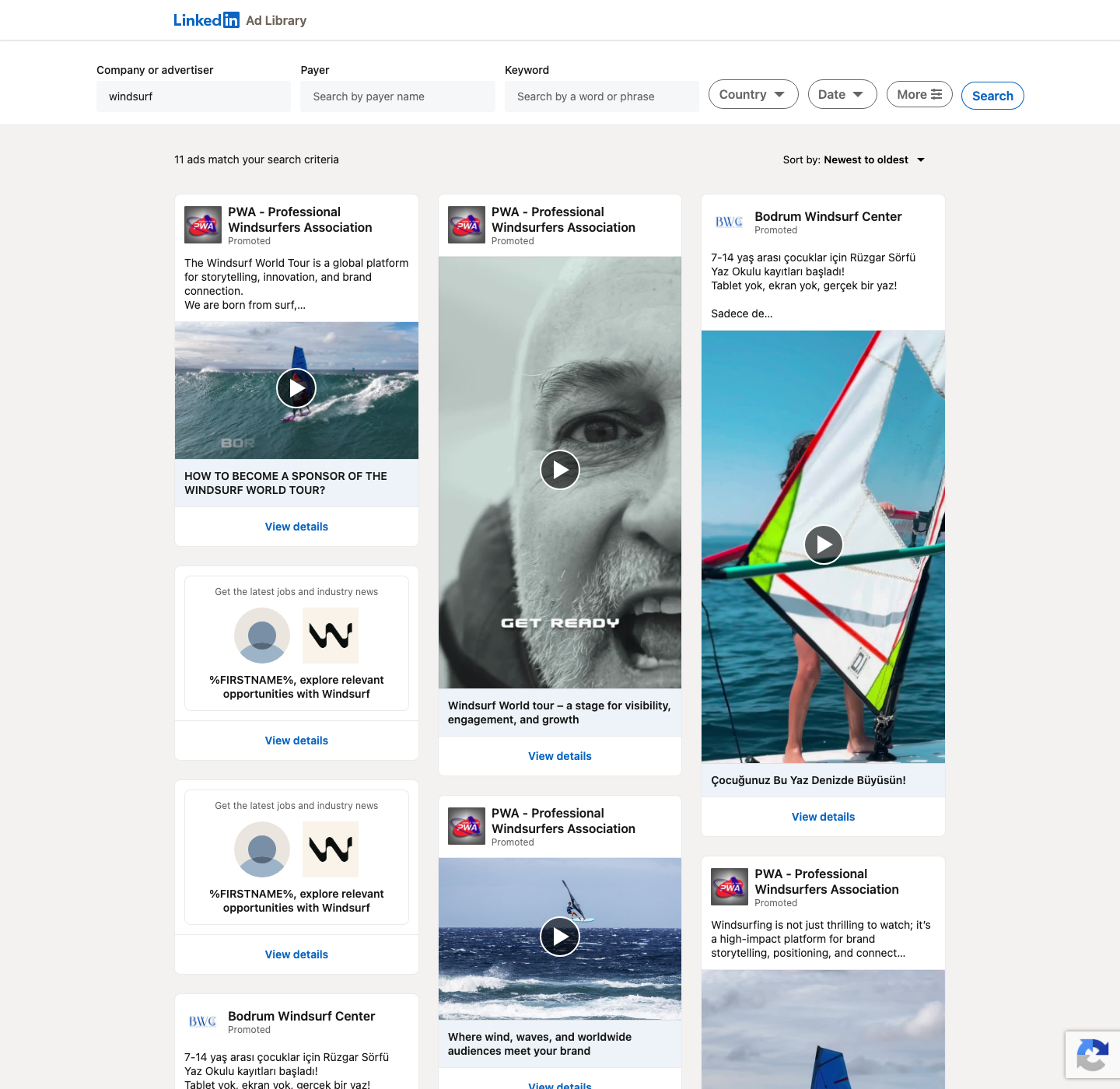
- Paid ads, lifetime: 4 Google ads, 0 Meta ads, 4 LinkedIn ads (all recruiting). The billboards were for hiring.
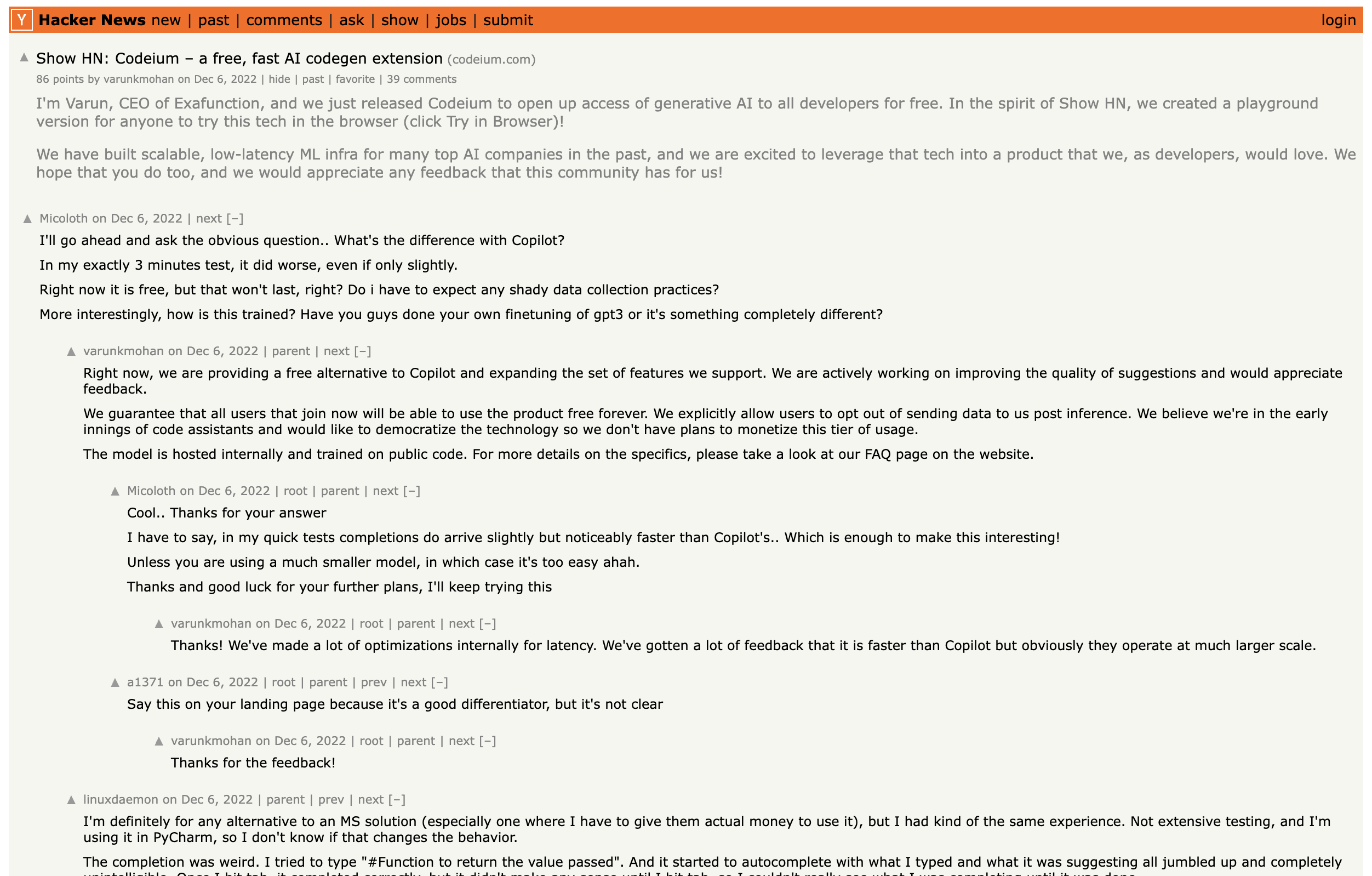
- Launch: a Show HN posted by the founder. 86 points, 39 comments.
- Aftermath: organic traffic down 85% from peak, 99.95% of ranking keywords gone, and windsurf.com now redirects to Devin Desktop.
The founders: the kings of too early
Varun Mohan and Douglas Chen met in middle school and both graduated MIT in 2017. Varun ran large-scale offline deep learning infrastructure at Nuro, the self-driving company; Douglas was at Oculus/Meta. Kleiner Perkins would later describe the founder-market fit in exactly those terms: ML infrastructure experts from Nuro and Oculus.
Emil's label for them stuck with me: the kings of too early. GPU virtualization in 2021, before the GPU crunch had a name. AI in the editor in 2022, when GitHub Copilot still felt like an afterthought. An agent-first IDE in 2024, when “you don't even want an IDE anymore, you want to manage your agents” was not yet obvious. Varun is 29 today, both founders are at Google DeepMind, and whatever he is working on now is probably five years early too. Worth a follow.
The origin story: they killed a working business. Twice.
Windsurf started in June 2021 as Exafunction, GPU virtualization, think AWS for GPUs before that was a crowded idea. An 8-person team managing around 10,000 GPUs across data centers, doing a couple million in revenue. In April 2022 they emerged from stealth with a $25M Series A from Greenoaks and Founders Fund, and if you know Founders Fund, the plan was always to deploy capital fast into a rocket ship.
Six months later they killed it. The trigger was dogfooding: the team were early GitHub Copilot users writing CUDA and C++ internally, and Copilot was their first real contact with an LLM application. It was rough, we used it too back then, but it was a glimpse of the future. They decided the value would not be in infrastructure, and built a code acceleration tool on top of their own infra instead. That was Codeium.
“We were making money on this. And we were just like, 'Hey, we're going to pivot entirely from this.'”
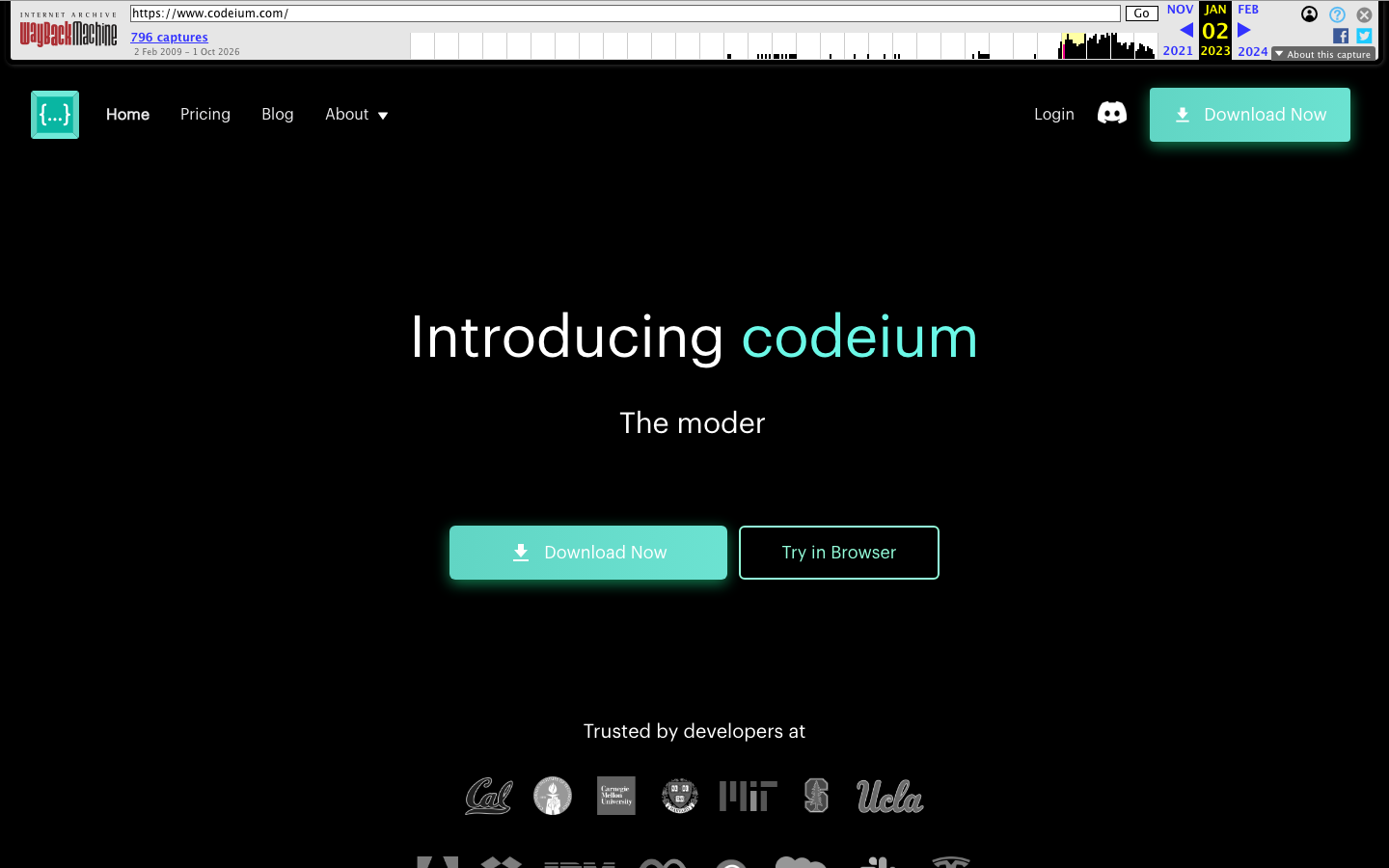
Codeium launched in beta in October 2022 as a free tool with a Discord community attached and “free now, free forever” on the homepage. The Show HN came that December, posted by varunkmohan himself: 86 points, 39 comments. Nothing viral. Then in November 2024 they did it again, launching the Windsurf Editor, a full VS Code fork with the Cascade agent, and knowingly cannibalizing their own extension business because they had hit the ceiling of what the VS Code ecosystem allowed.
“We should be cannibalizing the existing state of our product every six to 12 months. It should almost make the form factor of the existing product look dumb.”
The growth timeline
Founded as Exafunction, a GPU virtualization company. An 8-person team ends up managing ~10,000 GPUs across data centers, doing a couple million in revenue.
Emerges from stealth with a $25M Series A from Greenoaks and Founders Fund to be an infrastructure company. Roughly $28M raised in total.
Six months later they kill the profitable business. Codeium launches in beta: a free AI autocomplete extension, a Discord community from day one, and 'free now, free forever' as homepage copy.
The founder posts the Show HN himself. 86 points, 39 comments. An unremarkable launch for a company that would be the object of a $2.4B deal 31 months later.
Series B: $65M at a $500M valuation (Kleiner Perkins). 300,000+ developers; the company claims Codeium wrote 44% of its users' newly committed code.
Series C: $150M at $1.25B (General Catalyst). First public revenue datapoint: 'eight figures this year.' 700,000 users, 1,000+ enterprise customers.
Second self-cannibalization: the Windsurf Editor, a full VS Code fork with the Cascade agent, kills their own extension business. The inflection point.
~$12M ARR (Sacra estimate, not company-confirmed).
$40M ARR, tripling from December (Sacra's estimate; TechCrunch reported the same figure that spring). The Editor is working.
Codeium formally renames to Windsurf, and ARR peaks around $100M. That is roughly 2.5x in two months and 8x+ in four months.
Anthropic cuts Windsurf's direct Claude access amid OpenAI acquisition rumors. Customers churn to Cursor. The curve bends down.
Google pays ~$2.4B as a non-exclusive licensing fee and hires the founders plus senior R&D into DeepMind. No stake, no control. Roughly $1.2B to investors, $1.2B to employees.
Cognition (makers of Devin) acquires what remains at $82M ARR, 350+ enterprise customers, ~250 employees. The last number that is Windsurf's own.
Cognition, the combined company, crosses a $1B annualized run rate with customers like Nvidia, Citigroup, and Mercedes-Benz. That curve is Cognition's, not Windsurf's.
An honesty note on the numbers. The clean hook would be “$0 to $100M in four months,” and it would be wrong: there was a funded prior company with real revenue underneath Codeium. The honest framing is $12M to $100M in four months, then $82M four months later. And the $100M-to-$82M gap is a real decline with two plausible drivers, the Anthropic cutoff in June 2025 and enterprise buyers freezing during an acquisition rumor cycle. Almost every number in this story is a reporter's or an analyst's; the only ARR figure the company itself ever stated is the $82M.
The wedge: free forever, distributed by other people's marketplaces
Here is the thing that makes this breakdown strange: we went looking for the growth channels and mostly found absence. No meaningful ad history. No founder building an audience on Twitter. No cold outbound machine in the early days. So where did hundreds of thousands of developers come from?
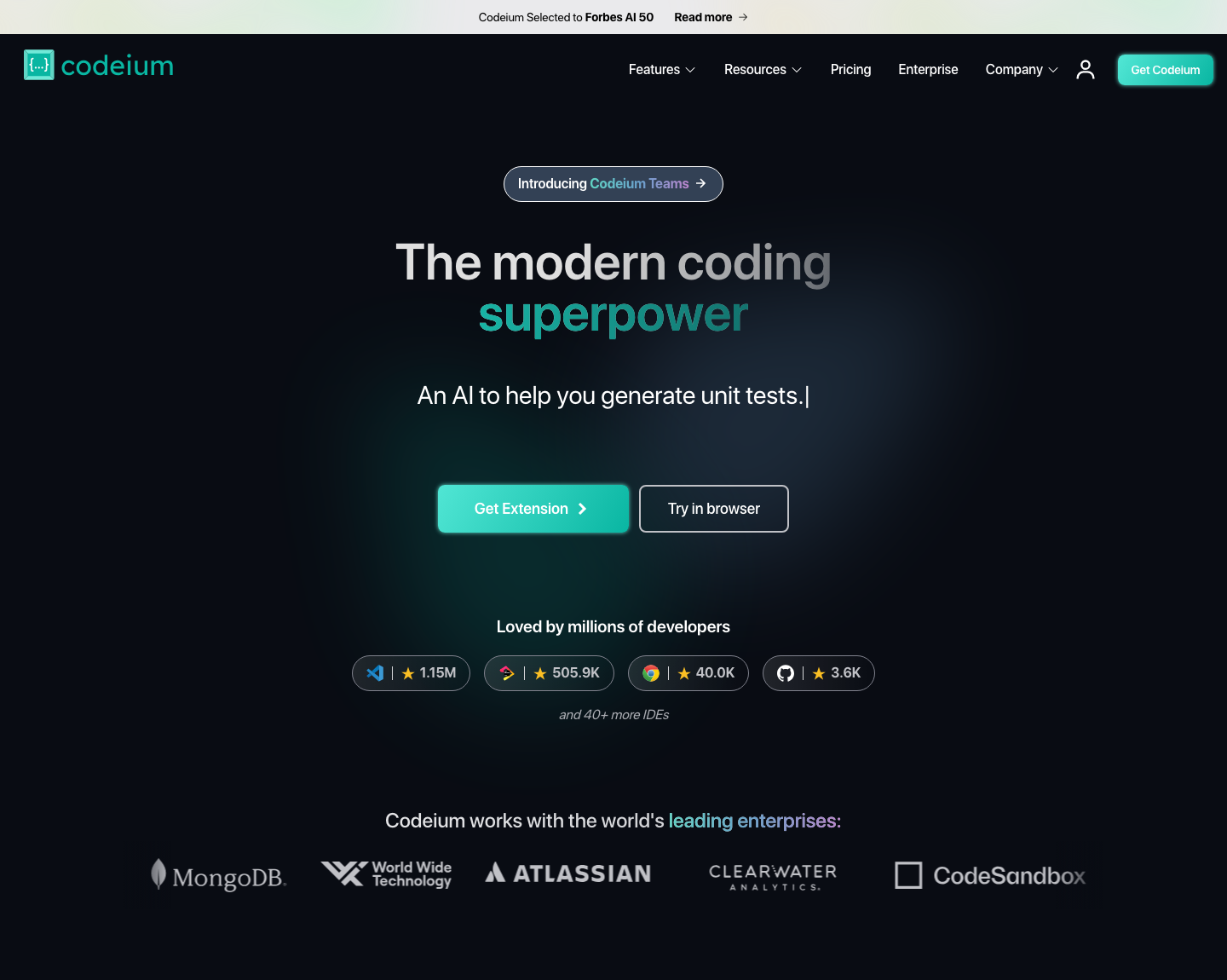
Emil's thesis, and I think he is right: directory SEO. Codeium was not trying to be a platform at first. It was an extension that plugged into VS Code, JetBrains, Chrome, 40+ IDEs developers already lived in. That means being listed in the VS Code marketplace, the Chrome Web Store, the JetBrains plugin directory, plus a GitHub presence at 3.6K stars. None of it shows up in Ahrefs, which is exactly why it is underrated: you ride the distribution of platforms growing faster than you are, and you get found when people search their need inside the directory instead of Google.
The other half of the wedge was the price: free for individual developers for roughly two years, funded by venture capital, with Teams and Enterprise layered on later. I compared it to Loom on the call: accumulate an enormous free base, then turn the paid faucet on and convert a slice of it overnight. You lose money at the beginning on purpose. “Free now, free forever” was not a feature of the strategy. It was the strategy.
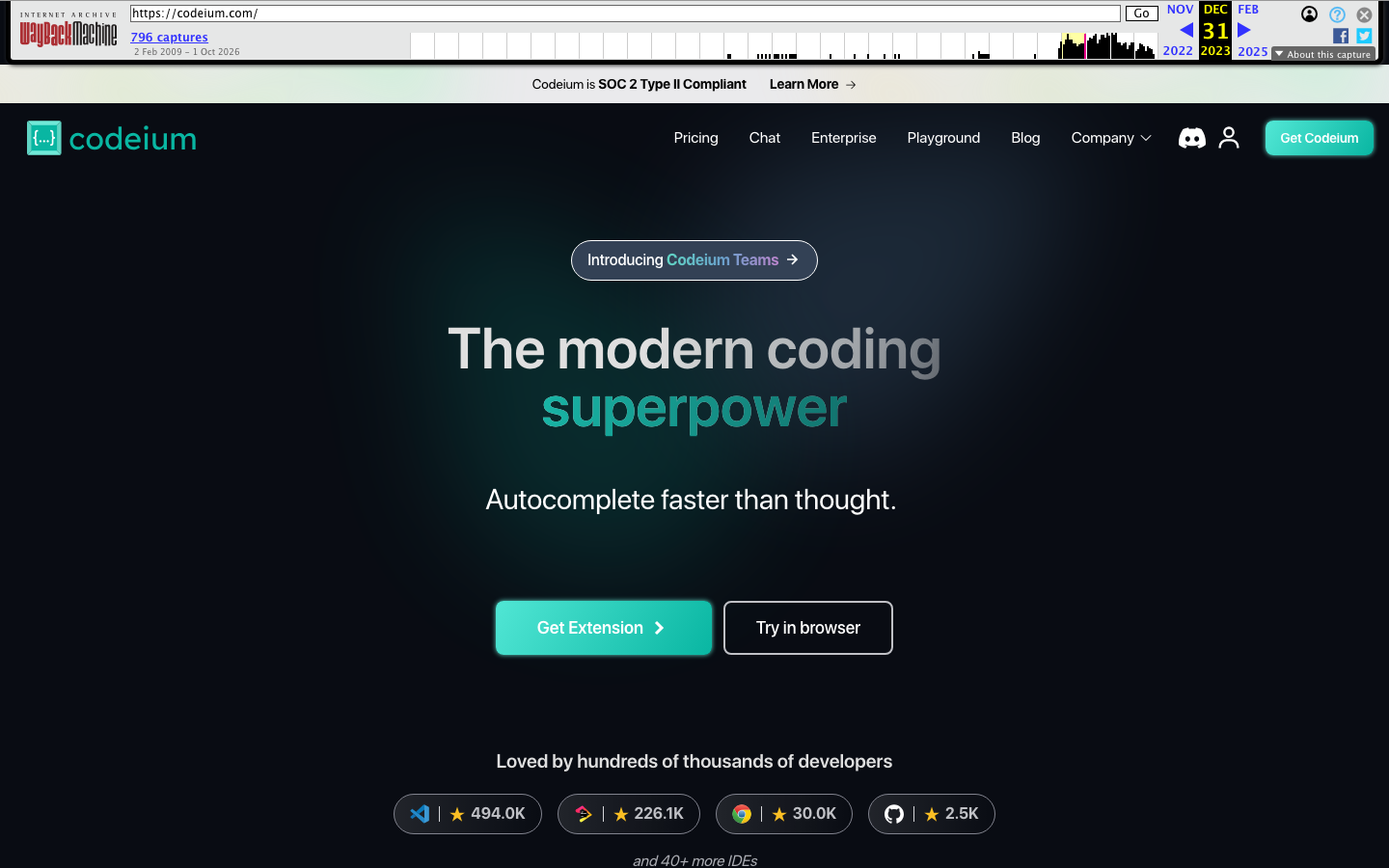
And you can watch it work in the Internet Archive, because their own landing page published the install counter as social proof, which makes it a free public growth metric for anyone doing competitive research:
Launch culture: Discord on day one, Waves every month
The community was part of the launch, not an afterthought: the Discord shipped with the October 2022 beta. The Show HN was posted by the founder himself. There were four Product Hunt launches across three brand names, and the flagship Windsurf Editor launch made only #5 Product of the Day with 351 upvotes, more proof that launches are reps, not lottery tickets.
Then there is the cadence. Thirteen named feature drops in about twelve months, the “Wave” release train, ending with “Wave 13: Merry Shipmas.” They used the cadence itself as copy (“Wave 3 has come only a month after Wave 2”), named everything off one water metaphor (Windsurf, Cascade, Riptide, Flows, Waves), and shipped paying users custom Mac dock icons as a headline feature. The best line the company ever wrote came from Wave 1: “this is the worst Windsurf is ever going to be.” Steal that one.
The ads chapter is four ads long
We pull the ad libraries on every breakdown. This is the emptiest set we have ever pulled. Google Ads: exactly four ads in the company's entire lifetime, all of them Cursor conquesting (“Cursor AI Alternative - Try Windsurf Instead”), run from Cognition's account, not even a Windsurf one. Meta: zero ads, ever, across Windsurf, Codeium, and Exafunction. Not one.
LinkedIn is where it gets funny. The account owner search for “windsurf” returns 11 ads: five from the Professional Windsurfers Association, four from a Turkish windsurfing school, and two from the actual company, both recruiting cards, one with the personalization macro visibly unrendered (“%FIRSTNAME%, explore relevant opportunities”), sandwiched between windsurfing hero videos.
Because here is the pattern: the only thing this company ever consistently paid to promote was hiring. The July 2024 billboard campaign (“Too full of life to be working at a 49-year-old enterprise software company?”, pointed at Microsoft) was an employer-brand play, reverse-engineered from a remark at a company board-game night, and their own blog admitted it: “Is this billboard campaign a gimmick? Well, yes. But if you're still reading this, maybe it's working!” Two rebrands later, the billboard photos are still served from exafunction.github.io, a GitHub Pages site under the company's original, long-dead name. Nobody ever moved the assets.
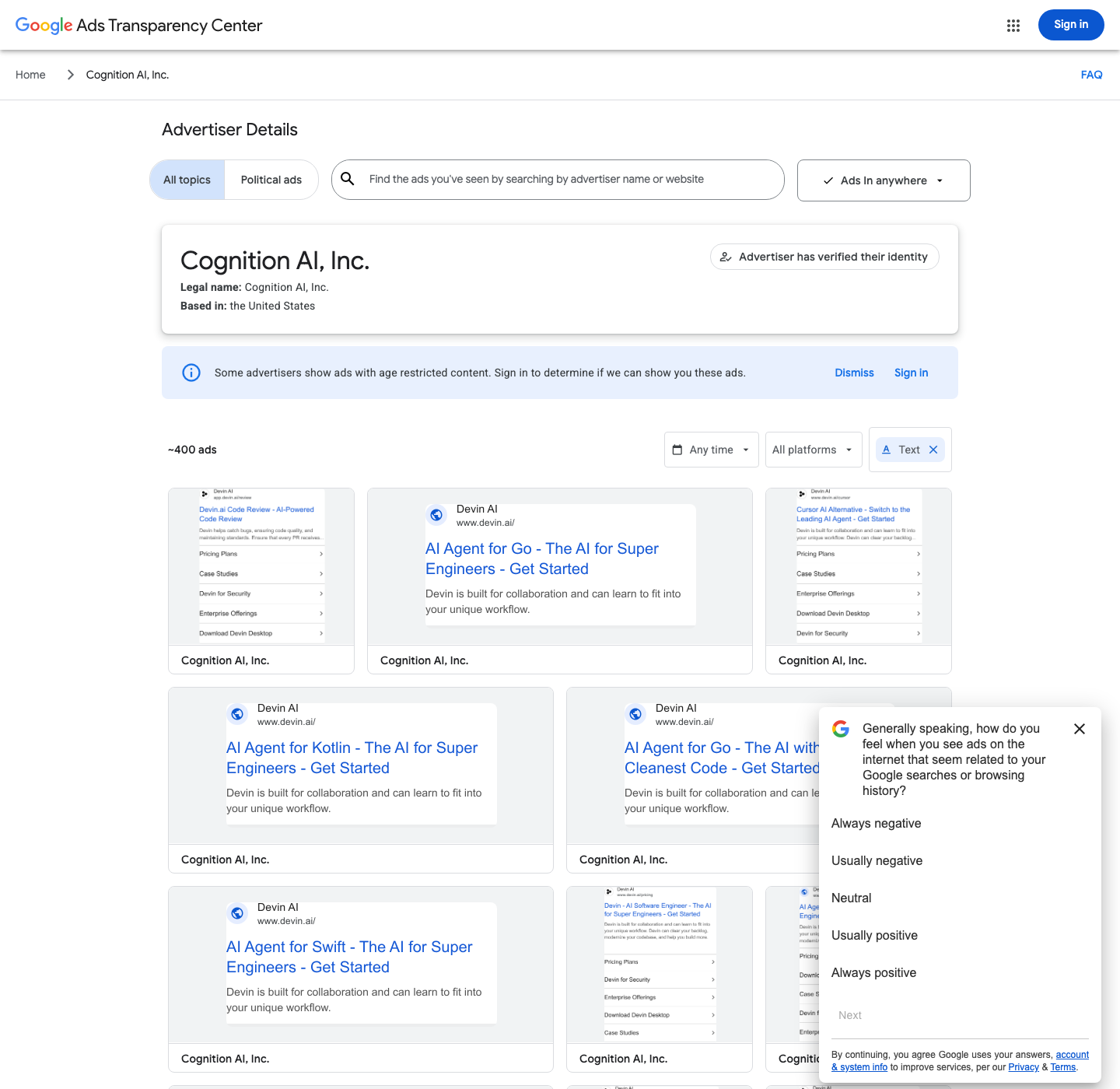
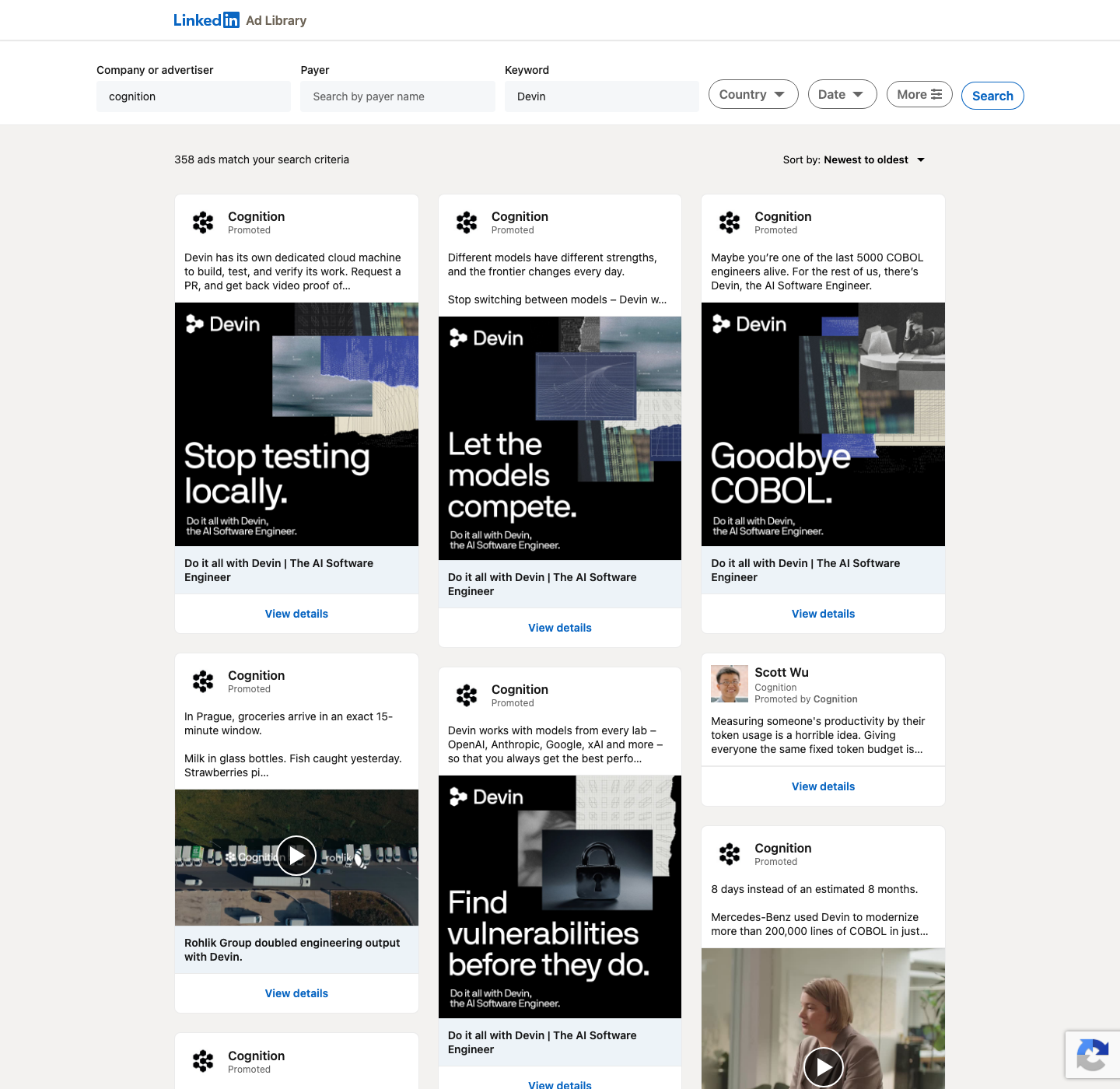
The real ad budgets exist today, but they belong to the acquirer. Cognition runs roughly 200 Google ads a month pointed at devin.ai, around 120 active Meta ads that are almost entirely whitelisted creator talking-heads with comment-gated CTAs (“Comment 'Devin' and I'll send you the link”), and a 358-ad LinkedIn brand campaign with genuinely great copy: “Maybe you're one of the last 5000 COBOL engineers alive. For the rest of us, there's Devin.”
The sales motion: inbound-led, then sharply upmarket
By the enterprise era the numbers on RepVue (still filed under the legacy Codeium slug) looked like this: $150K median base, $300K median OTE, a $238K average deal size, a 132-day sales cycle, 181 people. The detail that matters: inbound lead flow ranked in the 90th percentile of RepVue's software cohort. Outbound existed to supplement a strong inbound engine, the exact opposite of the Instantly motion.
You can read the same story in the org chart today: of Cognition's 100 open roles, 31 are sales, but only one is an SDR req, against eleven Account Director reqs, and that SDR posting has sat open for about 11 months. AEs own prospecting end to end. Post-acquisition the deals moved sharply upmarket: $238K averages in the Windsurf era versus “$1M+ average deal sizes” in Cognition's current Regional Sales Director posting. The GTM org had scaled 3 to 75 people in under a year pre-acquisition, and before all of that, the company's own recruiting copy claimed it was one of the fastest B2B SaaS companies ever to go from zero to eight figures.
Three days in July: the strangest exit in AI
The sequence, because it still reads like fiction. OpenAI was set to acquire Windsurf for a reported $3B. Microsoft blocked it: an IP clause entitles Microsoft to IP that OpenAI acquires, Windsurf would not extend those rights, and Microsoft owns GitHub Copilot, the same Microsoft the billboard had mocked eleven months earlier. In June, Anthropic cut Windsurf's direct Claude access amid the rumors, and customers started churning to Cursor. Then the weekend: on Friday July 11, Google paid roughly $2.4B as a non-exclusive licensing fee and hired Varun, Douglas, and the senior R&D team into DeepMind, no stake, no control. Jeff Wang, suddenly CEO, described the Friday all-hands plainly: a few people were in tears, and the Q&A was understandably hostile. Staff had walked in expecting an OpenAI acquisition. On Monday July 14, Cognition acquired what remained: the brand, product, customers, and $82M of ARR.
Under 5% of enterprise customers overlapped between Devin and Windsurf, which is why the merge actually added revenue. And in a detail that sums up the whole attention economy: windsurf.com's organic traffic peaked in July 2025, the exact month the company was broken up. The biggest search wave they ever caught was their own obituary.
The full oral history from the founders is worth your time:
The aftermath: what happens to a brand after it gets absorbed
This is the part no other writeup covers, and for anyone who cares about SEO or AI visibility, it is a cautionary dataset. Fifteen months after the peak (Ahrefs, October 2026):
- Organic traffic: 226,697/month at the July 2025 peak, 33,082 today. Down 85%.
- US ranking keywords: ~43,189 in June 2025, 20 in October 2026. A 99.95% wipeout, on a DR 83 domain.
- 91% of the remaining US organic traffic lands on a single page: the enterprise login page. What is left is not acquisition, it is existing users signing in.
- Brand demand collapsed with it: “windsurf” searches fell 74%, “windsurf ai” fell 97%. The market did not just stop ranking them. It stopped looking for them.
- Scoreboard: cursor.com does ~81K US organic visits on 1,375 keywords. The entire Cognition estate does about a quarter of that.
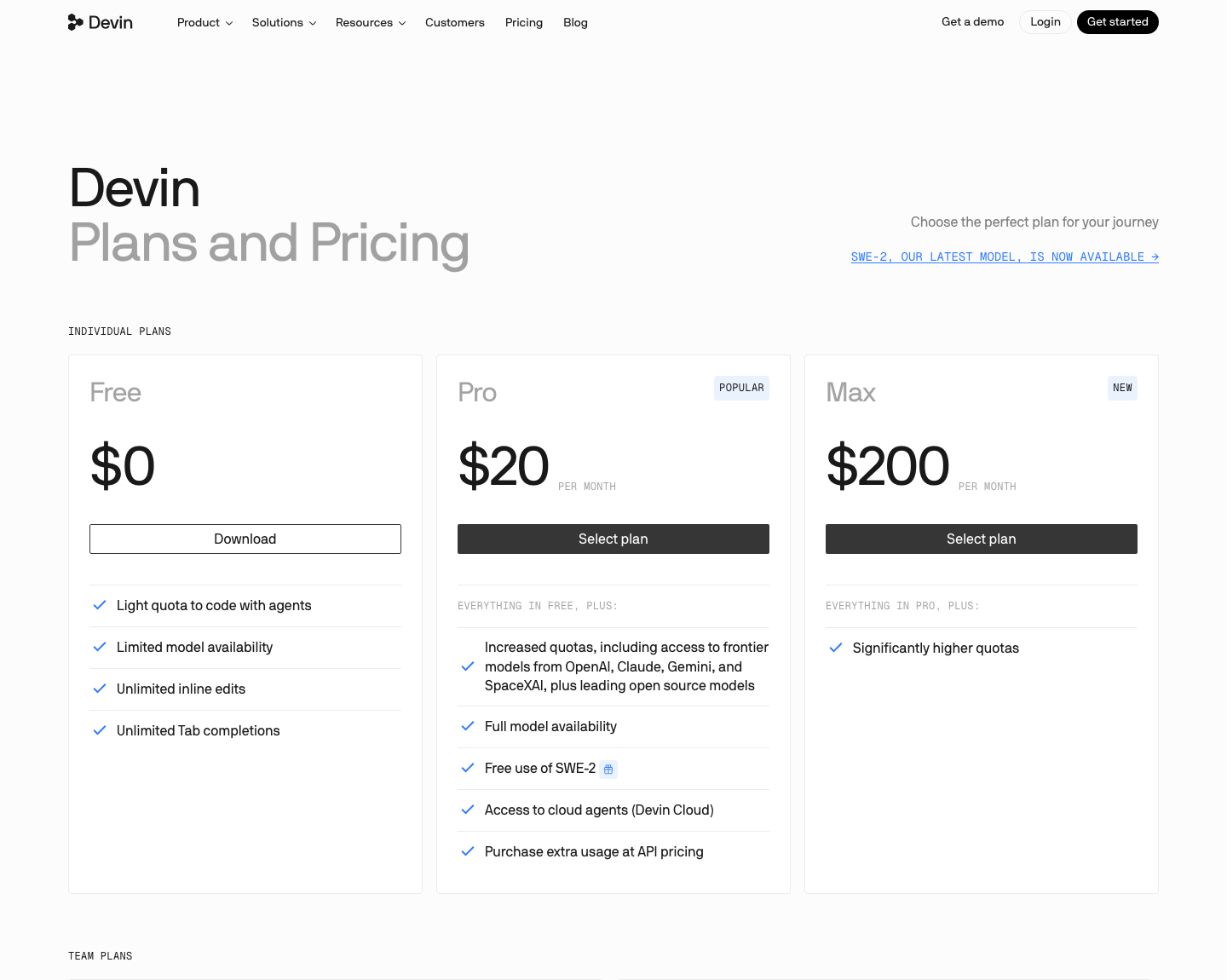
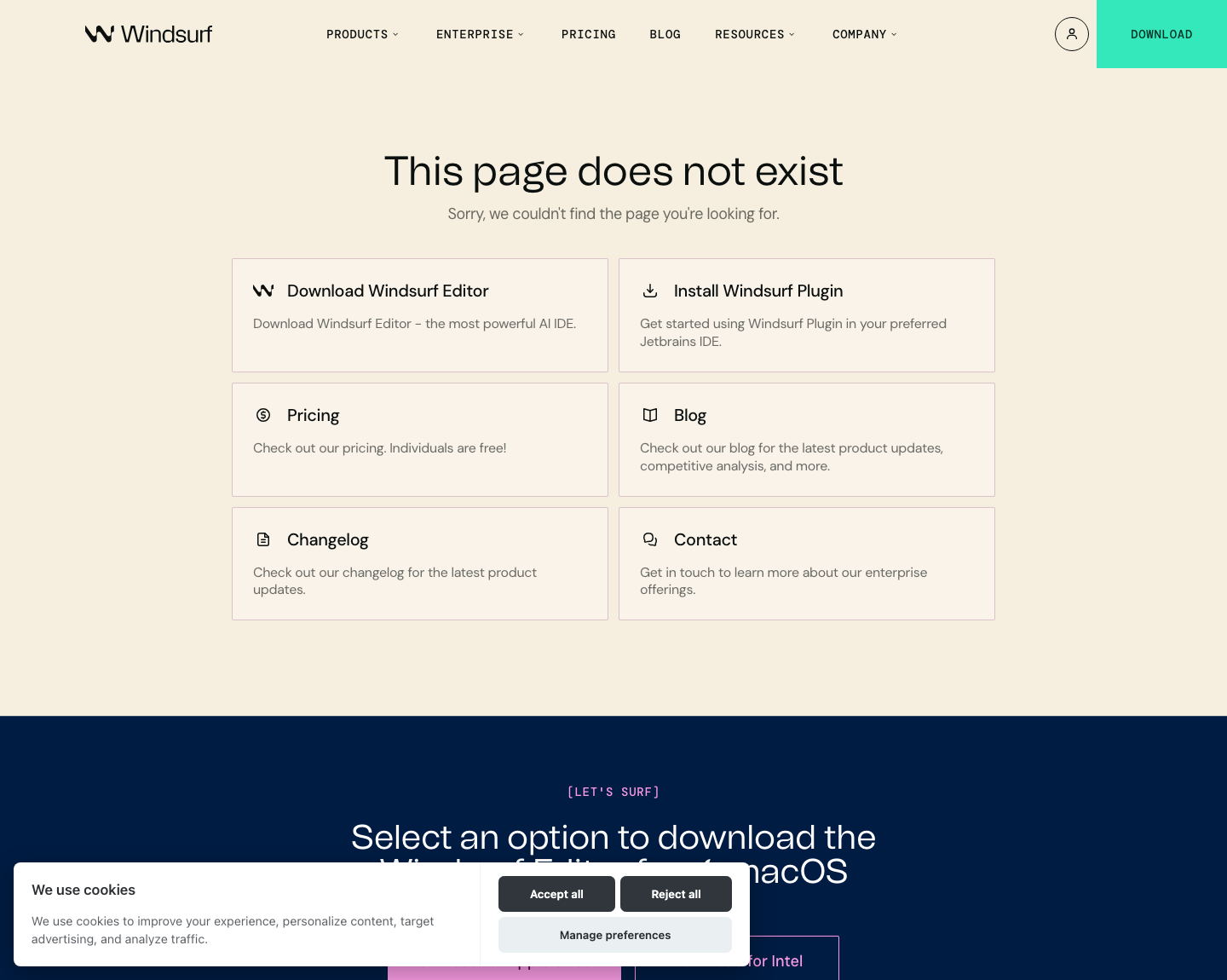
The site itself tells the story faster than any chart. The domain now 308-redirects to Devin Desktop, the pricing page is Devin's, and the one genuine marketing page still pulling traffic is the Cursor comparison page. The competitor page outlived the brand.
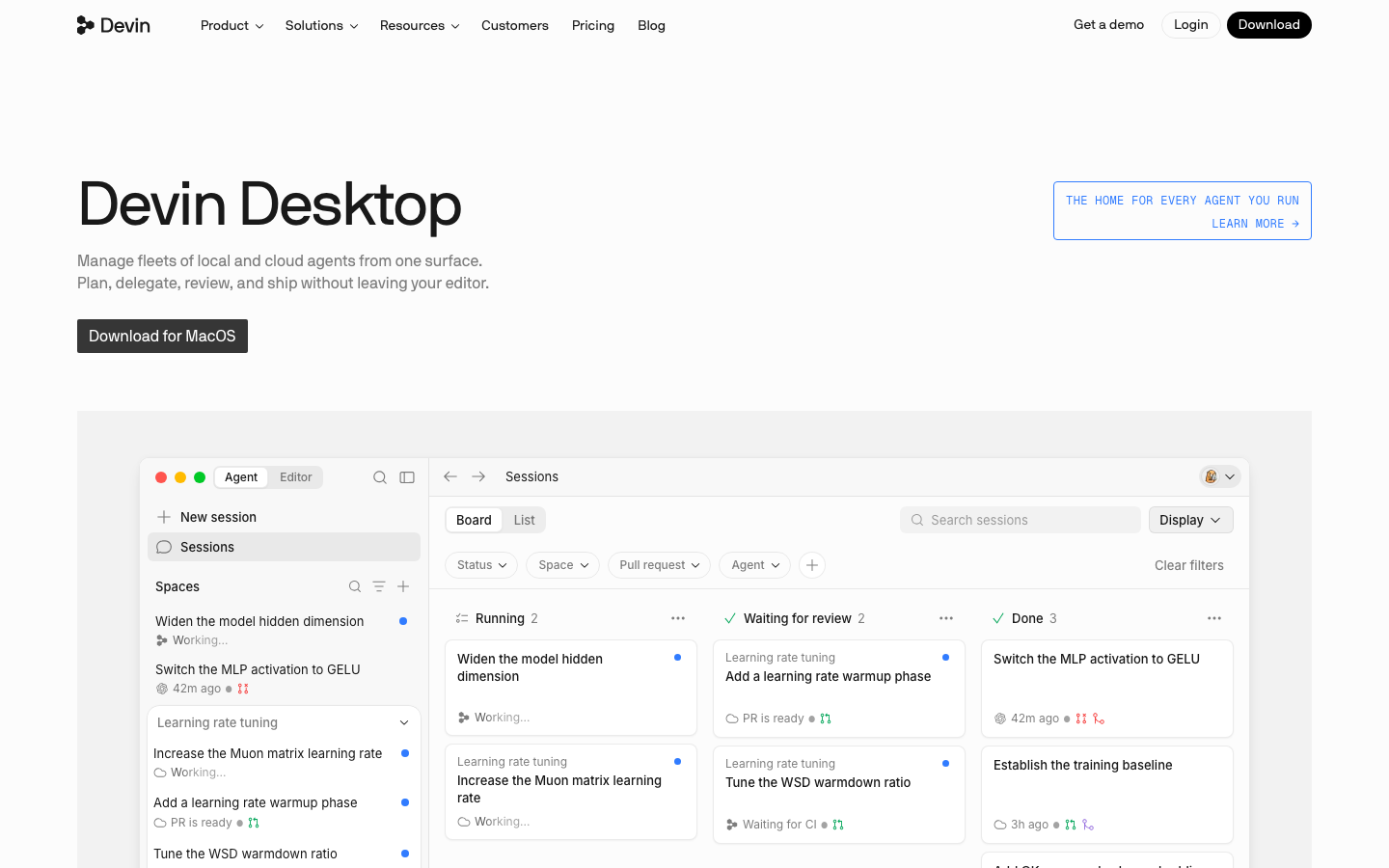
One more irony for the road: Similarweb's AI-insights panel for devin.ai reads “Windsurf is driving most of the AI Search traffic.” The brand they absorbed is still carrying their AI-search demand, while Windsurf's own panel shows nothing branded left at all.
What we'd actually steal
1. Pick a market that does the heavy lifting. Emil's first takeaway, and the honest one: these guys were in the right place at the right time, twice. Even the abandoned GPU business would have been a monster through the first half of the 2020s. Lightning in a bottle is not a playbook, but choosing a wave that is still growing is.
2. Directory SEO is the most underrated channel in dev tools. Being the complementary tool listed inside VS Code, Chrome, and JetBrains marketplaces is invisible to every SEO dashboard and worth more than most content programs. If a platform your customers live in is growing exponentially, being discoverable inside it means you grow with it for free.
3. Free is a hack, if you can afford it. Free for two years built an install base no ad budget could buy, and the conversion faucet turned on later. The catch is in the clause: they raised ~$243M to be able to give the product away. Freemium is a capital strategy wearing a pricing strategy's clothes.
4. Brand equity is real, and renames burn it. Codeium to Windsurf cost two years of accumulated brand, and the archive still shows the seams: the referral terms are headed “Codeium Referral Program” and name Exafunction as the counterparty to this day, through two corporate events and two renames. When the second migration (into devin.ai) hit, the SEO died. Migrate domains like it is heart surgery, because it is.
5. Ship a cadence, not just a product. The Wave train made the release schedule itself a marketing asset, and “this is the worst Windsurf is ever going to be” is the single best line of product copy we have seen in any of these breakdowns.
All 7 channels, recapped
1. Free as the wedge
Codeium was free for individuals for roughly two years. 'Free now, free forever' was homepage copy. Raise big, give the product away, turn the paid faucet on later.
2. Directory SEO
Listed in the VS Code marketplace, the Chrome store, JetBrains, 40+ IDEs, plus GitHub. Invisible in Ahrefs, massive in reality: ride the distribution of platforms growing faster than you.
3. Launch culture
Show HN posted by the founder, four Product Hunt launches across three brand names, a Discord from day one, and the Wave release train: 13 named drops in 12 months.
4. Install counts as marketing
Their own landing page published the VS Code install counter: 494K (Dec 2023) to 1.15M (Jun 2024). The social proof upgraded itself from 'hundreds of thousands' to 'millions.'
5. Almost zero paid ads
4 Google ads ever (all Cursor conquesting), zero Meta ads in the company's entire history, 4 LinkedIn ads, all recruiting. The billboards were for hiring, not demand.
6. Enterprise sales on top
RepVue: $150K median base, $300K OTE, $238K average deal, 132-day cycle, and inbound lead flow in the 90th percentile. Outbound supplemented a strong inbound engine.
7. PR they never planned
The OpenAI-Microsoft-Google-Cognition drama of July 2025 was their biggest search spike ever. It was also the month the company stopped existing on its own.
More GTM breakdowns
Frequently Asked Questions
How fast did Windsurf grow?+
Who founded Windsurf?+
Why did Codeium rename to Windsurf?+
What happened to Windsurf? Who owns it now?+
Did Windsurf run paid ads?+
What is Windsurf's revenue today?+
Show up where your buyers already are
Windsurf grew by being discoverable inside the platforms developers lived in. For B2B teams, those platforms are LinkedIn and AI answers. Postbeam turns your team's calls, docs, and expertise into the LinkedIn content that builds authority there, and turns every post into warm leads.
Start Your 7-Day Free Trial →