

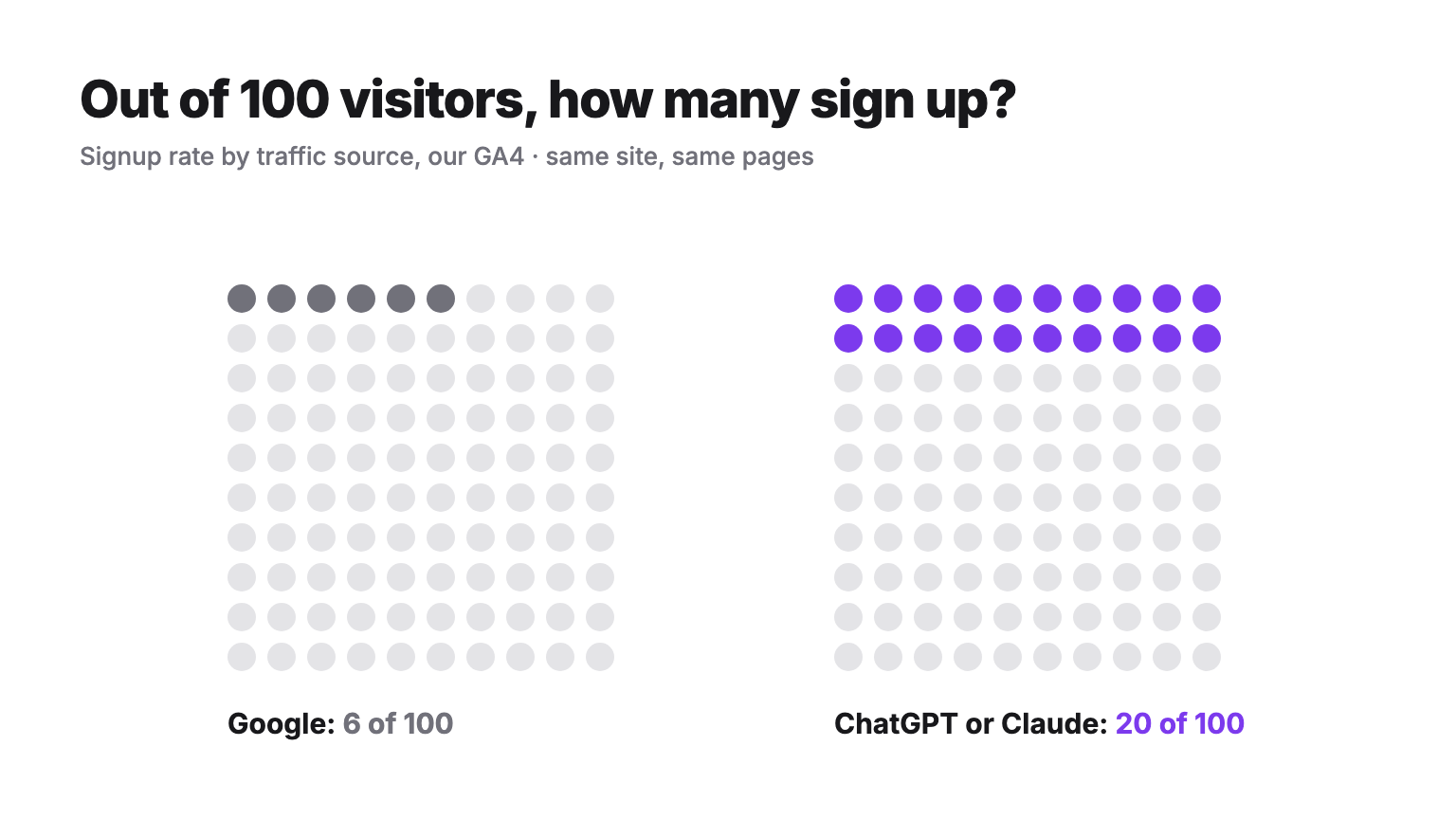
ChatGPT SEO is the work of getting your company named when a buyer asks an AI a question, and it caught me off guard even after years of running the classic B2B SEO playbook across two software companies with over 1,500 customers between them. On our site, for every hundred visitors from Google, about six sign up. For every hundred from ChatGPT or Claude, it's twenty. More than three times as many.
So I dug into where our leads actually come from across both companies. This post is the full write-up: what changed, our real signup numbers, the Cloudflare setting that silently hid us from every AI assistant for three months, the three things we're building to get named, and the honest take on when paid AI visibility tools are worth it (usually: not yet).
TL;DR
- Buyers ask AI, and AI names 2-3 companies - if you're not one of them, you never had a chance at the click.
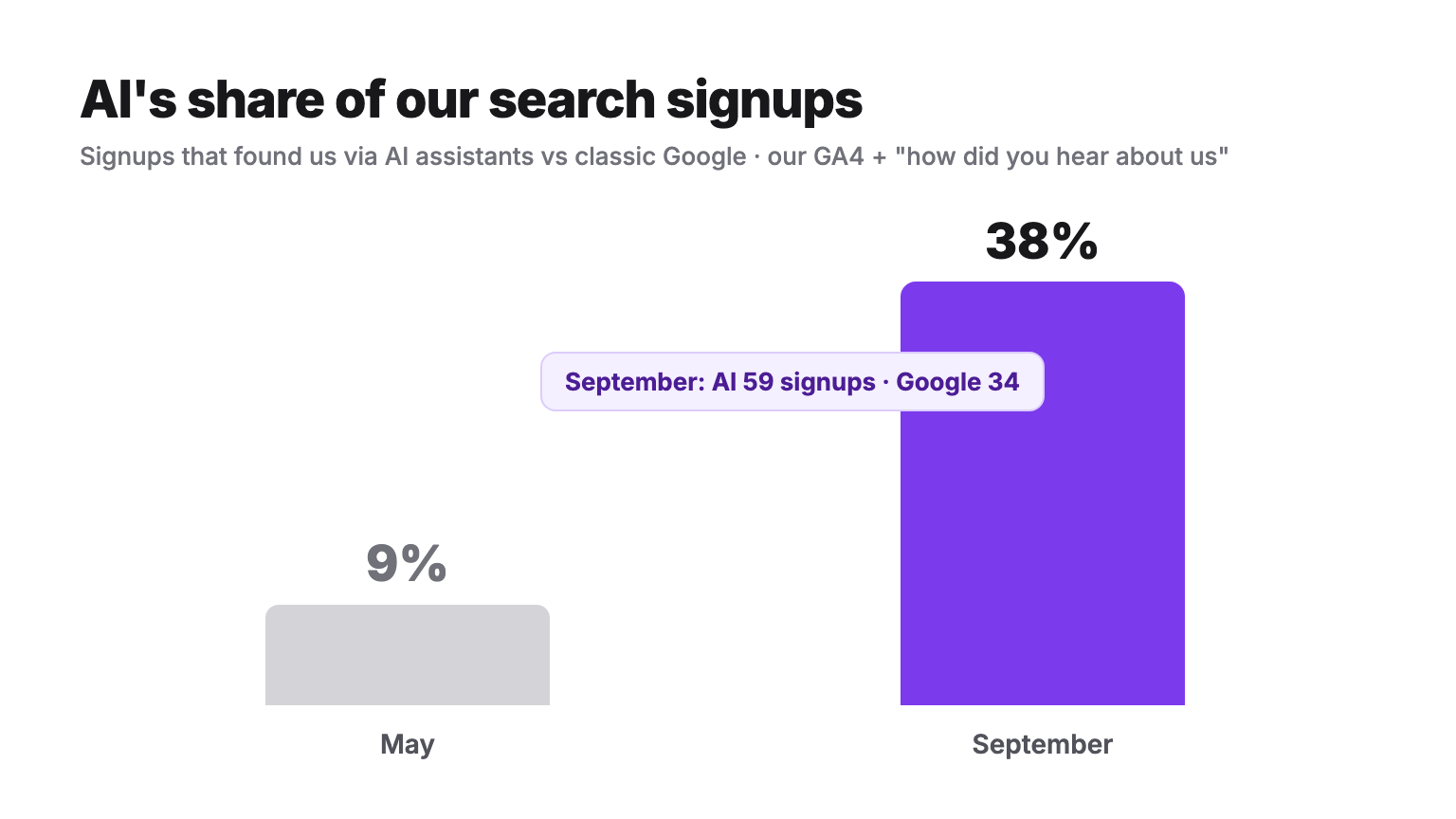
- Our numbers: AI visitors sign up at ~20% vs ~6% from Google; in September AI beat Google outright, 59 signups to 34.
- Step zero: make sure Cloudflare and robots.txt aren't blocking GPTBot and ClaudeBot. Ours were, for three months.
- Get named with answer pages, third-party mentions (LinkedIn is the #2 most-quoted site in AI answers), and data only you have.
- Measure it by asking the AIs your buyers' questions monthly and watching GA4's AI assistant line. Skip paid trackers unless one query is make-or-break.
What changed: from ten links to one answer
Before everyone used AI, someone had a problem, typed it into Google, clicked a link, read a page, and some of them signed up. We all played the same game: more blog posts, more keywords, more backlinks. And it still works - we took Postbeam from zero to about 4,000 visitors a month in a year with no content team using exactly that content engine. But the whole game assumed one thing: that the buyer would click.
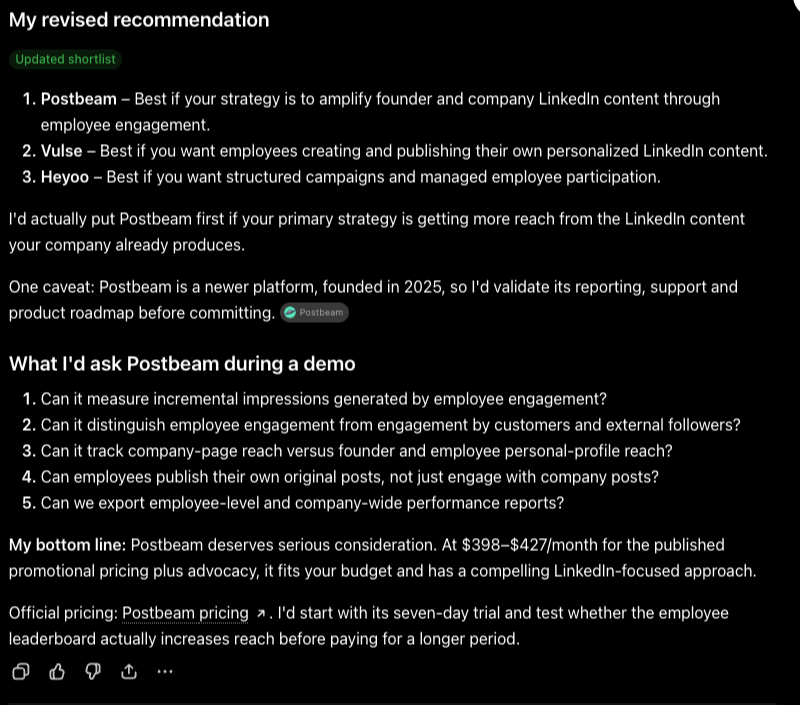
Now a buyer asks an AI: "what's the best tool for sending gift cards to employees in 30 plus countries?" The AI doesn't hand them ten links. It gives them an answer, and it names two or three companies. If you're not one of those two or three, you don't just lose a click. You never had a chance.
Our numbers: AI visitors sign up 3x more often
In the summer, a new line showed up in Google Analytics called "AI assistant." It just appeared. Those visitors are people who came to the site because ChatGPT, Perplexity, Claude, or Gemini recommended us, and they behave differently:
- Six in a hundred visitors from Google sign up. Twenty in a hundred from ChatGPT or Claude do. Over three times the signup rate for the same traffic.
- Since May, 133 people who signed up told us they found us through ChatGPT or Claude. For Google: 129.
- In May, AI was 9% of our search signups. By September it was 38%, and that month AI beat Google outright: 59 signups versus 34.
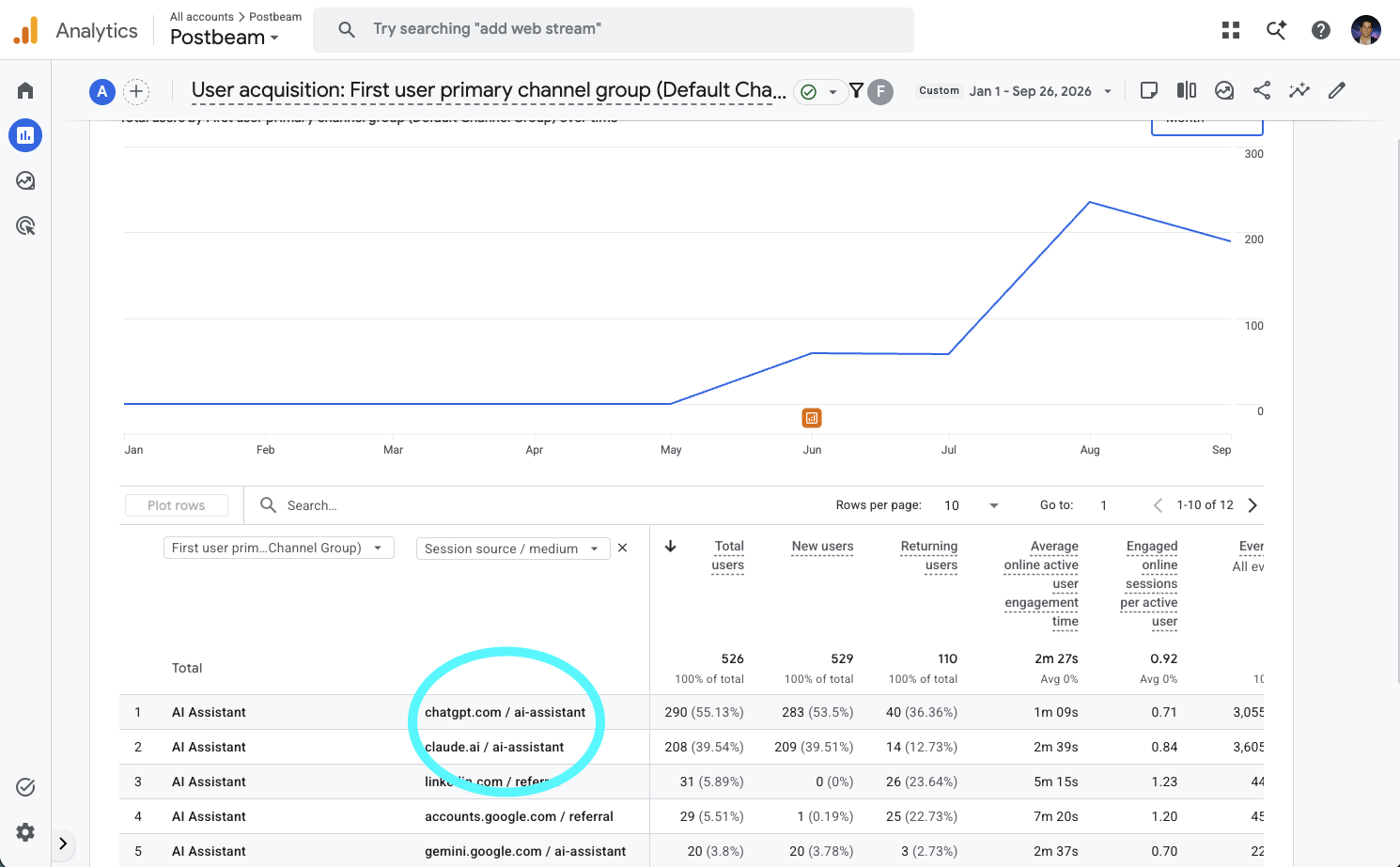
It makes sense when you think about it. By the time an AI visitor clicks, the model has already explained what we do and compared us to the alternatives. They show up with their research done, ready to buy. And it's not just Postbeam: at Hoppier, our other company, over half of new customers this year found us through ChatGPT, Copilot, and Gemini.
One honest caveat before the playbook: the people who pay most often still aren't referred by any search engine, AI or classic. They're referred by humans - word of mouth and LinkedIn conversations. AI brings you more people, and better informed ones, but people still trust other people more than anything. That's a big part of why we treat LinkedIn lead generation as the other half of this system.
Step zero: we were invisible to AI for three months
You can hide yourself from every AI assistant without knowing it. We did. For almost three months, our site was invisible to ChatGPT, Claude, and the other AI tools, and we had no idea.
We use Cloudflare. It sits in front of the website and blocks bots by default. That's great for stopping spam, but it was also blocking the AI crawlers that read websites. Every time someone asked an AI about our space, our newest pages didn't exist. We were writing posts and locking the door on the readers that mattered most. Nothing warned us: the site worked fine for people, Google was fine, only the AI tools couldn't get in.
Two checks, today:
- If you use Cloudflare or anything like it in front of your site, open the bot settings and make sure AI crawlers are allowed.
- Type your website into your browser and add
/robots.txt. If you see GPTBot or ClaudeBot next to the word "disallow," you're blocking them there too.
Being readable doesn't make you recommended, but blocked means never cited. Step zero is letting them in. Our free AEO checker walks you through this and the rest of the readiness checklist in about three minutes.
The three things that get you named
1. Pages that answer the exact question a buyer asks
Not keywords. Real questions a human would ask: What does it cost? How does it compare to the other options? Who is it not for? We're writing honest comparisons and pricing pages, including the parts where a competitor might actually be the better pick. When a page is honest, an AI can quote it. When it's pure sales copy, there's nothing to quote.
2. Mentions everywhere AI looks
Your own site only gets you so far, because AI doesn't automatically trust what you say about yourself. Think about how you judge a company you've never heard of: you check what other people say. AI does the same thing, across Reddit threads, YouTube videos, LinkedIn posts, review sites, and the niche sites in your industry. When the same name shows up in lots of trusted places, the model is more likely to recommend it.
For us, that's mostly LinkedIn, and it turns out to be a good bet. Semrush looked at 325,000 questions asked to ChatGPT, Google's AI Mode, and Perplexity, and LinkedIn was the second most quoted website, right after Reddit. My LinkedIn posts got over a million impressions last year, and every single one is something an AI can find and quote. We broke down exactly which posts get quoted in our 6,629-post LinkedIn reach study - spoiler: most of the cited posts weren't even viral.
3. Data only you have
AI can already write a generic ten-tips post. It doesn't need yours. What it can't make up is your numbers. At Postbeam, we published what we found in 6,629 LinkedIn posts from more than 350 companies. At Hoppier, we have years and over $50 million of transaction data on what gift cards people actually redeem across 60 plus countries. Nobody else can write those posts. When you publish real numbers, you become the source. And sources get named.
How to measure ChatGPT SEO (without paying for tools)
Here's my monthly loop. I open ChatGPT and ask the question a buyer would ask, like "what's the best tool for founders who want leads from LinkedIn?" Then I look at the answer. Are we named? Who is? Who isn't? Same question, word for word, in Claude and Perplexity. Then I open Google Analytics, find the AI assistant line, and look at two things: how many visitors it sent, and how many of them signed up. If we show up in more answers and that line keeps growing, the work is working.
On paid AEO tools: unless you're in a business where one specific query is critical to your success, I think they're overkill. There's nothing fundamentally different between AEO and SEO - you're still building authority, and authority is the thing that matters most. If you're a company like Mint.com, where "best credit cards" could be worth tens of millions, monitor it closely with Profound, Peec, Ahrefs, or Semrush. Otherwise, traditional SEO tools tracking keywords get you a good approximation. Emil and I argued the exact thresholds in our AI visibility tools breakdown.
The old game was getting clicks. The new game is getting named. And most companies haven't noticed it changed.
Frequently asked questions
What is ChatGPT SEO?
ChatGPT SEO, also called AEO (answer engine optimization) or GEO (generative engine optimization), is the work of getting your company named when someone asks ChatGPT, Claude, Perplexity, or Gemini a buying question. Instead of ranking in a list of ten blue links, you are optimizing to be one of the two or three companies the AI puts in its answer. The inputs overlap heavily with classic SEO: crawlable pages, direct answers, original data, and mentions on sites the AI trusts.
How do I rank in ChatGPT?
Three things, in order. First, make sure AI crawlers can read your site: check your CDN's bot settings and your robots.txt for GPTBot, ClaudeBot, and PerplexityBot blocks. Second, publish pages that answer the exact questions buyers ask - cost, comparisons, who it's not for - because honest, quotable pages are what AI answers lift. Third, get mentioned off your own site: Reddit, YouTube, LinkedIn, review sites, and niche roundups, since AI models weight third-party mentions far more than your own claims.
How do I check if AI crawlers are blocked on my site?
Open yoursite.com/robots.txt and look for GPTBot, ClaudeBot, Google-Extended, or PerplexityBot next to a Disallow rule. Then check the bot-protection settings in Cloudflare or whatever sits in front of your site - many services block AI crawlers by default. Ours did: our site was invisible to ChatGPT and Claude for almost three months and nothing warned us. The site worked fine for people, so we only caught it by checking.
Do visitors from ChatGPT really convert better than Google visitors?
On our site, yes, by about three times. For every hundred visitors from Google, about six sign up. For every hundred from ChatGPT or Claude, about twenty do. It makes sense: by the time someone clicks, the AI has already explained what we do and often compared the alternatives, so they arrive with their research done. In September, AI assistants beat Google outright for us: 59 signups versus 34.
Do I need a paid AEO tool to track AI visibility?
Usually not. Unless one specific query is make-or-break for your business - the way 'best credit cards' would be for a consumer finance site - dedicated AI-visibility trackers are overkill. Ask ChatGPT, Claude, and Perplexity the questions your buyers ask once a month, word for word, and watch the AI assistant line in Google Analytics. If a single query really is worth that much to you, tools like Profound, Peec, Ahrefs, and Semrush can monitor it closely.
How long does ChatGPT SEO take to work?
Faster than classic SEO in our experience. AI assistants refresh their retrieval sources continuously and there are fewer entrenched incumbents, so we have seen pages picked up in AI answers within weeks of publishing. Unblocking crawlers works even faster: that is a one-time fix with compounding payoff. The slow part is the same as SEO - building enough third-party mentions and original data that you become the obvious answer.
Publish the content AI actually cites
Postbeam turns your team's expertise into LinkedIn posts and information-gain content built to win Google, ChatGPT, and Claude traffic - and captures the warm leads who engage. See pricing or start free.
Try Postbeam free7-day free trial. 30-day money-back guarantee.