
LinkedIn content strategy for B2B teams
A LinkedIn content strategy answers five questions: who posts, what you post, how often, how it gets distributed, and how you measure it. This guide walks through the full framework the best B2B teams use, and how Postbeam runs it end to end.
The framework at a glance
Five decisions, in order. Get these right and the rest is execution.
- 1
Who posts
People beat logos. Lead with founder and exec profiles, backed by the team.
- 2
What you post
Four pillars: point of view, customer stories, behind the scenes, practical how-tos.
- 3
How often
A sustainable cadence you review weekly. Consistency beats volume.
- 4
How it spreads
Your own team's first-hour engagement extends every post's reach.
- 5
How you measure
Reach to engagement to warm leads to pipeline. Not likes.
Part 1
Who posts: people beat logos
The single biggest strategy decision is not what to post. It is who the posts come from. Company pages broadcast; people build relationships. On LinkedIn, a founder or executive writing in their own name consistently reaches far more of the right people than the same message published under a logo.
B2B is following the path B2C already took: buyers want to hear from people, and the people become the face of the brand. The modern playbook is founder-led content at the center, with executives and team members posting in their own voices, and the rest of the team amplifying every post with early likes and comments.
This does not mean abandoning the company page. It means treating it as a home base while the reach, trust, and conversations happen on personal profiles.
Founder / exec
The anchor. Opinionated, consistent, unmistakably human. This is where most of the reach comes from.
The team
Sales, product, and customer-facing folks posting their own takes and engaging with each other's posts.
Company page
Home base for announcements and proof. Supporting cast, not the lead.
Part 2
What you post: four content pillars for B2B
You do not need endless ideas. You need a small set of pillars you rotate through, so every post has a job: teach, prove, show the humans, or help. Here is the rotation that works for B2B.
Point of view
Take a clear, defensible stance on where your industry is going or what most people get wrong. Contrarian takes earn attention because they force a reaction; agreeable summaries earn nothing. If a competitor could publish the same post, sharpen it.
Customer stories and lessons
Not case-study brochures. Tell the story of a real problem a customer had, what changed, and the lesson anyone in your audience can take away, even if they never buy from you. Proof wrapped in a lesson travels much further than proof alone.
Behind the scenes
What you are building, what broke, what you decided and why. These posts build the relationship that makes the other pillars land, because people root for teams they feel they know.
Practical how-tos
Step-by-step posts your ideal customer can use the same day, in the exact area your product lives. This is the pillar that attracts the right audience, not just a big one.
Drafting across four pillars every week is where most strategies stall. In Postbeam, Marv drafts posts in your voice across all four, so the calendar starts full and your job is editing and approving, not staring at a blank page.
Part 3
How often: consistency beats volume
The most common failure mode is not posting too little. It is sprinting: two weeks of daily posts, then a month of silence. LinkedIn rewards accounts that show up steadily, and so do audiences.
Pick a rhythm your team can sustain for months, put it on a shared calendar, and review it weekly: what shipped, what resonated, what is queued for next week. Batch the drafting into one sitting and schedule the posts out, so a busy week never turns into a silent one.
Postbeam's content calendar, scheduling, and approval workflow exist for exactly this: drafts get written in batches, approved by whoever owns the voice, and published on schedule without anyone remembering to hit post.

Part 4
How it spreads: your team is the distribution
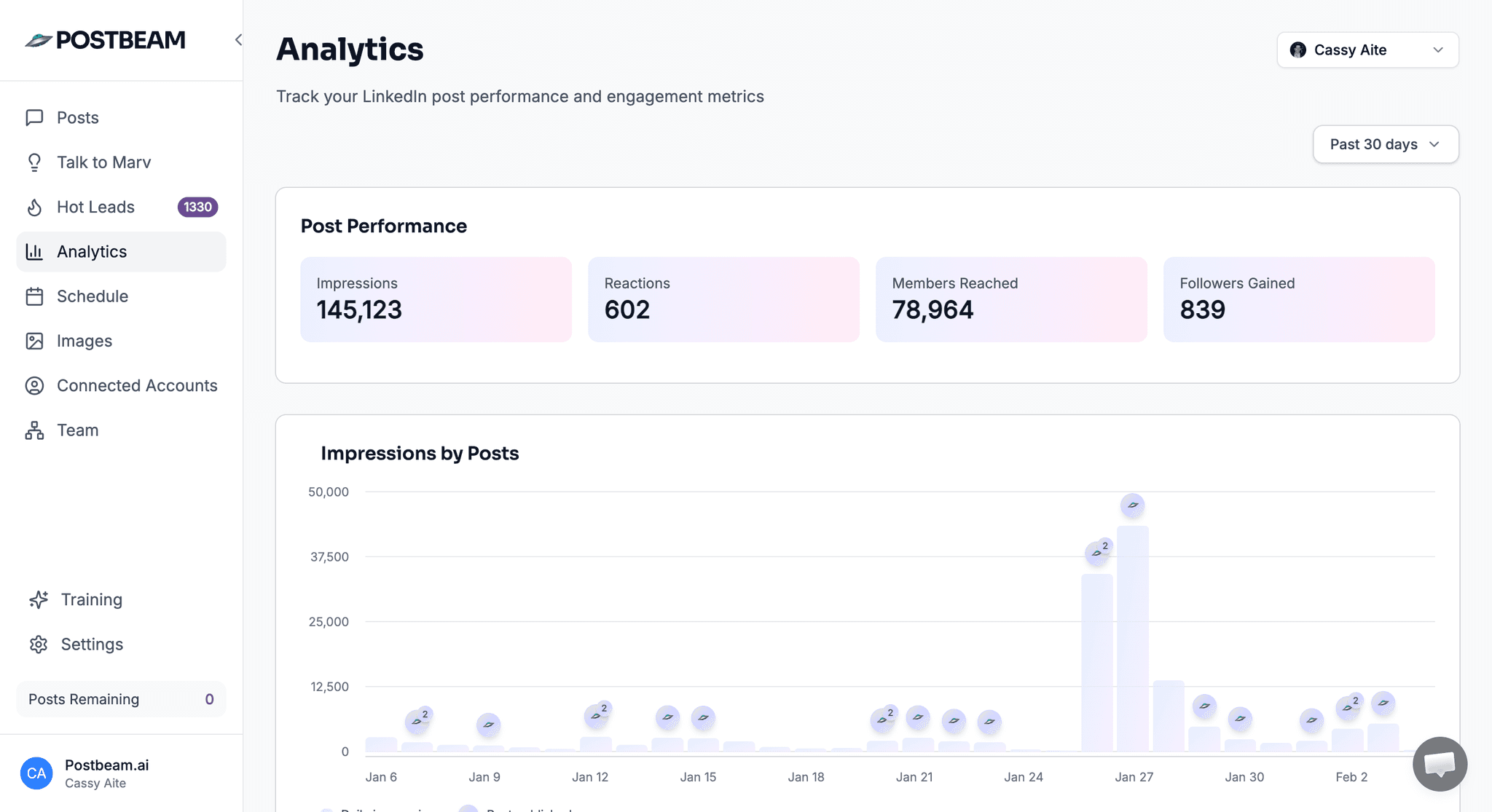
A post's first hour matters. Early likes and comments from your own team signal that a post is worth showing to more people, which extends its reach well beyond your followers. The teams that win at LinkedIn treat engagement as a team habit, not a favor.
Slack nudges at the right moment
The moment anyone on the team publishes, a Slack notification goes out. No one has to remember to check LinkedIn; the nudge arrives exactly when engagement counts most.
A leaderboard that makes it stick
A leaderboard shows who engages most with the company's content. Friendly competition turns a one-week initiative into a lasting habit.
Both are part of Postbeam's Employee Advocacy add-on: $349 per month flat per company, up to 100 employees. See how it works →
Part 5
How you measure: pipeline, not likes
Impressions and likes are inputs. The strategy is only working if it moves down a funnel you can name: reach, then engagement, then warm leads, then pipeline. Measure each stage, and never report the first two as if they were the last two.
Reach
Are the right people seeing the posts at all?
Engagement
Are they reacting, commenting, following?
Warm leads
Which engagers actually match your ICP?
Pipeline
Did follow-ups turn into conversations and deals?
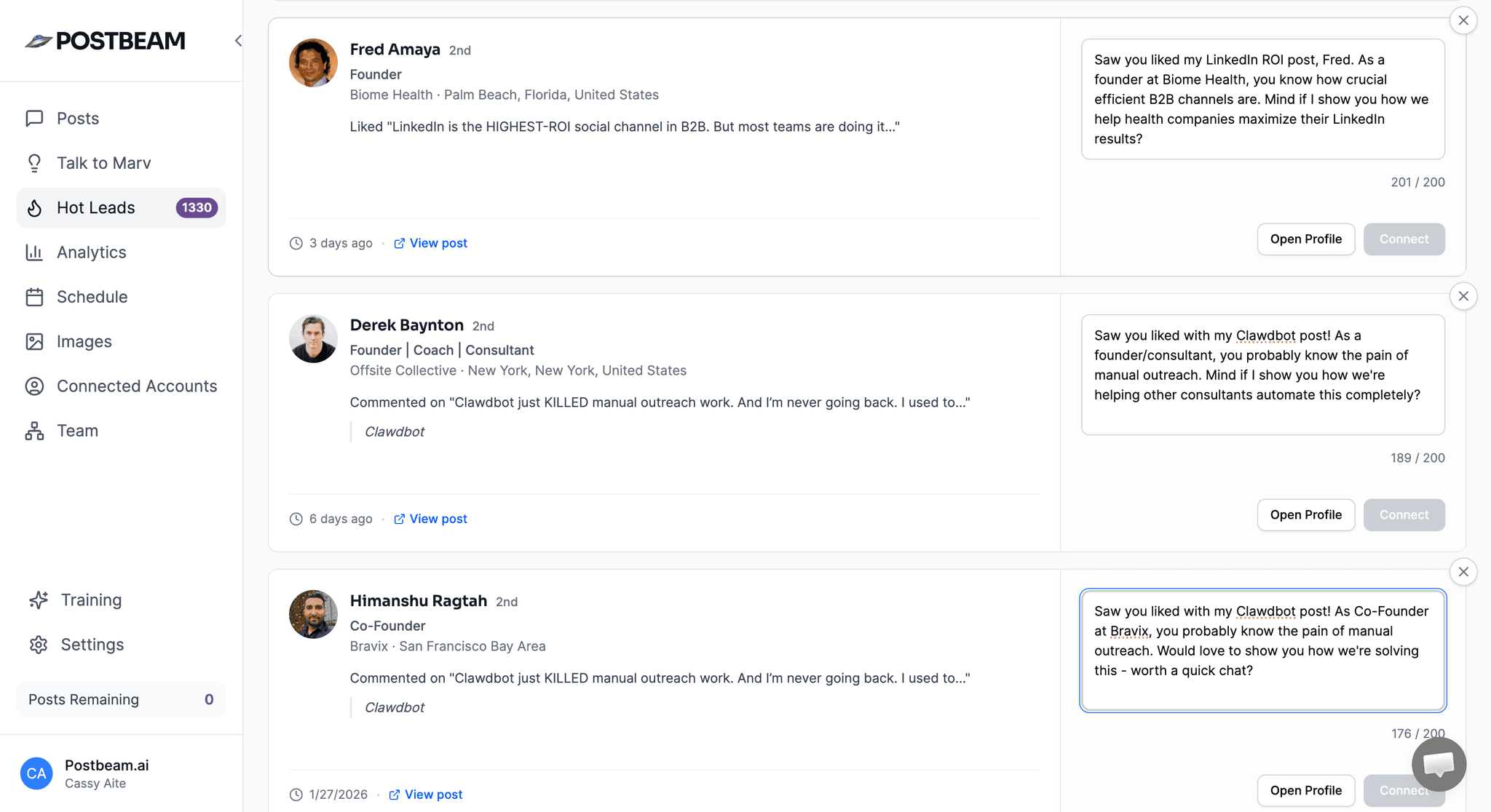
Every post's engagers become a follow-up list
This is the step that connects content to revenue. Postbeam captures who engaged with every post and filters them against your ideal customer profile - title, seniority, company size, industry - so the output of a good post is not a number, it is a list of warm prospects.
Export the list to HubSpot, Salesforce, or CSV and your sales team follows up with people who already know who you are.
Postbeam is the system that runs this strategy
Each part of the framework maps to a part of the product, built on official LinkedIn partner APIs.
Drafting
Marv drafts posts in your voice across your content pillars. Drafts stay drafts until you approve them.
Cadence
Content calendar, scheduling, and an approval workflow keep the rhythm going without anyone babysitting it.
Distribution
The Employee Advocacy add-on ($349/mo flat per company, up to 100 employees) adds Slack notifications and a leaderboard.
Measurement
Engagement is captured on every post and filtered against your ICP, then exported to HubSpot, Salesforce, or CSV.
Solo $49/mo. Team $39/user/mo. Every plan starts with a 7-day free trial.
LinkedIn content strategy FAQ
What should a B2B company post on LinkedIn?
Four pillars cover most of what works for B2B: point-of-view posts that take a clear stance on your industry, customer stories and the lessons behind them, behind-the-scenes posts about building the company, and practical how-tos your ideal customers can use the same day. Rotate the pillars so your feed teaches, shows proof, and builds a relationship instead of just promoting.
How often should we post on LinkedIn?
Pick a cadence your team can hold for months, not a sprint you abandon in three weeks. Consistency beats volume: a steady rhythm of a few posts per week per person, reviewed weekly, compounds far better than a burst followed by silence. Batch drafting and scheduling makes the rhythm sustainable.
Should we post from the company page or personal profiles?
Lead with personal profiles. Founder and executive accounts consistently reach far more people than company pages, because people follow people. Keep the company page as a home base, but put the real effort into founder-led content supported by team engagement.
How do I measure LinkedIn content ROI?
Follow the funnel: reach, then engagement, then warm leads, then pipeline. Likes and impressions are inputs, not outcomes. The step that makes ROI concrete is filtering every post's engagers against your ideal customer profile - title, seniority, company size, industry - so you get a follow-up list of real prospects, not a vanity number.
How do I get my team to engage with our posts?
Make it visible and make it easy. A Slack notification the moment a teammate publishes tells everyone exactly when their like or comment matters most, and a leaderboard turns participation into friendly competition. That is what Postbeam's Employee Advocacy add-on does, at a flat $349 per month per company for up to 100 employees.
Can AI run my LinkedIn content strategy?
AI can run the mechanics, and a person should own the judgment. Postbeam's assistant Marv drafts posts in your voice, and Postbeam connects to Claude and ChatGPT so you can plan and draft from your AI assistant. Every draft stays a draft until a human approves it, so nothing goes out that you have not read.
Keep exploring
B2B content marketing: the ultimate guide
How LinkedIn fits into all ten channels that work in 2026.
Executive thought leadership strategy
The founder-led side of the playbook, in depth.
LinkedIn post ideas
Concrete prompts to fill your four content pillars.
Best time to post on LinkedIn
Timing your cadence for the audience you want.
Employee Advocacy add-on
Slack nudges and a leaderboard that make team engagement stick.
Put the whole strategy on rails
Draft with Marv, schedule the calendar, rally the team, and turn every post's engagers into a follow-up list.
Solo $49/mo, Team $39/user/mo. Built on official LinkedIn partner APIs.