

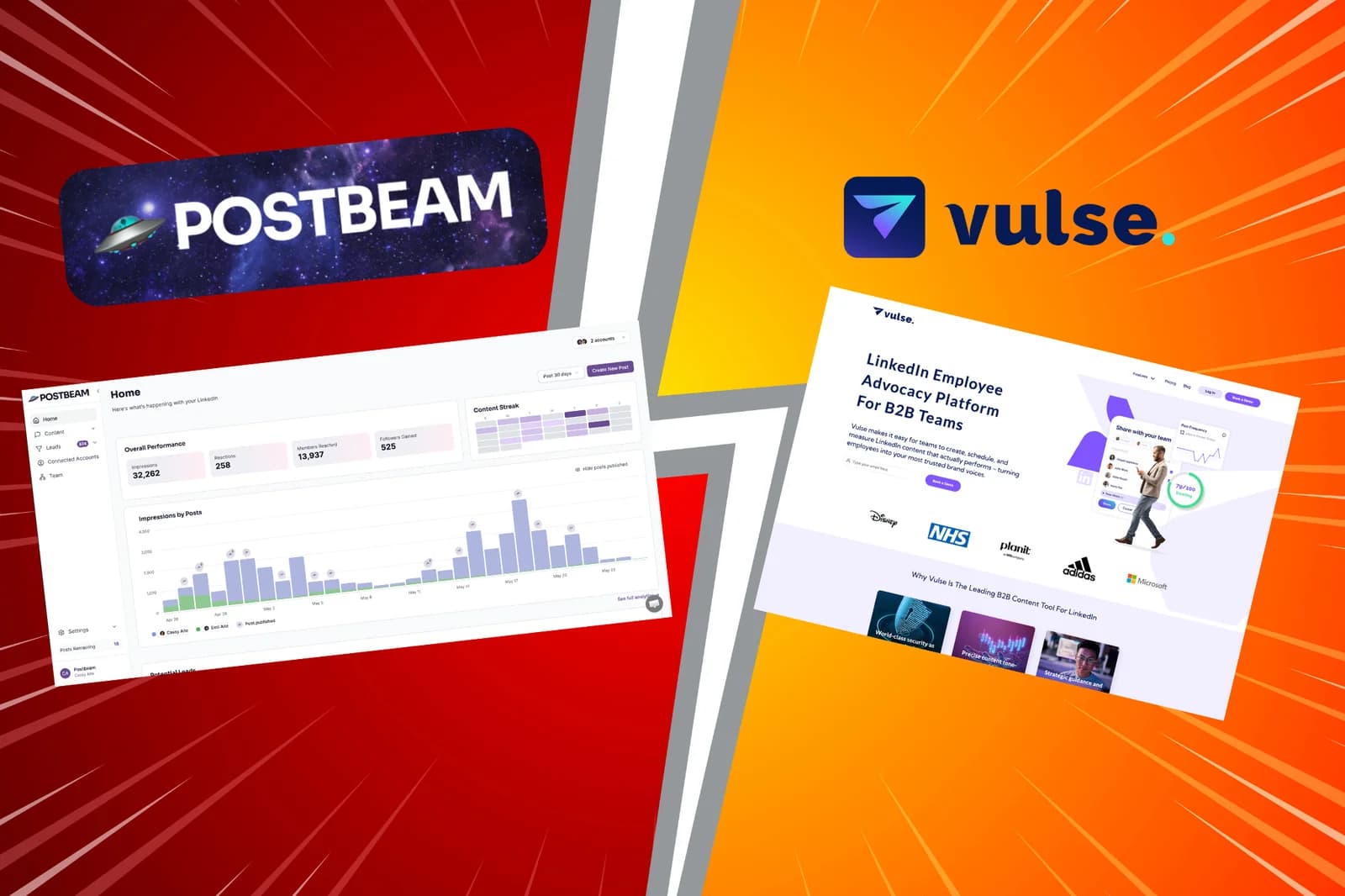
TL;DR
Vulse is an enterprise-focused employee advocacy tool built around a leaderboard. Founded in 2019, before the AI-native era, it feels like classic boring SaaS: comms-team dashboards, pricing only in GBP, and AI features that were retrofitted on top rather than built in from the start. The advocacy features are gated to a demo-only Pro tier; the two published tiers (Basic £17/mo, Premium £37/mo) are really personal-brand LinkedIn schedulers, not team advocacy.
Postbeam is a social selling tool. The same posts that Vulse helps you publish, Postbeam turns into warm leads: it surfaces the ICP-matched people who engaged with each post and pre-drafts the opening message.
Different categories, mostly. The real question is whether you're trying to maximize program participation (advocacy) or convert engagement into pipeline (social selling). Most B2B teams need the second; they buy the first by accident.
Quick Comparison Table
| Feature | Vulse | Our PickPostbeam |
|---|---|---|
| Category | Employee advocacy | Social selling + advocacy |
| Pricing | £17 / £37 / Pro (demo) | Solo $49/mo · Team $39/user/mo |
| Free Trial | Demo required | 7 days, self-serve |
| Core Focus | Activate employees to post | Turn engagement into pipeline |
| AI Writing | AI post suggestions | Per-teammate brand-voice AI |
| Content Library | Admin-curated library | Idea library + brand voice presets |
| Scheduling | Yes | Yes (LinkedIn-native) |
| Analytics | Reach, engagement, leaderboard | Per-post + warm lead signals |
| Employee Leaderboard | Yes (core feature) | No (different philosophy) |
| Warm Lead Capture | No | Yes, on every post |
| First-Message Drafting | No | Yes, ICP-matched |
| Best For | Enterprise marketing-led advocacy | Founders, GTM teams, agencies |
Vulse pricing is not publicly listed. Postbeam pricing is shown on monthly billing as of mid-2026; annual plans save 20%.
Postbeam - best for B2B teams that want LinkedIn engagement to turn into pipeline
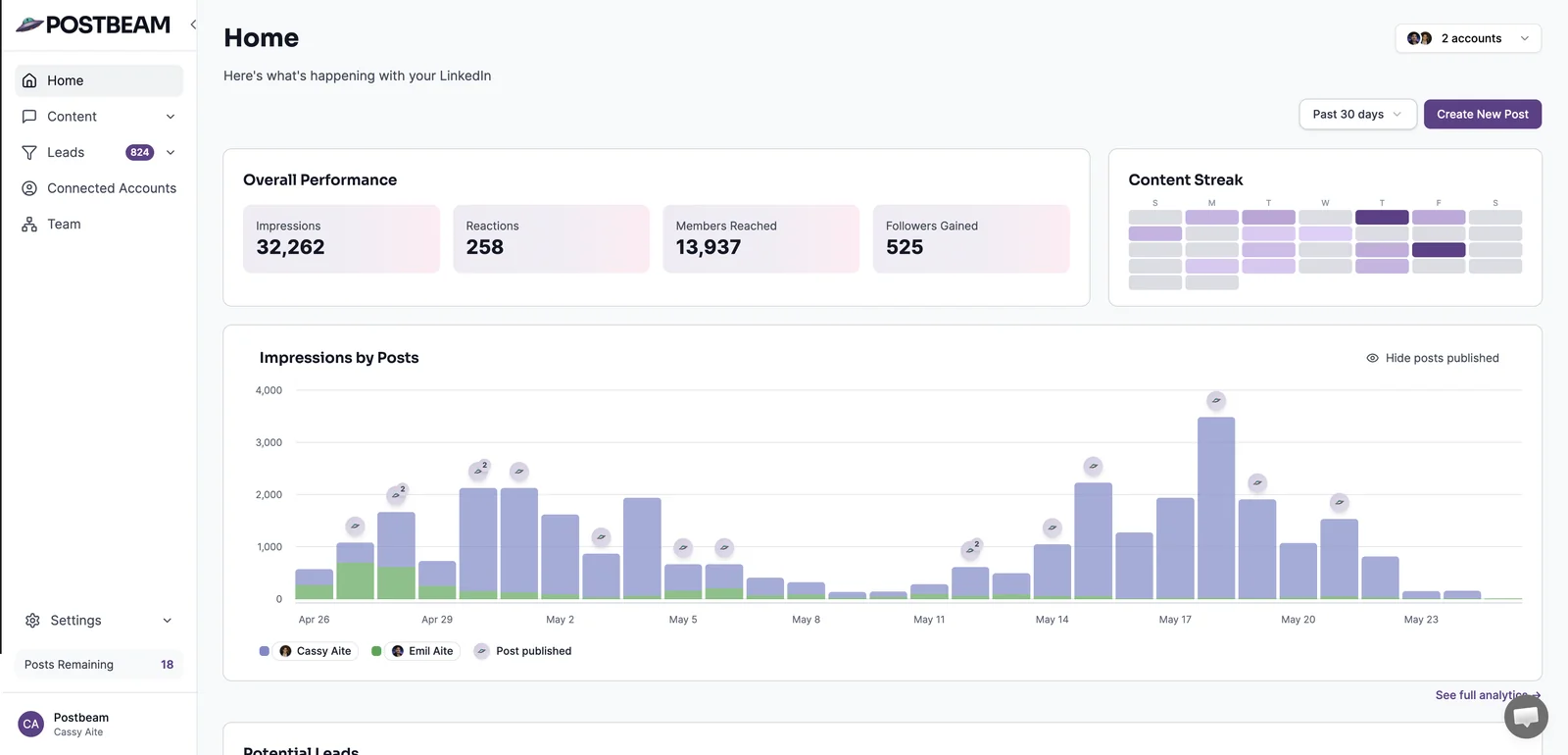
Postbeam is a LinkedIn-native social selling platform. You draft and schedule posts in each teammate's voice, and every post that goes live surfaces the people who engaged as warm leads, filtered by your ICP, with the first message pre-drafted. Scheduling, analytics, and team workflows are all in one place, but the differentiator is what happens after a post goes live.
Postbeam pricing
Pros
- +Warm lead detection on every post: ICP-matched engagers surface in-context with a pre-drafted opening message
- +Per-person brand voice presets so teammates sound like themselves, not the same AI draft
- +Public, transparent pricing with a real 7-day free trial (no demo required)
- +Posts through LinkedIn's official partner APIs, so no Chrome-extension or automation-flag risk
- +Team scaling: $39/user/mo flat, no enterprise contract negotiation
Cons
- −LinkedIn-first by design, not a 12-network corporate-comms suite
- −Smaller template library than legacy advocacy tools
Vulse - best for enterprise marketing teams running structured employee advocacy programs with leaderboard-style coordination
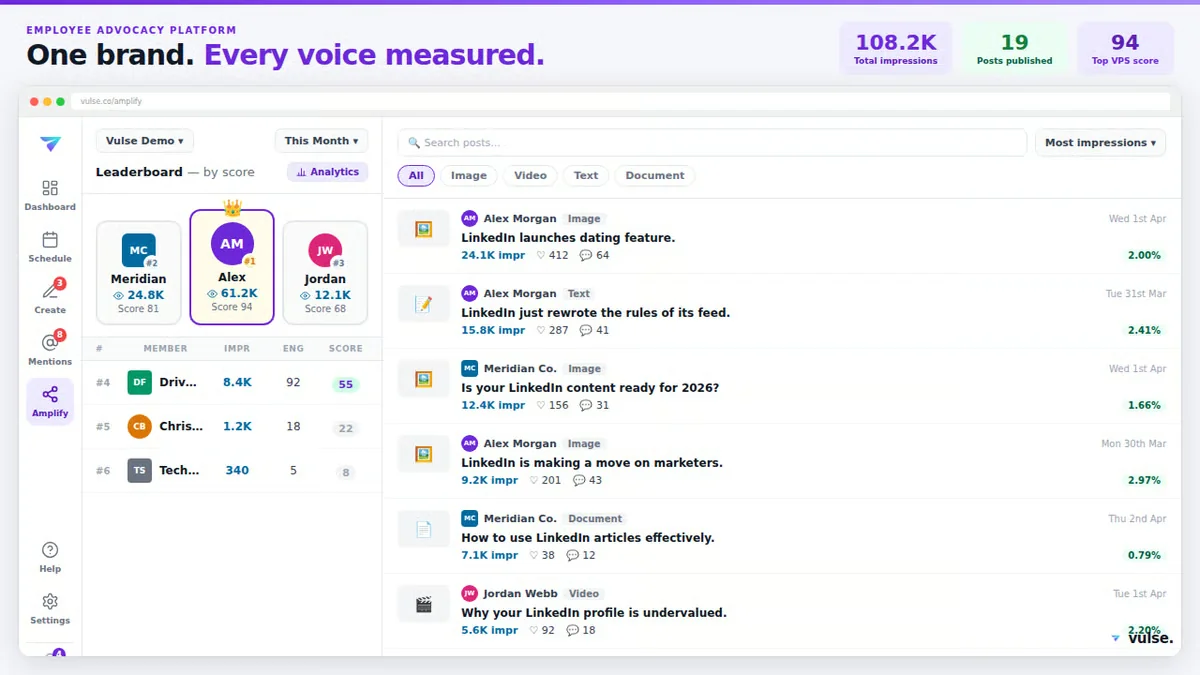
Vulse is a UK-based employee advocacy platform built primarily for enterprise sales and marketing teams. It gives admins a content library, post suggestions, scheduling, and a leaderboard that ranks employees by engagement. Founded in 2019, before the current AI-native generation of LinkedIn tools, the product's AI features feel bolted on rather than core to the experience.
Vulse pricing
Pros
- +Built-in employee leaderboard for tracking participation across the team
- +Content library so admins can push approved drafts to employees
- +Brand-asset library for consistent visuals across employee posts
- +Analytics on employee reach, engagement, and program participation
Cons
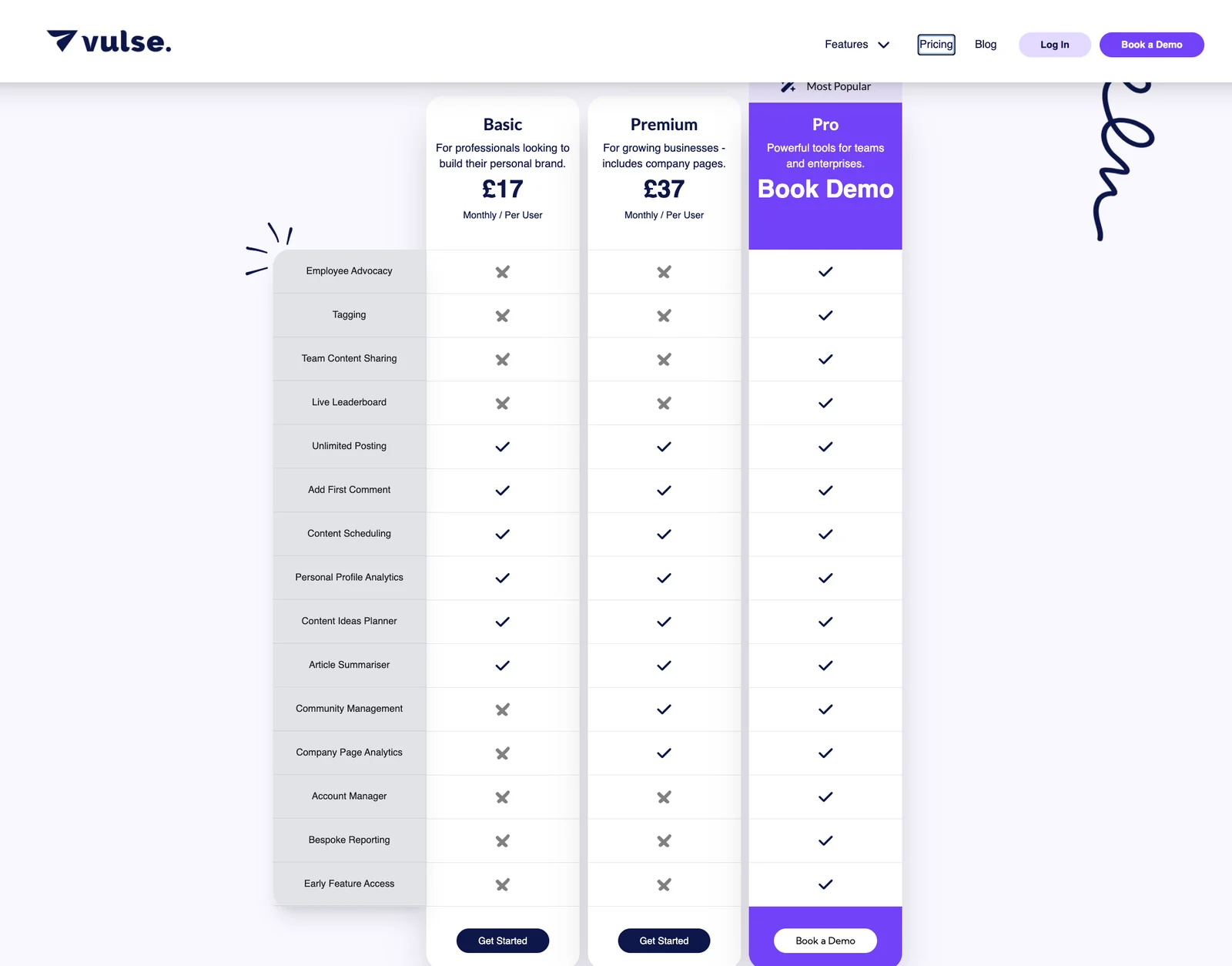
- −Employee advocacy locked to the Pro tier, which is demo-gated only (Basic £17 and Premium £37 don't include it)
- −Pricing only listed in GBP (£) — US and EU buyers do the currency math themselves
- −Boring-SaaS dashboard aesthetic and a leaderboard-first product philosophy
- −Founded in 2019, pre-AI-native generation; the AI features feel retrofitted rather than core
- −Enterprise-focused — not built for founder-led or small GTM teams
- −Engagement-leaderboard model rarely changes employee behavior on its own
- −Focused on advocacy reach metrics, not on turning engagement into sales pipeline
- −No warm-lead detection or ICP filtering on post engagers
Feature-by-Feature Comparison
1. Core philosophy
Vulse is built around program participation. The leaderboard, the content library, and the analytics all roll up to one number: how many of your employees posted this month, and how much reach did they generate as a team? It's the comms-team view of LinkedIn.
Postbeam is built around pipeline outcomes. The same posts get scheduled, but the platform's job doesn't end there. Every post is a warm-lead surface: which ICP-matched people engaged, what should you say to them, when should you reach out. The metric that matters is conversations started, not impressions earned.
Verdict: Depends entirely on what you're trying to do. Most B2B teams optimize the wrong metric here.
2. The leaderboard question
This is Vulse's headline feature, so it deserves a real look. The leaderboard ranks employees by engagement, participation, or reach, and the assumption is that ranking publicly will motivate people to post more.
The honest take: leaderboards rarely change behavior on their own. Pareto applies here. Around 20% of any team is going to post regardless of whether you have a leaderboard. The other 80% don't post because they don't know what to say, not because they don't see their ranking. Ranking them publicly can actually demotivate the bottom half. Tools that help individual teammates draft in their own voice (per-person brand-voice AI, drafts-for-teammates workflows) tend to outperform leaderboard-only approaches when measured by actual posting consistency.
Verdict: Leaderboards work as a small reinforcement on top of an already-functioning system. They don't fix the “my team won't post” problem.
3. AI writing and brand voice
Vulse was founded in 2019, before the AI-native generation of LinkedIn tools. The AI features (post suggestions, content ideas) feel bolted on top of the original advocacy product rather than designed into the core. Outputs are generic and feel similar across users, because the AI doesn't learn per-person voice.
Postbeam is AI-native and ships per-teammate brand-voice presets. The first time a teammate publishes a post, Postbeam learns their voice; every subsequent draft is rewritten to sound like them, not like a corporate template. For team content programs, this matters more than people expect. The single biggest reason employees stop posting is feeling like the drafts don't sound like them.
Verdict: Postbeam wins on AI quality for team use. Vulse's AI is fine if you're fine with content that reads as “corporate.”
4. What happens after the post goes live
Vulse reports back to admins: impressions, reactions, comments, share counts. Helpful for program reporting, not helpful for the person who has to follow up with prospects.
Postbeam shows the engagers themselves, filtered against your ICP, with the highest-intent ones surfaced first. A pre-drafted opening message references the post they engaged with so the outreach feels contextual instead of cold. This is the difference between “your post got 200 likes” and “these 12 of those 200 are your target buyers, here's what to send them.”
Verdict: Postbeam wins decisively here. This is the warm-lead gap that no employee advocacy tool fills, including Vulse.
5. Pricing transparency
Vulse publishes pricing for two tiers: Basic at £17/user/month (personal-brand features only) and Premium at £37/user/month (adds company pages). The Pro tier, which is the only one that actually includes the employee advocacy features (Live Leaderboard, Team Content Sharing, Account Manager, Bespoke Reporting), is demo-gated with no public price.
In other words: the lower tiers compete with personal LinkedIn schedulers ( Taplio, Supergrow, AuthoredUp), not with employee advocacy tools. If you came to Vulse for the advocacy features, you're still in “book a demo” territory.
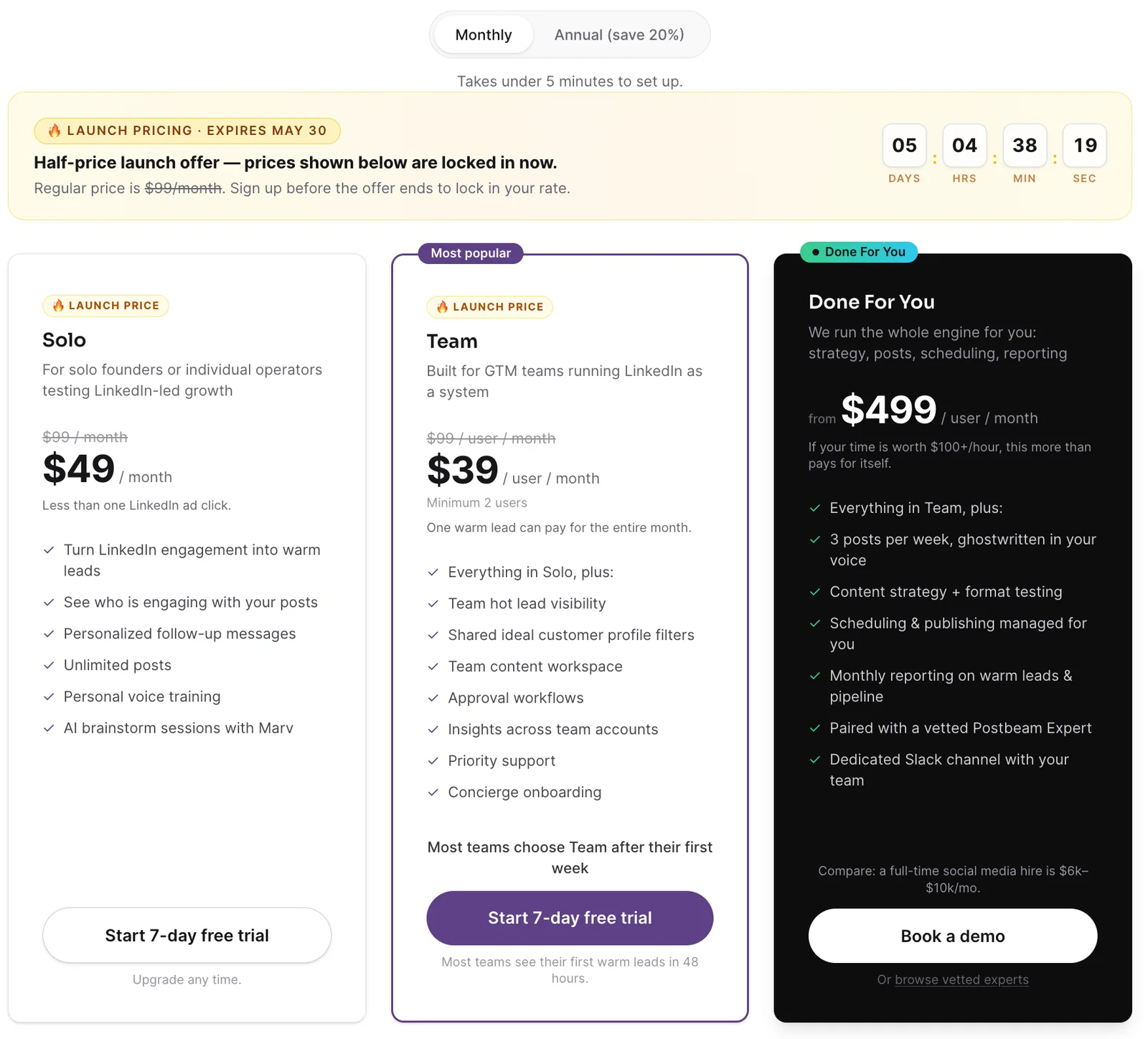
Postbeam publishes everything: $49/mo Solo, $39/user/mo Team, $499/mo Done For You. The Team plan includes advocacy features out of the box, with a 7-day free trial and no credit card required.
Verdict: Postbeam wins on advocacy-tier transparency. Vulse's public pricing only covers the personal-brand tiers, not the team advocacy tier most buyers are actually shopping for.
The Missing Piece: Advocacy Without Pipeline Is a Reach Report
Here's what most Vulse-style advocacy programs end up producing: a quarterly slide saying “our employees generated 4.2M impressions this quarter.” That slide doesn't close deals. It looks great in the board deck.
The real outcome you want is conversations with the people who engaged with those 4.2M impressions. Specifically, with the fraction of those people who match your ICP and are showing buying intent. Vulse doesn't produce that. Postbeam was designed around exactly that loop, which is also why we built a separate employee advocacy product on top of the social selling core.
Postbeam closes the loop. Same scheduling, same content library, same team workflows as a traditional advocacy tool, but with warm lead capture on every post and a pre-drafted opening message for each engager. Content becomes a pipeline tool, not a reach report.
Try Postbeam Free for 7 Days →Who Should Choose What
If...
You're a marketing or comms team running a structured advocacy program with reach KPIs
→ Vulse. Leaderboard, admin dashboards, and program reporting fit a comms-led motion. Be ready for a demo-gated sales process.
If...
You're a founder, GTM lead, or agency owner who wants LinkedIn to drive pipeline (not just reach)
→ Postbeam. Warm lead detection, per-person brand voice, transparent pricing, and a 7-day free trial. Built for the team that's selling on LinkedIn, not just publishing on it.
If...
You're at a 500+ person enterprise with a dedicated comms team and a six-figure advocacy budget
→ EveryoneSocial or Sociabble. Vulse competes here, but the most established players in pure enterprise advocacy are larger. See the full breakdown in the related guide below.
Frequently Asked Questions
Is Vulse a social selling tool?+
What does Vulse cost?+
Does Vulse have warm lead detection?+
Do employee advocacy leaderboards actually work?+
Can I use both Vulse and Postbeam together?+
What's the best alternative to Vulse?+
Related Articles
7 Best Employee Advocacy Tools in 2026 →
The full breakdown of advocacy platforms, what they actually do, and which ones are misclassified as advocacy.
Best LinkedIn Scheduling Tools (2026) →
Compare the top schedulers for solo, agency, and team workflows.
Employee Advocacy Platform →
How Postbeam approaches advocacy without the leaderboard playbook.
What Is Social Selling? (2026 Guide) →
The actual difference between advocacy, social selling, and just posting.
Supergrow vs Taplio: Which Is Better? →
Head-to-head of two AI-first LinkedIn tools — pricing, features, real reviews.
Postbeam vs Supergrow: Honest Breakdown →
What you actually get for $19, $39, and $49. Pricing, features, and pipeline impact.
AuthoredUp vs Taplio: Which to Use →
AuthoredUp is a writing tool. Taplio is all-in-one. Pick the right fit.
Best Taplio Alternatives 2026 →
6 Taplio alternatives compared — pricing, AI quality, scheduling, analytics.
Stop Reporting Reach. Start Producing Pipeline.
Vulse helps your team post. Postbeam helps your team post and turn every post into warm leads. Start your 7-day free trial.
Start Your 7-Day Free Trial →